
Trinity Sunday, homily of Archbishop Eamon Martin
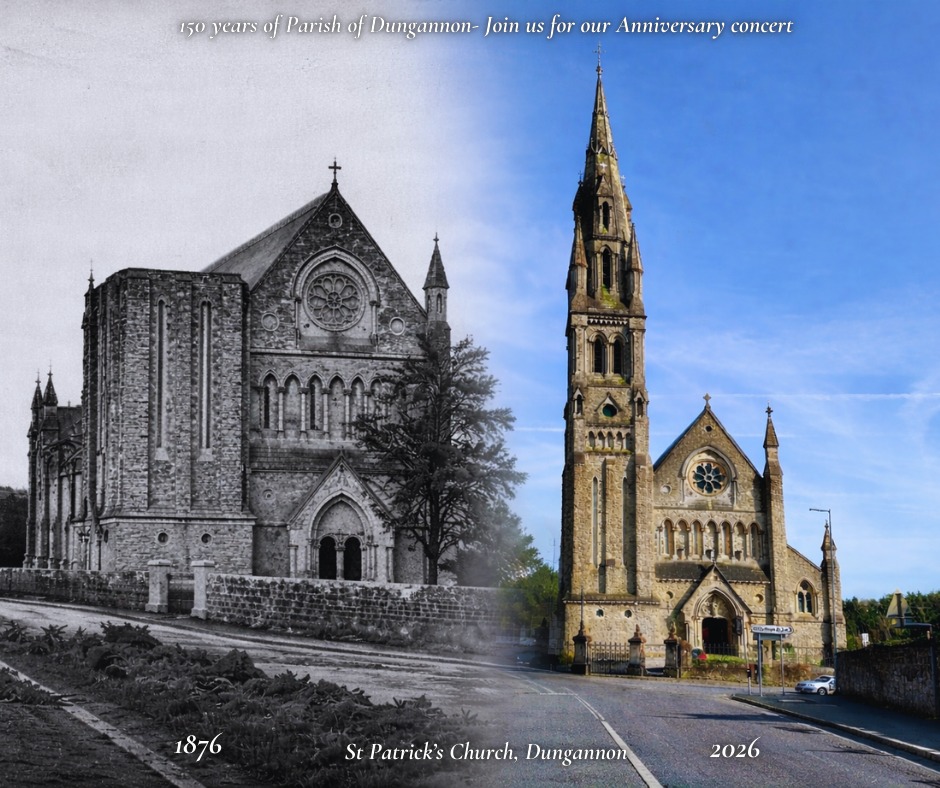
 It’s only right that we should celebrate this significant milestone of 150 years in the life of St Patrick’s Church Dungannon. So much has changed in the world since 1876 – it was only in that same year that Alexander Graham Bell patented the world’s first telephone; to think that this beautiful church was designed and built before the invention of the electric light bulb or the motor car!
But in another way 150 years is only a blink in time; many people nowadays are living to be more than a hundred years old; in 1876 my great grandparents were already married and beginning to have their families. Still, it must have been some sight for some of your great grandparents to see this splendid new Church, designed by the great architect JJ McCarthy, rising above Dungannon, and finally opening its doors on the Feast of the Holy Trinity!
And so here we are, celebrating the Vigil Mass of Trinity Sunday 2026, joyfully gathered in the name of the Father, and of the Son, and of the Holy Spirit, united in praise and thanksgiving to God for this beautiful “house of prayer” that is so dear to this parish and to our archdiocese.
Glory be to the Father, and to the Son, and to the Holy Spirit;
the God who is, who was, and who is to come.
Alleluia!
This is the place where our children are baptised in the name of the Blessed Trinity: Father, Son and Holy Spirit. This is the place where, in the confessional, our sins are absolved in the name of the Father, and of the Son, and of the Holy Spirit. And everyday, people of many nations are welcomed to this holy place to celebrate the Eucharist.On arrival they bless themselves in the name of the Trinity, and, at the end of Mass, they are once more blessed and sent out in the name of Father, Son and Spirit to love and to serve the Lord.
Thanks be to God for all those who, over fifteen decades, have ensured that St Patrick’s Church has remained an inviting and dignified sacred space, beautifully adorned for the glory of God and the sanctification of God’s people.
We thank God for the clergy who have served here and for the many lay people and religious sisters and brothers who have offered their gifts and talents over the years to ensure that St Patrick’s has remained a beating heart of prayer for the parish and wider community.
On various occasions, this church has been tastefully restored – not least after last year’s damage from Storm Éowyn. Brothers and sisters, you do so because this church building holds many memories – happy and sad – for you, and for your families. To think of the many joyful moments like baptisms, first communions, confirmations and marriages; but also of those sad times, like funeral, anniversaries and memorials, or the days when you may have come here simply to light a candle or kneel and pour out your heart in prayer and in tears for some special intention when you needed God’s help in your life.
Down the decades St Patrick’s has seen many troubled times in Ireland and around the world – two world wars; the deep community divisions of the early 20th century during the struggles for Irish Independence; more recently the terrible toll of violence and grief during the most recent conflict in the north. If these walls could speak, they’d tell of countless prayers, broken hearts and anguished minds, grief, fears and hopes, forgiveness and efforts to bring reconciliation, healing and lasting peace.
As I said, back in 1876 our world was a very different place. Here in Tyrone the Industrial Revolution had brought new mechanisation into the linen industry- steam power came to Stevenson’s flax mill in Moygashel and Dickson’s Weaving Factory in Milltown, and many people were employed in the production of dress linens, towels, and damasks. The Great Northern railway took over the local lines, adding a branch line to Coalisland and Cookstown for the movement of coal, flax, and other goods. But sadly, in those post famine times, hundreds of destitute men, women and children died every year in the Dungannon workhouse while many others left for America or Australia.
Sadly the Industrial Revolution was having a similar impact around the world, so much so that in 1893 Pope Leo XIII wrote a strong social encyclical about the need to alleviate the poverty of the working classes, and despite the great advances in machine production, to emphasise the importance of people being able to earn a living wage and have their rights as workers respected.
I think it’s an amazing coincidence that just this past week, another Pope Leo, this time Pope Leo XIV, has written his first encyclical on the theme of developments in artificial intelligence. The Holy Father believes that once more Humanity is standing at a “historic crossroads” where artificial intelligence is already shaping our personal lives and freedoms, homes, workplaces, schools and communities, hospitals, public services, economies and democracies.
In Magnifica Humanitas Pope Leo asks us to consider carefully in the light of rapid advances in technology: ‘What kind of people are we becoming, and what kind of world are we building?’ Like his predecessor back at the end of the 19th century, our Pope Leo is not criticising technological advances in themselves. He recognises that when technology and new inventions protect life, relieve suffering, support learning, and help us care for the vulnerable and for our common home, we should welcome them with gratitude. But we must work to ensure that such advances protect the common Good and especially help care for those often forgotten by society.
Christians, and all people of goodwill must ask of AI: Is it true? Is it just? Does it honour the person made in God’s image? Does it protect the vulnerable and serve the common good, or does is it used to accumulate wealth and power in the hands of a few? What is its impact on human life and dignity, solidarity, justice, care for creation, and the Common Good?Does it serve human persons or instead tend to dehumanise or aim to replace them?
To this end we ought to consider in the midst of all sorts of new inventions, trends fashions and other novelties, what is it that lasts? What is always worth protecting in the midst of change and challenge?
I remember Cardinal Ratsinger ( soon to be put Benedict XVI) asking that question: he said
“But what endures? Money does not. Even buildings do not, nor books. After a certain time, longer or shorter, all these things disappear. The only thing that lasts forever is the human soul, the human person created by God for eternity.
The fruit that endures is therefore all that we have sown in human souls: love, knowledge, a gesture capable of touching hearts, words that open the soul to joy in the Lord. So let us go and pray to the Lord to help us bear fruit that endures. Only in this way will the earth be changed from a valley of tears to a garden of God.”
Friends, as we mark the endurance of this beautiful church of Saint Patrick for a full century and a half, I’m reminded that our faith speaks to the people of every age. As this evening’s gospel says, “God love the world so much that he gave his own Son”, and Jesus Christ in whom we believe, is the same: yesterday today and forever. Our faith allows us to grapple with the challenges of every day. Who knows what tomorrow brings, what life will be like here in Dungannon in another 50 or 100 years? But we should not be afraid, because our priests and people will continue to read the signs of their times and apply the enduring truths of the gospel to the context in which they live and learn and work. Despite change and challenge, we believers seek to bring the good news of Jesus Christ into our troubled world.
On behalf of Bishop Michael and Cardinal Sean I congratulate you, the people of this parish, on this significant anniversary of your church, and if I was to have one, wish this evening, it would be that you will keep the faith alive and not be afraid to witness to our faith in today’s confused, complicated and troubled world. I encourage you to do so in a way that our young people our families will continue to appreciate the importance of having faith so that they can shoulder the storms difficulties and trials of life while holding fast to the rock of faith brought to us by our patron, St Patrick.
God bless you all.
+ Archbishop Eamon Martin
Archbishop of Armagh, Primate of All Ireland