


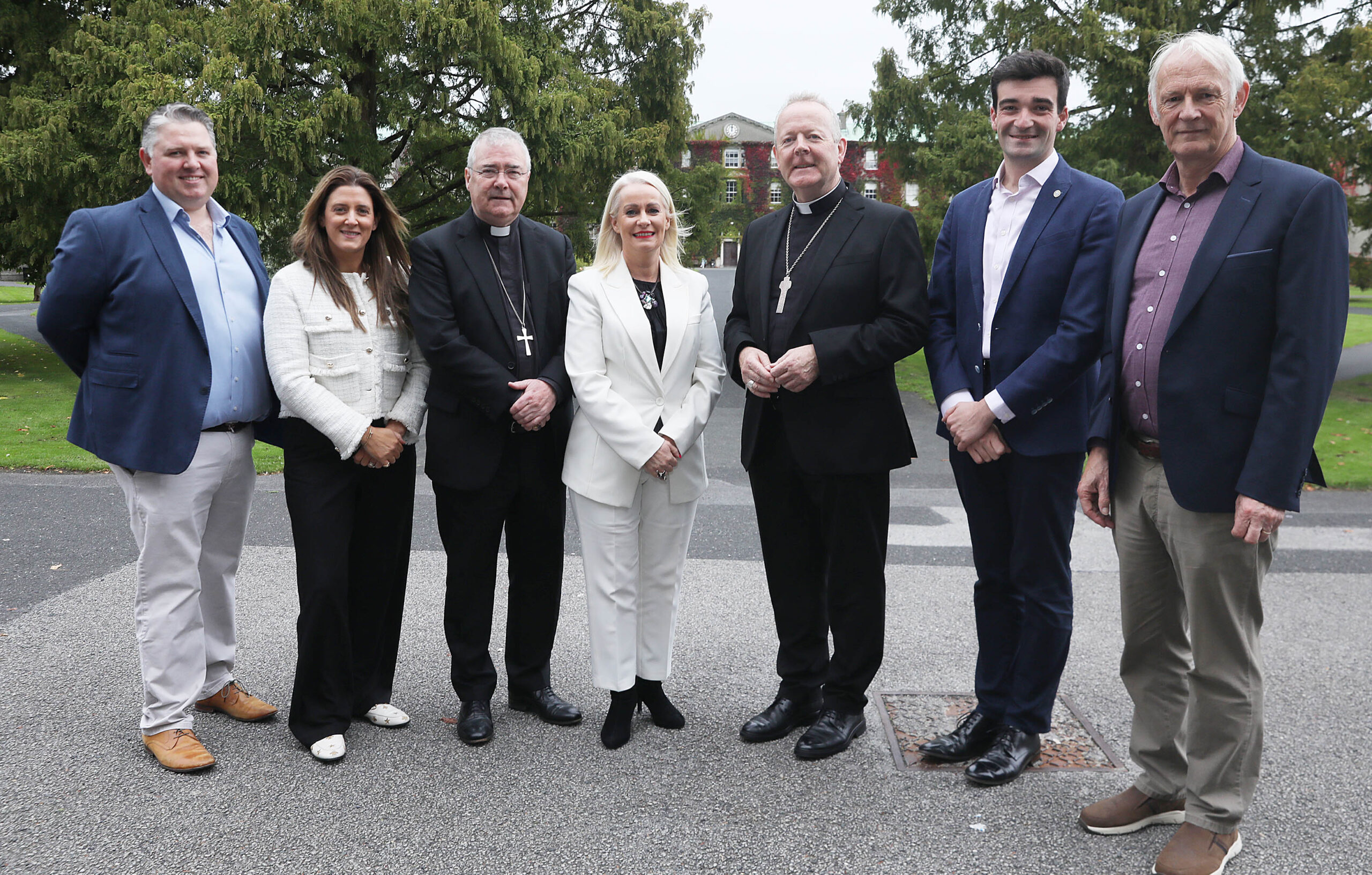
Archbishop Eamon Martin: “Who has the power to call the current conversation about AI, and whose voice is still missing from the room?”

Today in Saint Patrick’s College, Maynooth, voices from across Church, public life, education, technology, healthcare, law, media and wider society gathered for the Living Magnifica Humanitas conference, reflecting on the opportunities and challenges presented by Artificial Intelligence.
Opening the conference, Archbishop Eamon Martin reflected on Pope Leo XIV’s encyclical Magnifica Humanitas and its invitation to ask not simply what AI can do, but what its development means for the human person, human dignity, responsibility and the kind of society we are creating.
He invited those gathered to consider a particularly important question:
“Who has the power to call the current conversation about AI, and whose voice is still missing from the room?”
Archbishop Eamon emphasised that the Church does not claim to have technical answers to every question raised by AI. Rather, it seeks to contribute to the conversation by keeping human dignity, conscience, relationship, responsibility and the common good at its heart.
Opening address by Archbishop Martin at the ‘Living Magnifica Humanitas‘ conference in Maynooth
 It is only four months since Pope Leo XIV published his first encyclical letter, Magnifica Humanitas: On the Protection of the Human Person in the Age of Artificial Intelligence. And it has certainly sparked a worldwide conversation.
Artificial intelligence is already impacting and shaping our personal lives, workplaces, schools and communities; our hospitals, public services, economies and democracies. People are asking what Artificial Intelligence will mean for their children, their work, their privacy and freedoms, their relationships and their future.
Magnifica Humanitas is essentially an invitation from Pope Leo to reflection and dialogue. It asks, not just: ‘What can AI do for us?’, but more profound questions like: ‘What kind of people are we becoming through AI, and what kind of world are we building?’
At today’s ‘Living Magnifica Humanitas’ conference, we are responding to Pope Leo’s invitation. We have gathered a range of voices: parents, students and teachers, clergy and religious, industry experts, politicians and regulators, academics, media and leaders from the medical, legal, finance, military and charity sectors.
Our gathering is an opportunity to share our personal thoughts and reactions, but more importantly, it provides a space to listen to one another, to learn from different perspectives, and to discern together how we might respond to the opportunities and challenges of AI for today and tomorrow.
The Church does not claim to have a technical answer to every AI question, but she does offer ethical principles to the debate over AI. The Church has faced technological revolutions before. Way back in 1891, Pope Leo XIII wrote about “rerum novarum” – the “new things” – in other words, the innovations of his day. In our times, Pope Leo XIV readily accepts that “over the centuries, technological development has significantly improved the living conditions of humanity. At the same time,” he says, “each phase of progress has also revealed the ambiguity of tools that can cause harm when not oriented toward the Good.”
From Ireland’s point of view, the development of Artificial Intelligence is not an abstract issue or something happening far away. AI is being hosted, shaped, governed and developed here on this island. Back in May, I invited leaders across society, and Church, in Ireland to take up the challenges of this encyclical with seriousness and courage. I suggested that we must ask together: ‘What responsibilities do governments, companies and citizens have in shaping ethical AI on the island of Ireland, and beyond? Does AI serve human persons or, instead, tend to dehumanise or even aim to replace them? In an AI environment, how do we defend the dignity of workers and every human person, especially the most vulnerable?’
The Church as a convenor of conversation
In preparing Magnifica Humanitas, Pope Leo listened. He listened to scientists, engineers, political leaders, teachers and parents. He also wanted to hear those whose voices can disappear when a so-called “technocratic paradigm” reigns. At the launch of his encyclical letter in May, Pope Leo said, ‘What a great sign of hope that, with our differences, we can listen to one another.’ He went on to say that together we can, “discern the major questions of our time, and so, the future of humanity’ (Address 25 May 2026).
Pope Leo knew that the Church has a capacity to convene conversations across disciplines, interests, generations and experiences. Clearly scientists and developers need to be at the table. So do philosophers, theologians and ethicists. But the conversation also needs teachers, parents and young people; workers whose employment may change; people living with disability; artists and communicators; those experiencing isolation; and those who will live with decisions made by algorithms without ever having had a voice in designing them.
Pope Leo says explicitly, ‘Communities and intermediary organizations must not be reduced to passive recipients of decisions made elsewhere; they must be able to contribute to discernment and oversight’ (MH 108).
So perhaps one of the questions we might keep in mind this morning is: ‘Who has the power to call the current conversation about AI, and whose voice is still missing from the room?’
In genuine human conversation and dialogue, something can emerge between us that neither of us possessed before the encounter – not because our differences have disappeared, but because we have entered into relationship through them. Human conversation can be a threshold and gateway that opens the possibility of something completely new – we can even change our mind (see Pope Leo XIV, Magnifica Humanitas, 8).
Interestingly, Pope Leo makes an important distinction between human, and AI, interaction: Artificial intelligences “may imitate language, behaviour and analytical skills, or even simulate empathy and understanding.” But, he adds: AI lacks “the affective, relational and spiritual perspective through which human beings grow in wisdom.” (MH 99)
Defending Human Dignity
At the heart of Pope Leo’s encyclical lies the conviction that human dignity deserves protection at all times. Human beings are created in the image and likeness of God. At the Incarnation God came among us with a human voice, a human face and a human heart. In today’s world of screens, artificial voices and digital masks, the Church therefore defends the dignity of each human person, with a real face and authentic voice, who cannot be reduced to data to be copied or manipulated.
AI can do remarkable things. It can sort through vast amounts of information, recognise patterns, and create words, images and voices that feel very real. It can even at times mimic human behaviour and qualities, but AI does not have a conscience. It cannot care, love, suffer, forgive, pray or hope as humans can, nor can it be truly “wise”. As Pope Leo puts it, “artificial intelligences do not experience life, do not possess a body, do not experience joy and pain, and do not know from within what love, work and responsibility mean.”
Much contemporary AI works through statistical and probabilistic processes. It learns patterns from what has already occurred and estimates what is most likely to follow. But no past completely determines a human future. No human person can be reduced to their dataset. In fact, conversion, forgiveness, vocation, grace and freedom all disrupt probability and prediction. The Gospel asks: “Who might this person yet become?” The Creator Spirit asks, “What might come into being which we could not have predicted from what has gone before?”
That is why Pope Leo warns against surrendering decisions to systems which cannot know “the hope that people are able to change” (Magnifica Humanitas, 102).
AI, Moral Agency and the Temptation to Surrender Human Judgement
This brings us to one of the most important contemporary questions raised by the emergence of AI: “What happens when we entrust questions of life and death to systems whose mode of ‘judgement’ consists ultimately in computation, optimisation and rule-following?”
Pope Leo XIV places this question at the centre of Magnifica Humanitas. He insists that AI must remain under the direction of human intelligence, conscience and freedom, and that human beings must continue to determine both its use and its limits (Magnifica Humanitas, 97).
Pope Leo is clear about why this matters. AI may surpass us in speed and computational capacity, but it does not experience the world as a human person does. AI does not suffer, love, mature through human relationships, or know responsibility from within (MH, 99).
Pope Leo addresses this question directly in relation to war. He cautions that autonomous weapon systems can make war appear more feasible while placing it increasingly beyond human control. He rejects the idea that an AI might become an “artificial moral agent.” Moral judgement, he says, cannot be reduced to calculation. It involves conscience, personal responsibility and recognition of the other as a person. His conclusion is clear: lethal or irreversible decisions cannot be entrusted to artificial systems, and “no algorithm can make war morally acceptable” (MH 197-199).
In this regard, the risks of AI do not arise only from system failure. They also arise from those who might intentionally misuse powerful AI systems. Criminal networks, hostile states, extremist groups and other malicious actors could choose to use AI to scale cyberattacks, deception, disinformation and the exploitation of digital vulnerabilities.
Pope Leo therefore warns that we cannot be satisfied with the “moralization of machines”, or the alignment of AI with supposedly human values (MH197). We must also ask, “Whose morality is being embedded in the system and whether those ethical frameworks remain open to public scrutiny and shared discernment?” Otherwise, the moral vision of a small number of designers and institutions risk becoming the invisible infrastructure within which everyone else must live.
That is why, at the presentation of the encyclical last May, Pope Leo put the matter even more succinctly: AI needs to be “disarmed”, he said, freed from those logics that turn technology into an instrument of domination, exclusion and death.
Conclusion
As we begin our reflection today, it is worth considering that the more powerful our rule-governed machines become, the more urgently we need wise human beings to oversee them, human beings who are formed in prudence and virtue. It is not that we should fear technology, or reject it. Instead we must ensure that technological power remains embedded within human responsibility, conscience, relationship and the common good.
The danger is not simply that machines may become increasingly powerful. It is that human beings may gradually surrender to AI the very capacities that make genuinely human judgement possible.
The questions before us today are immense, not only about who is building, controlling or benefiting from artificial intelligence, but also who is convening the human conversation around it, whose voices are being heard, and what understanding of the human person is guiding us? As Pope Leo XIV himself put it on the day he launched his encyclical: “Let’s not fear artificial intelligence but constantly keep the question of the human in play” … “Let us protect our magnificent humanity.”
Video Contributions to the Conference
🎥 Watch Bishop Paul Tighe’s contribution
🎥 Watch Professor Anna Rowlands’ contribution
As Pope Leo reminds us: “Let’s not fear artificial intelligence but constantly keep the question of the human in play.”
Contributors to the ‘Living Magnifica Humanitas‘ conference were: Seminarian Mark McDonnell; Archbishop Eamon Martin; Archbishop John McDowell, Church of Ireland Primate of All Ireland; Ms Niamh Smyth TD, Minister for AI; Ms Emma Redmond, Head of OpenAI Ireland; Professor Stephen Williams, formerly QUB; Dr Lisa Cunningham, HSE Consultant in Emergency Medicine; Dr Barry Scannell, Partner at William Fry corporate law firm; and Ms Ciara O’Brien, business and technology journalist with The Irish Times. The panel moderators were Mr Alan Hynes-Cendrzak and Ms Natalie Doherty.