

Archbishop Eamon Martin Encourages Prayer for the Cause of Venerable Father Edward J. Flanagan
 During a recent visit to Omaha, Nebraska on, 16th July 2026, Archbishop Eamon Martin visited Boys Town, the world-renowned community founded by the Irish priest Venerable Father Edward J. Flanagan.
He was welcomed to the Boys Town Campus by the Student Vice Mayor, together with Archbishop Michael McGovern and Fr Jeff Mollner, National director of Mission and Spirituality. During his visit he had the opportunity to spend some time in prayer at the Dowd Memorial Chapel, where Father Flanagan is buried. The visit offered an opportunity to remember the life of an Irish priest whose faith, courage and practical care transformed the lives of generations of children and who continues to shape services for young people and families across the United States.
Founded in Omaha in 1917, Boys Town began when Father Flanagan opened a home for boys who were homeless, abandoned or caught within the juvenile justice system. At a time when many regarded such young people as problems to be punished, he saw children who needed safety, affection, education and another chance.
Father Flanagan’s conviction was simple but radical: no child should ever be reduced to their mistakes or circumstances.
“There is no such thing as a bad boy,” Father Flanagan insisted. He believed that destructive environments, poor example and inadequate care could wound a child and that kindness, love and patient formation could open even the most troubled heart.
From its beginnings in downtown Omaha, Boys Town moved west of the city in 1921 and grew into a community with schools, family homes, a chapel, post office and youth government. Father Flanagan wanted children not only to receive care, but also to grow in responsibility, belonging and dignity.
That vision continues today through Boys Town’s residential, educational, healthcare and family support services. In Nebraska alone, nearly 14,000 children were served or impacted last year, with its wider work reaching communities across the United States.
A life of heroic virtue
On 23 March 2026, Pope Leo XIV recognised Father Flanagan’s heroic virtue and declared him Venerable, advancing his cause for canonisation. The declaration marked a significant moment for Boys Town and for the Church in Ireland, recognising that his work for children flowed from a life shaped by faith, charity, courage and hope.
Bishop Kevin Doran, Bishop of Elphin, the diocese in which Father Flanagan was born, recently encouraged people, particularly those who work with young people, to look to Father Flanagan as a model of Christian living and to pray for his beatification.
Father Flanagan’s witness still speaks clearly. He refused to divide children into the deserving and undeserving. He looked beyond behaviour to the experiences, relationships and environments that had shaped a young life. He also believed that love must become practical: a safe home, good teaching, friendship, healthcare, responsibility and the patient presence of adults who refused to give up.
Archbishop Eamon visited Boys Town on the 16th of July this year and during his visit recalled the enduring bond between Ireland and the work begun in Omaha, Nebraska more than a century ago.
Archbishop Eamon’s visit also offered a timely reminder that the measure of a Christian community lies partly in how it receives, protects and accompanies its children.
The story of Boys Town continues wherever people take seriously Father Flanagan’s conviction that no child stands beyond the reach of kindness, belonging and hope.
An Irish priest who challenged prejudice
Edward Joseph Flanagan was born on 13 July 1886 at Leabeg, near Ballymoe, County Roscommon. He emigrated to the United States in 1904 and was ordained to the priesthood in 1912.
His work with vulnerable children grew from his Christian conviction that every person bears the image and likeness of God. Boys Town welcomed children according to their need, regardless of race, religion or ethnic background. This approach challenged the racial segregation, sectarianism and prejudice of early twentieth-century America.
Father Flanagan spoke out frequently and publicly against racism and resisted the influence of the Ku Klux Klan. During the Second World War, he also assisted Japanese-American families who had suffered internment and discrimination. His concern for children eventually took him beyond the United States. After the war, he visited Japan, Korea and parts of Europe to advise on the care of children displaced or orphaned by violence.
When he returned to Ireland in 1946, he strongly criticised the treatment of children in industrial schools and other institutions. His intervention provoked hostility at the time, but it revealed his willingness to speak plainly whenever systems failed to respect the dignity of children.
Father Flanagan died in Berlin on 15 May 1948 while undertaking further work on behalf of children affected by the war. His remains were returned to Boys Town and laid to rest in Dowd Memorial Chapel. Archbishop Eamon visited his tomb during a recent visit to Boys Town, praying at the resting place of a priest whose ministry joined faith with determined action on behalf of children who had often been forgotten.
“He ain’t heavy, Father, he’s my brother”
 One of the most familiar images associated with Boys Town is the depiction of an older boy carrying a younger child on his back.
When Father Flanagan asked whether the child was too heavy, the boy replied: “He ain’t heavy, Father, he’s my brother.”
These words expressed the kind of community Father Flanagan hoped to create, one in which children learned that they belonged to one another and that the burdens carried for another person were never carried alone.
Archbishop Eamon’s meeting with the student vice Mayor of Boys Town brought him into contact with this distinctive part of Father Flanagan’s legacy. By giving young people a voice in the life of the community, Father Flanagan highlighted the fact that care for children must involve more than providing services for them. It must also recognise their gifts, listen to their experiences and invite them to take responsibility for the community they share.
Following his visit, Archbishop Eamon encourages the faithful to continue to pray for the advancement of Father Flanagan’s cause and, in particular, for his beatification.


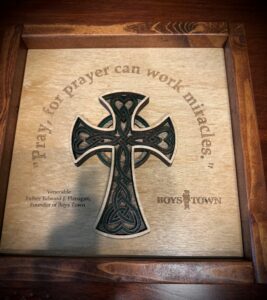
- Father Flanagan’s Cross,
- Archbishops Michael McGovern and Eamon Martin with Father
Jeff Mollner
Father Flanagan League, Beatification and Intercession Prayer

