
St Brigid of the Beatitudes: A Call to Mercy, Dignity and the Voice of Women
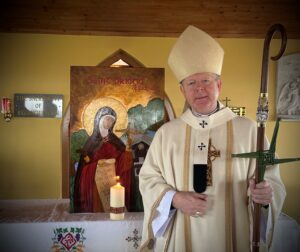 Tomorrow, as the Church celebrates the Feast of St Brigid, Archbishop Eamon Martin will invite us to reflect on St Brigid as a woman who brought the Beatitudes to life and modelled a deeply Gospel-shaped way of living.
In his homily, Archbishop Eamon will reflect on the tradition that St Brigid and her companions each chose a Beatitude as the guiding charism of their consecrated lives. He reminds us that the Beatitudes are not abstract ideals, nor separate virtues to be picked and chosen, but a single portrait of Christian holiness – what Pope Francis once described as the Christian’s “identity card”.
St Brigid was and is a powerful witness to mercy. Archbishop Eamon reflects on the fact that she is presented as a woman whose compassion embraced the poor, the sick, the vulnerable and those on the margins, a woman whose life consistently defended human dignity. For St Brigid, mercy was not a sentiment but a way of life, one lived generously, courageously and at great personal cost.
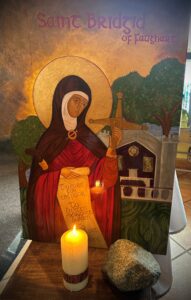 Archbishop Eamon’s homily offers a strong and timely affirmation of women in the life and mission of the Church. St Brigid is held up not only as a model of holiness, but as a reminder of the indispensable contribution women have made and do make to Church and society. In a world where the dignity of women is too often threatened or diminished, Archbishop Eamon highlights the urgent need for women’s voices, insights and leadership – particularly in the area’s of dialogue with contemporary culture, decision-making and governance, safeguarding, education, catechesis and care for the vulnerable.
As we celebrate St Brigid of the Beatitudes, we are invited to renew our commitment to a Church shaped by mercy rather than power, by humility rather than dominance, and by a shared baptismal vocation. St. Brigid’s life challenges each of us to live the Beatitudes visibly and courageously, so that the Church may more clearly reflect the Kingdom of God in our time.
Text of Archbishop Eamon Martin’s Homily – St Brigid of the Beatitudes – a model for Christian living today
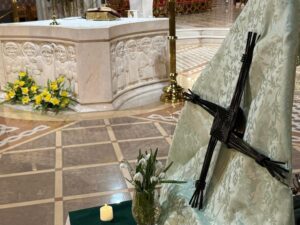 Whenever Saint Brigid first chose to embrace the consecrated life, she was joined by seven other women. The story is told that each of them, after receiving the veil of religious life, chose one of the eight beatitudes of Jesus to be their motto – to represent the particular gift or ‘charism’ that they wanted to guide their life of dedication to God. It is a wonderful coincidence then, that as we celebrate the Feast of Saint Brigid this year on a Sunday, the set gospel reading from chapter 5 of Saint Matthew’s Gospel features those eight sayings of Jesus known as “the Beatitudes” which he spoke at the beginning of his famous ‘sermon on the mount’.
Jesus offered the ‘beatitudes’ to describe His way to holiness – the only pathway to true happiness. He tells us that “Happy” or “Blessed” are the poor in spirit; the gentle; those who mourn; and, those who hunger in thirst for what is right. He then singles out the merciful; the pure in heart; peacemakers; and, those who are persecuted in the cause of right.
If, like St Brigid and her companions, you were to select one of the beatitudes as your motto – to represent the kind of person you would like to be – which would you choose? To be Poor in spirit? Meek and gentle? Someone who weeps or mourns the sin and suffering in the world? Or, a person who hungers and thirsts for what is right? Would you desire to be always a merciful person? Or, to be pure in heart? A peacemaker? Or would you want to be known as someone willing to be persecuted in the cause of right?
Of course all eight of the beatitudes are inter-related. They are not describing eight different types of person, but one: the perfect Christian! They set out the essence of being the true follower of Christ. No wonder then, that our late Holy Father, Pope Francis, liked to describe the Beatitudes as the Christian’s “passport” or “identity card”, – their blueprint for holiness. If you are ever fortunate enough to meet someone who represents all eight beatitudes at once, then you have met a perfect Christian – you have met a saint!
The more I reflect on the life of Saint Brigid, the more I realise how much she represents a woman who brought the beatitudes to life! Interestingly, when she was reflecting on which beatitude would most inspire her life of consecration to God, she chose: “Happy are the merciful”; “Blessed are the merciful – they shall have mercy shown them”. She clearly wanted to model a life of mercy towards the poor, the sick, the vulnerable, those people who struggled with diseases or disabilities, the weak, the sinner, the lost. Like Jesus she wanted to promote their dignity at all times, to welcome them, to be with them, to accompany them.
They say she learned this beautiful quality from her Christian mother – remember, Saint Brigid lived at the very dawn of Christianity on this island; her mission was to call people away from empty paganism, from chasing after false and superficial gods and goddesses and instead to offer them Jesus, who is the Way, the Truth, and the Life. Apparently, her pagan father couldn’t stand Brigid’s complete generosity towards the poor and the vulnerable – he felt she was going to bankrupt him by her kindness and goodness!
St Brigid was driven by compassion and hospitality to those whom the world tends to forget, or brush aside; she wanted her convent to be a haven of mercy for the weak – not just the materially poor, but also the poor in spirit, those who were spiritually hungering for the real food that would sustain them in life: the Bread of Life, the Body of Christ, the Church of God.
She was truly “St Brigid of the Beatitudes”! She, and her companions did not want to live just one of the beatitudes; they wanted to “action” them all, and to model their lives as followers of Christ: poor in spirit, gentle, pure in heart, peacemakers, merciful, able to weep for the suffering and sinners, determined to work for what is right and just in the world even if it meant being persecuted for doing so. She challenged people not to cling to the superficial and empty promises of pagan gods and goddesses; she was pointing them instead to the true God, to the Holy Spirit, to Christ and the Kingdom of Heaven! Her clear message was that if you your life inspired by Jesus Christ and His beatitudes, then you shall be truly satisfied; you shall inherit the earth; you shall be comforted; you shall have mercy shown you; you shall see God; you shall be called daughters and sons of God; yours will be the kingdom of heaven!
This is not an easy message. The beatitudes of Jesus are very challenging – they turn the values of this world on their head – by saying it is the poor, the persecuted, the gentle, the humble, the pure in heart who find true happiness, rather than the rich and powerful, the strong and aggressive. This world, often obsessed with money, power, individual freedoms and status, tries to convince us that it is those with the biggest armies, the most powerful weapons, the most money and access to celebrity, privilege and personal pleasure who are the greatest. Jesus and St Brigid represent an entirely different pathway. The way of the beatitudes; the promise of true perfection; the path to true happiness with God in eternal life.
Saint Brigid is often offered as a model for women in Ireland today. Saint Brigid is certainly an inspiring example of the indispensable contribution that women make to the daily life and mission of the Church, and society. Sadly we live in a world where the personal dignity of women is too often threatened by violence, abuse, inequality, commercial surrogacy, pornography, and now by the manipulation of female images online, gender ideology, the false promise of abortion on demand and other forms of exploitation.
The voice of women – St Brigid’s voice – and the specific vocation and charism of women is needed more than ever today, especially in the Church, for we struggle at times to navigate the complex, contradictory and misleading messages surrounding contemporary issues which, left unchecked, risk the “dehumanising” of human life and dignity.
Pope St John Paul, in Christifideles Laici,(his apostolic exhortation on the vocation and mission of the lay faithful) emphasised that women exercise a special role in the mission of Christ because “women have the task of assuring the moral dimension of culture”. He reminded us that God actually entrusted the human being to women, “precisely because the woman in virtue of her special experience of motherhood is seen to have a specific sensitivity towards the human person and all that constitutes the individual’s true welfare, beginning with the fundamental value of life.”
St Brigid of the Beatitudes reminds us today of the importance of promoting the specific charisms and dignity that women can bring to the Church’s mission. I’m thinking especially of dialogue with contemporary society; decision-making, governance and leadership; education, catechesis and evangelisation. The Church, and wider society needs the particular insights and witness of women – inspired by St Brigid of the Beatitudes – in matters such the protection of human life; outreach to poor, vulnerable and marginalised people; the safeguarding of children, marriage and the family; quality education and spiritual formation in our schools and parishes; and best practice in care and support for those who are disabled, sick or dying.
For that reason, I wish to pay tribute today to women – pastoral and present – in Ireland and throughout the world, who like Saint Brigid, have consecrated their lives to God, and dedicated themselves generously to promoting mercy, dignity of the human person, compassion towards the poor and the sick, and many other religious gifts and charisms. Tomorrow, the Feast of the Presentation of the Lord, is also the World Day of Prayer for Consecrated Life. Let us pray and give thanks for all women and men who have given up everything to serve God and the Church in such a selfless manner. We pray for more vocations to the religious life to the priesthood, and for a deep sense of vocation in all the baptised – inspired by the Beatitudes!
We Pray…
St Brigid,
You were a woman of peace.
You brought harmony where there was conflict.
You brought light to the darkness.
You brought hope to the downcast.
May the mantle of your peace
cover those who are troubled and anxious, and may peace be firmly rooted in our hearts and in our world.
Inspire us to act justly and to reverence all God has made.
Brigid you were a voice for the wounded and the weary.
Strengthen what is weak within us.
Calm us into a quietness that heals and listens.
May we grow each day into greater
wholeness in mind, body and spirit.
Amen.
A Naomh Bríd a Mhuire na nGael,
scar orainn do bhrat,
A Naomh Bríd a chroí na féile,
stiúir sinn ar an mbóthar ceart,
A Naomh Bríd gheanúil ghrástúil,
ar ár namhaid cosain sinn,
A Naomh Bríd a bhean rialta álainn,
ar uair ár mbáis glaoigh orainn.
+ Archbishop Eamon Martin
Archbishop of Armagh, Apostolic Administrator of Dromore, Primate of all Ireland