Sunday, April 5, 2026
Home Blog Page 54

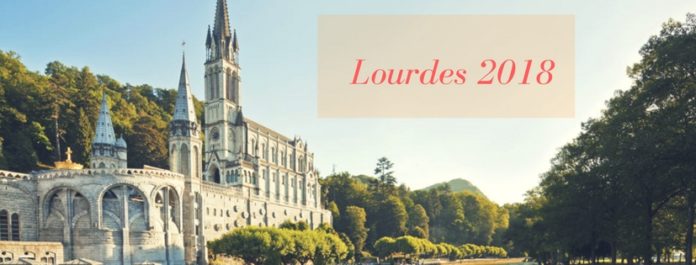
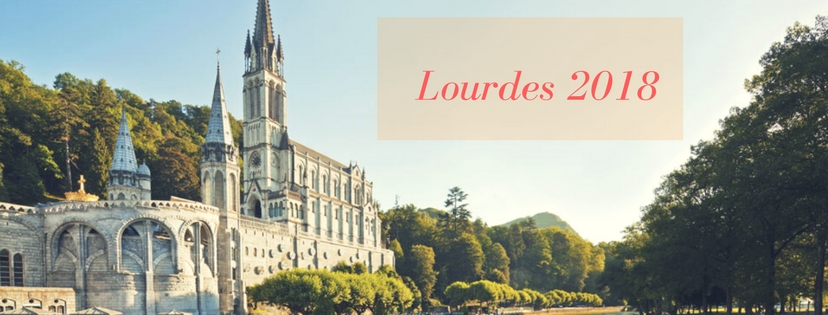
Lourdes 2018 with ADYC

The annual Armagh Archdiocesan Pilgrimage to Lourdes will take place from 12th to 17th May 2018 from Belfast and Dublin airports. Armagh Diocesan Youth Commission (ADYC) will be leading the young pilgrims on next year’s Diocesan Lourdes Pilgrimage. ADYC view pilgrimage as a key part of young people’s faith development.

A special package has been arranged for young pilgrims aged 16 – 18, at a reduced cost of €600.00 per person.

A typical package will include:
» Direct flight from Belfast or Dublin to Tarbes-Lourdes Airport and return;
» Return airport transfers with guide assistance;
» 5 nights hotel accommodation | Daily breakfast, lunch and dinner;
» Full programme of religious ceremonies and Masses;
» Guided tours, youth programme;
» Full assistance of Joe Walsh Tours guides and representatives.

Check out our poster and printable booking form here: 

ADYC Lourdes Poster

ADYC Lourdes – Booking Form


Click here for our Online Booking Form


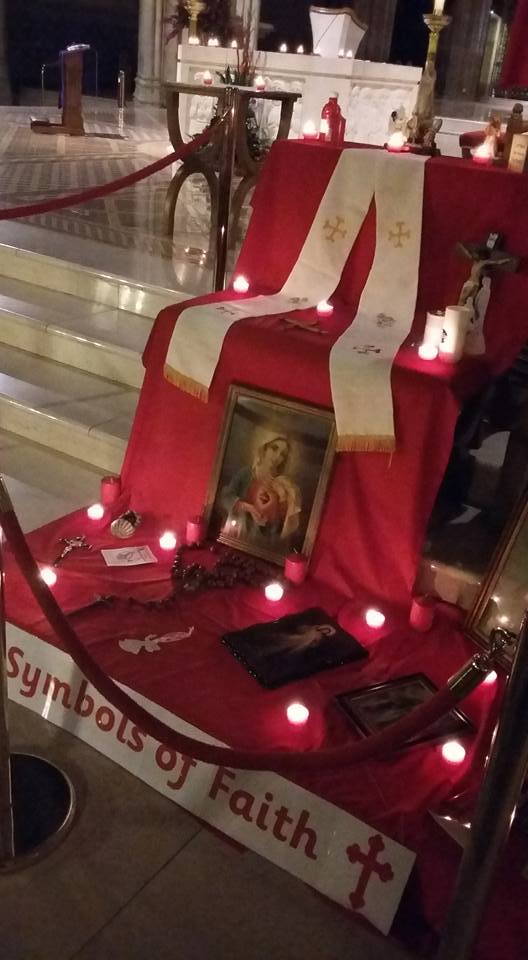
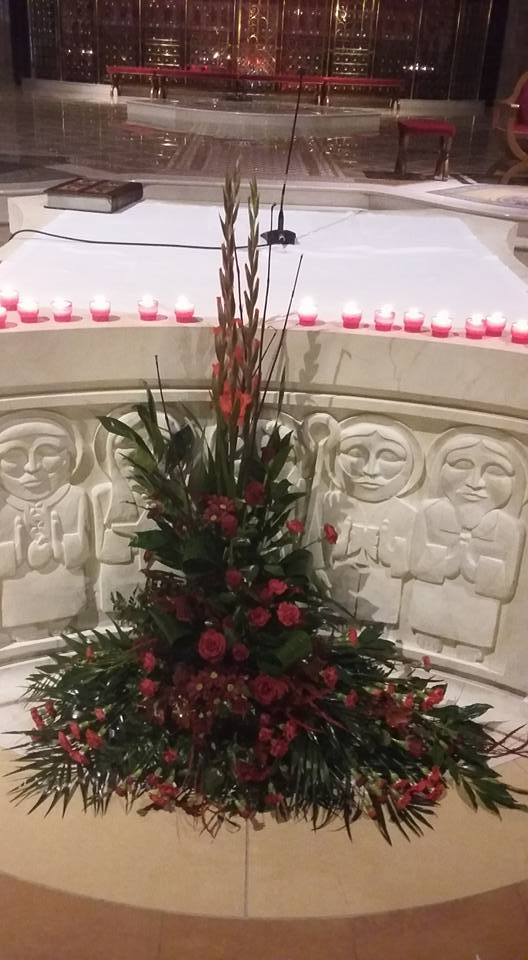
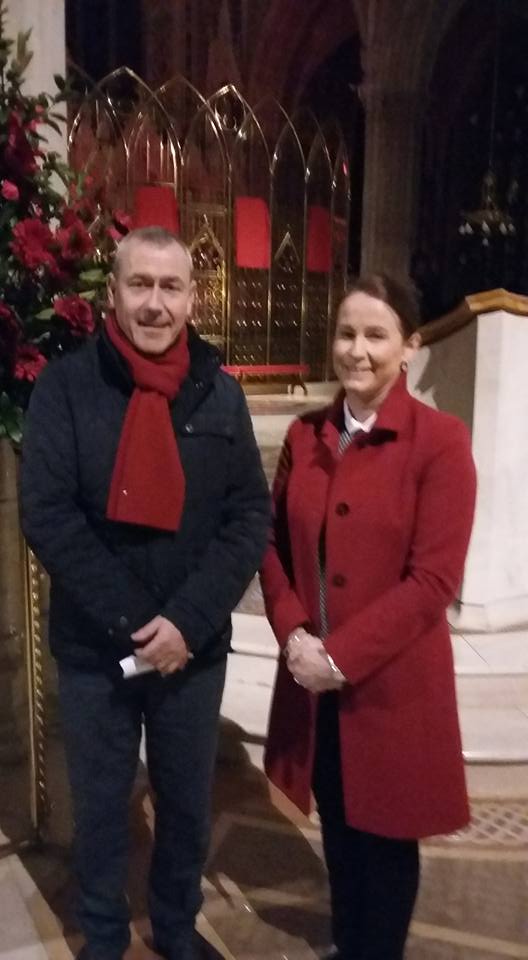
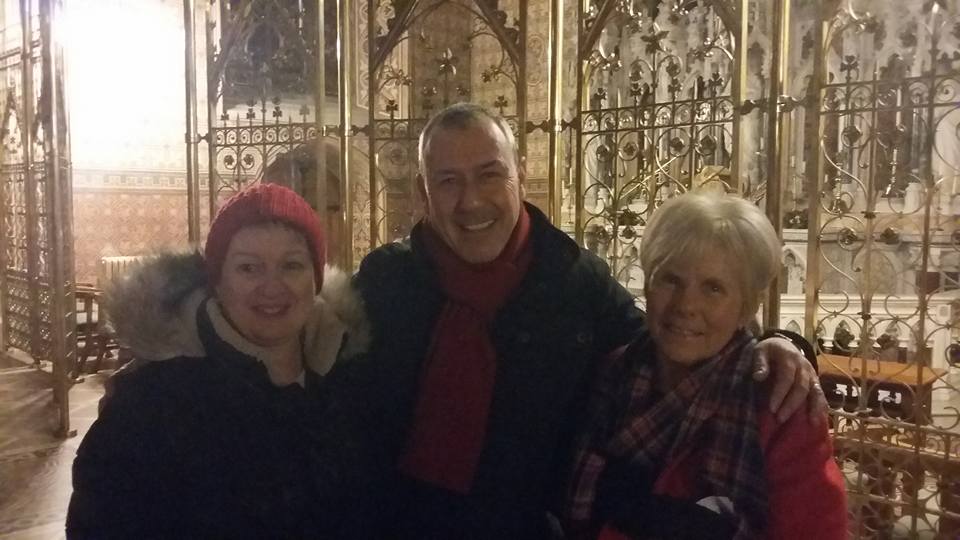
Red Wednesday around the Archdiocese

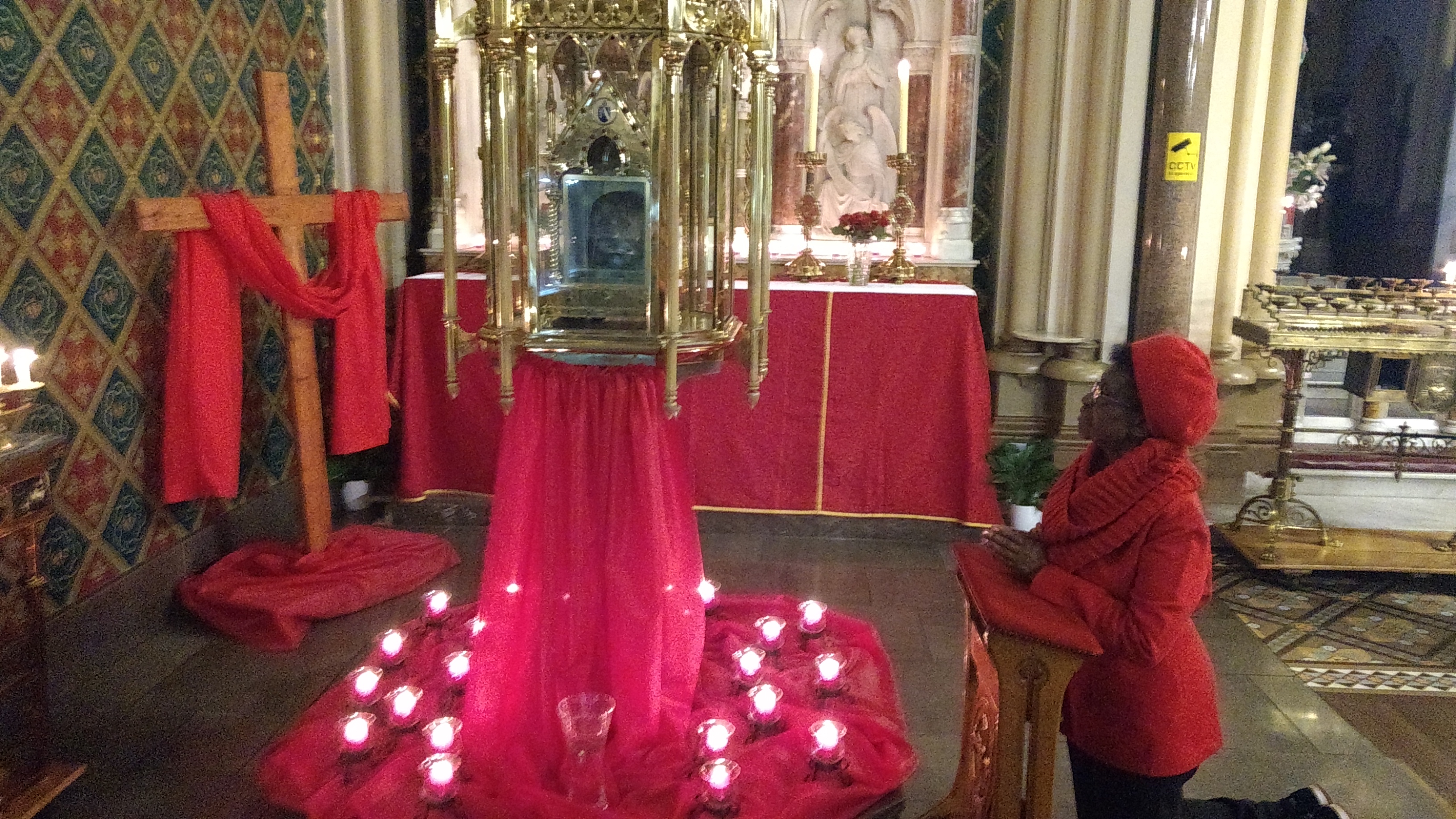
Sarah Namaddu a refugee from Uganda, praying on Red Wednesday for persecuted Christians at the Shrine of St. Oliver Plunkett in Drogheda.


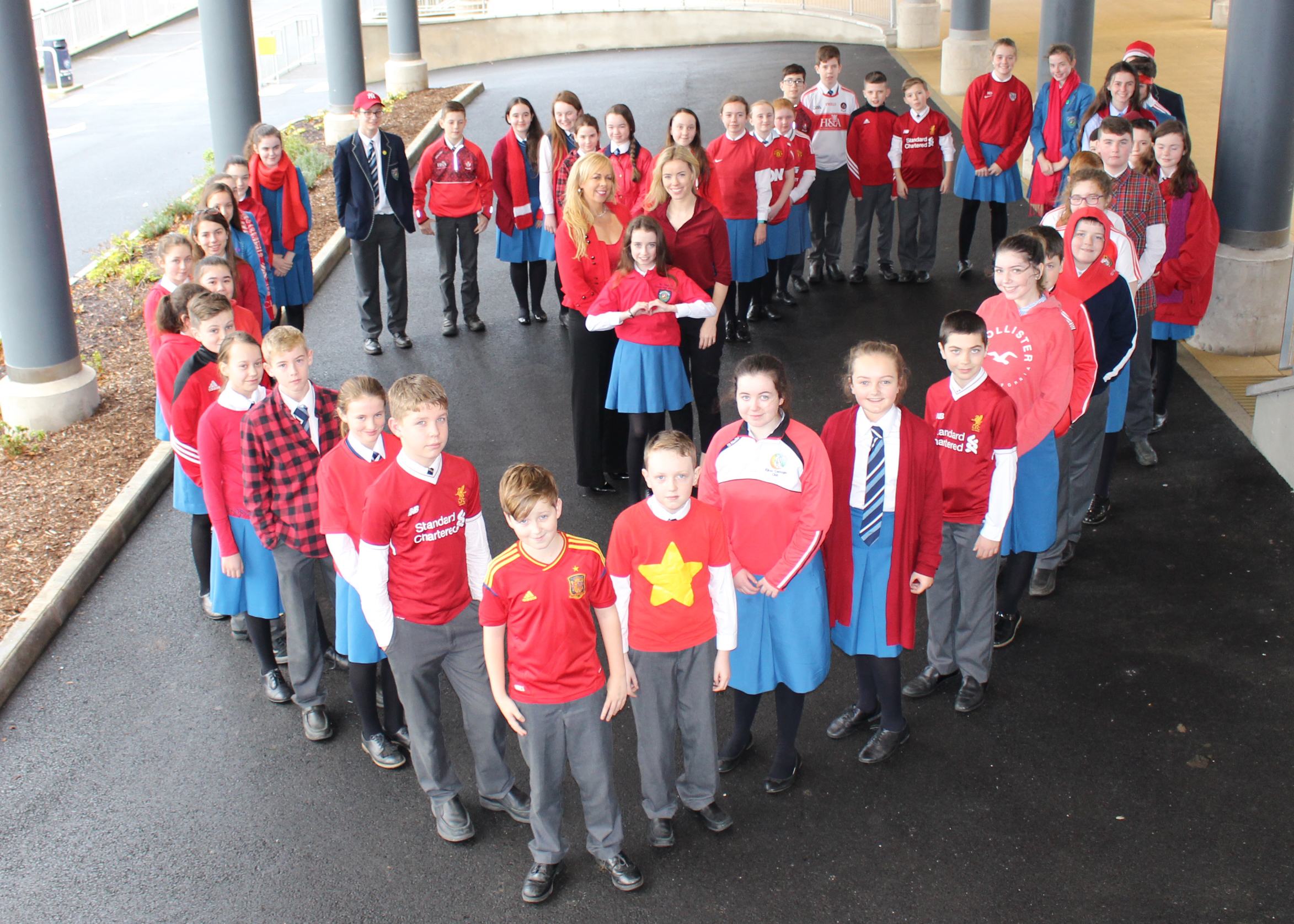
Pupils from St Mary’s Grammar School, Magherafelt

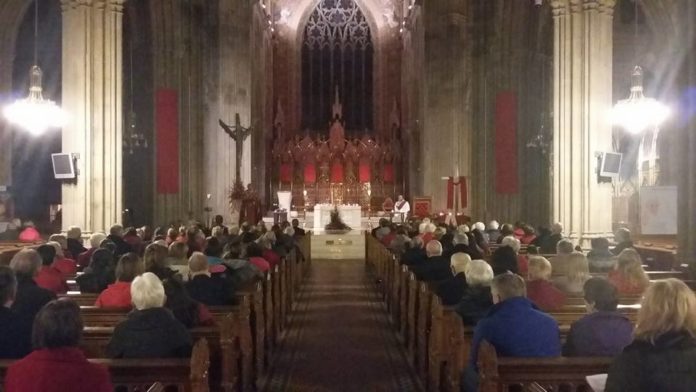
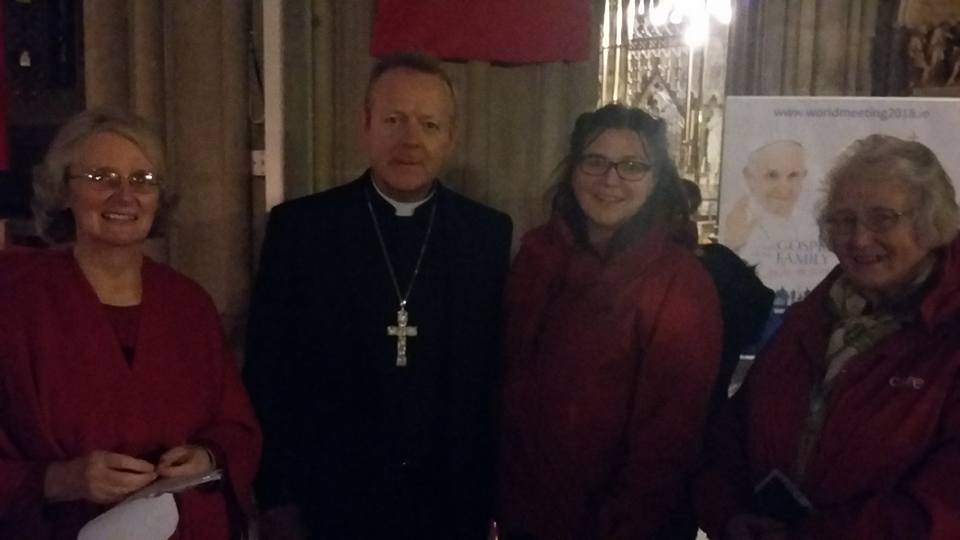
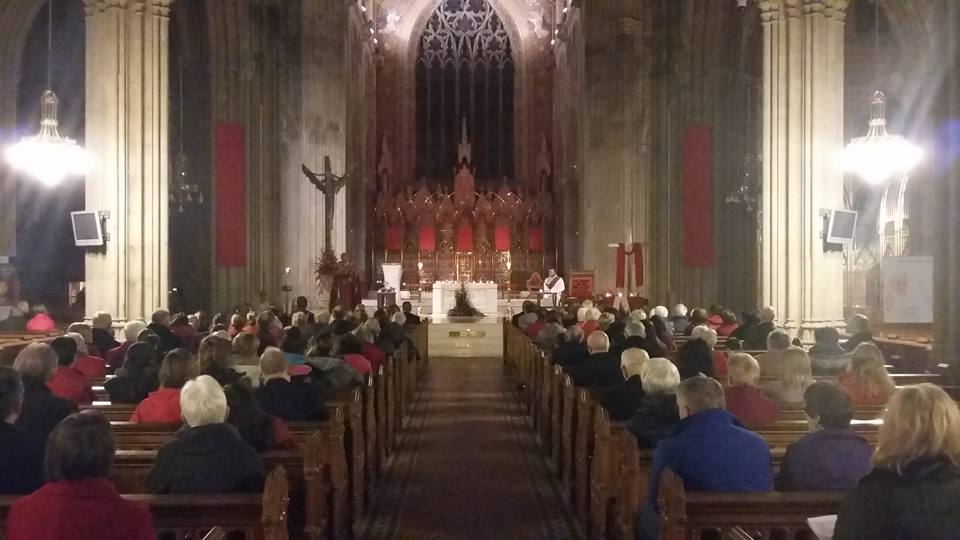
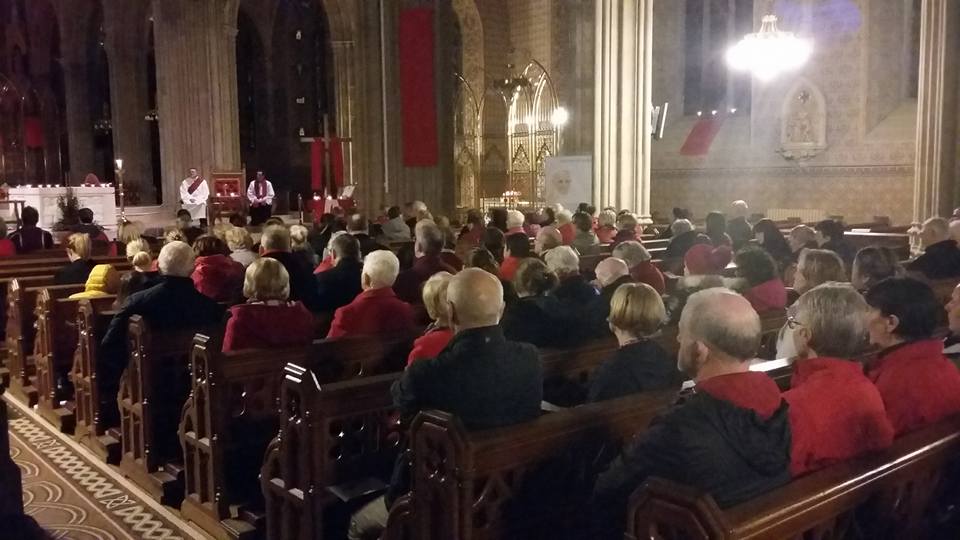
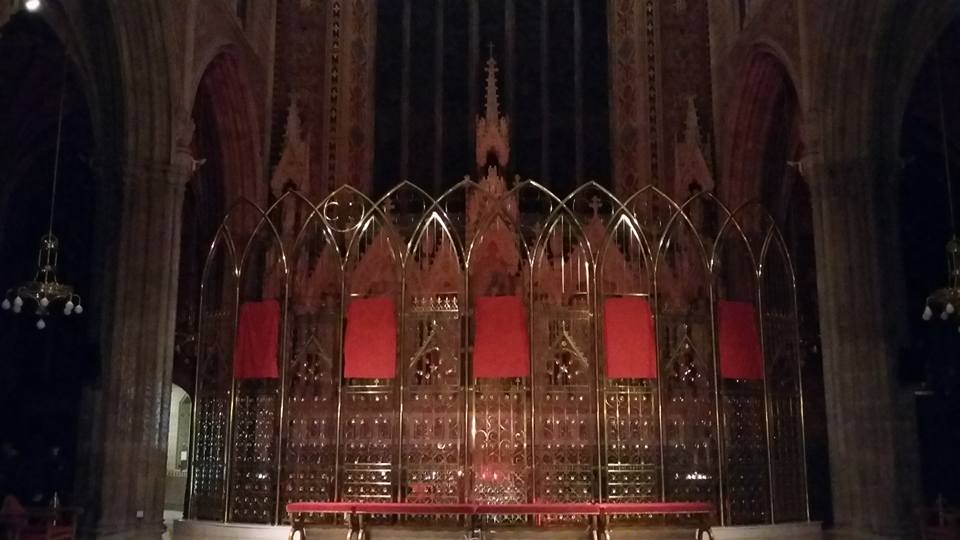
Address of Archbishop Eamon Martin at Vigil of Prayer for lighting red Saint Patrick’s Cathedral, Armagh, for #RedWednesday

Jesus told his apostles before he left them at the Ascension: “You will receive power when the Holy Spirit comes upon you, and you will be my witnesses in Jerusalem, and in all Judea and Samaria, and to the ends of the earth!” (Acts 1:8)

Many churches and public buildings in Ireland and Britain are being lit up in red this week, and people are wearing a red item of clothing, to help shine a light on the reality of Christian persecution across the world, and to highlight the injustices perpetrated against other minority and faith groups.

It happens that #RedWednesday this year falls on the Feast of Saint Cecilia – perhaps one of the most well-known martyrs of the early Christian Church.  Wearing red on 22nd November is therefore nothing unusual – we wear red vestments on all the martyrs’ feasts and also on days which recall Christ’s suffering, like Palm Sunday and Good Friday.

Red also points us to the Holy Spirit – the fire of God’s love.  We wear red vestments on Pentecost Sunday, for the Sacrament of Confirmation and on other Masses of the Holy Spirit.  This is fitting; the word martyr means ‘witness’, and it is the Holy Spirit who gives us the courage to witness.

In my Latin class at school we learned the phrase:

sanguis martyrum semen Christianorum est: the blood of martyrs is the seed of Christians.  It was written by the historian Tertullian more than 18 centuries ago, at a time when the Roman Empire was determined to stamp out the rapidly growing Christian faith.  This era is often referred to as the Age of Martyrs, when the blood of Christians poured out red as thousands laid down their lives rather than renounce or compromise their faith in the midst of Pagan culture.  But the blood of the martyrs turned out to be the seed of the Church.  Far from destroying the faith through fear and intimidation, the cruelty of persecution magnified the powerful witness of these faithful believers.  Under the guidance of the Holy Spirit, Christianity was renewing the face of the earth and nothing would stop it.

All that may seem a long time ago, but it is shocking to realise that in the twenty-first century, Christians continue to be persecuted, displaced, intimidated, tortured, and even executed on account of their faith.  Places of worship are targeted by violence and destruction.

News of some of these attacks on Christians passes fleetingly across our TV screens – e.g. the twin attacks by IS which killed 47 Coptic Christians last Palm Sunday in Egypt.  But sadly, much of this persecution continues without recognition, attention, or anything significant being done to prevent it.  Various Christian groups work to highlight what is happening – like Open Doors and Aid to the Church in Need.  This time last year representatives of different Christian traditions in Ireland gathered in Portlaoise to discuss the persecution of Christians at the 27thannual Irish Inter-Church Meeting. Afterwards they said:

“In the course of our reflections we were challenged, encouraged and inspired.  We were challenged by the sheer scale of the suffering and the urgent need for a response from the international community, while recognising that the complexity of the problems do not lend themselves to obvious, externally–imposed solutions.  We were encouraged to hear that our spiritual solidarity in prayer and pilgrimage means a great deal to those who are experiencing persecution, and that the work of Christian development organisations is helping those who have been displaced begin to rebuild their lives, in the hope of one day being able to return home.  We were inspired and humbled by the courage of those who have risked everything to remain true to their faith.  Their example gives us hope, when we might feel tempted towards resignation and despair”.

We agreed that, “as churches, we can play our part by keeping this issue on the agenda of our political leaders and ensuring that the victims of persecution are not forgotten, by making donations in support of the urgent humanitarian needs and by working to ensure that our society models the inclusive approach to minorities we would wish to see in the Middle East and throughout the world.” (Statement of 27th IICM 2017).

It was encouraging therefore to note that, earlier this year, the issue of persecution of Christians was discussed at debates in the Dáil and at Westminster in April and July this year.

On #RedWednesday, we are being invited once more to pause, reflect and raise awareness of this horrific reality in our world.

The recently published second report on Christians oppressed for their faith by Aid to the Church in Need: Persecuted and Forgotten 2015-2017, highlights some grim realities that might otherwise have remained hidden for many of us, including:

  • The terrible life-threatening conditions for many Christians trying to live and believe in North Korea, Somalia, Afghanistan Pakistan and Sudan;
  • The reality that in almost all the countries reviewed, the oppression and violence against Christians have increased since 2015;
  • The impact of the displacement and exodus of Christians in countries like Iraq and Syria threatens to extinguish some of the oldest Christian presences in the world;
  • The horrendous activities of Boko Haram in Nigeria whose genocide has led to the displacement of millions;
  • The hostile treatment of Church communities in China, with widespread removal of crosses and demolition of church buildings;
  • The “unspeakable atrocities” against Christians in North Korea.

The witness and martyrdom of so many persecuted Christians around the world challenges me this #RedWednesday to ask: what does their suffering mean for us?  Surely it means more than simply lighting our churches red or wearing a red armband for the day?  Let me offer three suggestions:

Firstly, the persecution of fellow Christians reminds us of the importance of reconciliation and peace building between Christians of different traditions – a lesson that is particularly important for Christians here in Ireland.  Sadly, many people looking in at Ireland from outside, see a history of division and sectarianism, of intolerance, mutual recriminations, and open hostility within the Christian family – I repeat what I said last month: this is a source of scandal, and something which has dimmed the light of the Gospel.  Reflecting on our persecuted brothers and sisters throughout the world should remind people of faith in the various Christian traditions on the island of Ireland, that we all share the responsibility of leading the way in transforming relationships and in healing the legacy and pain of our troubled past.

Secondly, the plight of persecuted Christians reminds us of the importance of advocating for freedom of conscience and religion which is enshrined in article 18 of the UN Declaration of Human Rights.  We should all be concerned about the growing incidence of intolerance against Christians in many parts of the world and call on our Governments to do everything they can to prevent this persecution wherever and to whomever it happens.  Governments have a responsibility to respect the fundamental right to freedom of conscience and religion of all their citizens, including (indeed particularly) when these citizens are a minority in their country.  This is true whether these citizens are Christians or, for example, Muslim refugees in Myanmar or people of the minority Yazidi religion in northern Iraq. 

Those who do not respect freedom of thought, conscience and religion must be held to account.  We should call on our Governments, in these islands, to put on the agenda of their foreign policies, respect for the freedom to manifest religion or belief, whether in teaching, practice, worship or observance.  The insistence that countries uphold this freedom should form an important part of decisions to allocate aid funding.

Thirdly, the martyrdom and witness of our fellow Christians invites us to consider how we ourselves witness to our faith in Irish society.  Our wounded world needs so much to be healed and enlightened by the Gospel, and we are all called to be prophetic in shining the light and truth of the Gospel into some of the trickiest and most sensitive issues of our time.

Our call to witness compels us to courageously present in public discourse our sincerely held Christian convictions about the dignity of the person and the sacredness of all human life, about marriage and the family; about the widening gap between rich and poor and the need for solidarity and a fair distribution of goods in the world; about care for the Earth, our Common Home; about the need to build a society that is marked by peace, justice and care for all, especially the most vulnerable.

I thank God for the freedom of worship and religion that we enjoy on this island, a freedom that is denied so many people in our world today.  I recognise that to be like Christ in an increasingly secularised world increasingly means being different, counter-cultural, and not easily swayed by the prevailing attitudes and opinions around us.

On this #RedWednesday I invite you to pray for the gift of courage, the grace of witness and loyalty to Christ for Christians all over the world and especially for those who continue to be challenged, attacked, displaced or even murdered for what they believe in.

Death of Very Rev James Crowley PE

Reposing of remains at 60 Aughnagar Road, Ballygawley, Co Tyrone, BT70 2HP;

Removal to Church of the Assumption, Tullyallen, at 7.00pm on Wednesday, 22 November, arriving for Mass at 7.30pm:

Funeral Mass at 12.00 noon on Thursday, 23 November, followed by burial at the Church of St Joseph, Ackinduff.


Born: 15 January 1929, St Joseph’s Hillhead, Glasgow

Studied           St Patrick’s College, Armagh             1941 – 46                   

St Patrick’s, College, Maynooth         1946 – 53

Ordained: 21 June 1953, St Patrick’s, College, Maynooth

Appointments

On loan, Diocese of Brentwood         1953 – 1955

Curate, Termonfechin                         1955 – 65

Curate, St Peter’s, Drogheda              1965 – 75

Curate, Carrickmore                            1975 – 83

Parish Priest, Killeeshil                       1983 – 05

Pastor Emeritus                                   2005 – 17

Date of Death: 20 November 2017

Death of Very Rev Brendan McNally PE

The death took place on Sunday, 19 November 2017, of Fr Brendan McNally PE, in Moorehall Lodge Village, Ardee.  We thank the Lord for his fifty-nine years of generous priestly ministry in the Archdiocese.  May he rest in peace.

Reposing at Moorehall Lodge Nursing Home, Ardee, Co Louth, from this evening, 20 November;

Removal to Church of St Malachy, Reaghstown, at 2.30pm on Tuesday, 21 November, arriving at 3.00pm.  Reposing at Church of St Malachy until Mass at 7.00pm;

Funeral Mass at 12.00 noon on Wednesday, 22 November, followed by burial in Reaghstown Cemetery.


Date of Death: 19 November 2017, Moorehall Lodge Village, Ardee

Born:  26 September 1933, Parish of Ballymena

Studied:          St Patrick’s College, Armagh             1945 – 51

                        St Patricks, College, Maynooth          1951 – 58

Ordained:  21 June 1958, St Patrick’s College, Maynooth

Appointments

On Loan, Brentwood Diocese                                    1958 – 59

Assistant, St Peter’s, Drogheda                                  1959 – 63

Curate, Lordship & Ballymascanlon                           1963 – 76

Curate, Holy Redeemer, Dundalk                              1976 – 80

Administrator, Holy Redeemer, Dundalk                  1980 – 87

Parish Priest, Tallanstown                                           1987 – 06

Pastor Emeritus, Assistant Pastor, Tallanstown            2006 – 08

Pastor Emeritus                                                            2008 – 17

Opening Address of Archbishop Eamon Martin for International Conference on Priestly Formation

‘Models of Priestly Formation: Assessing the Past, Reflecting on the Present and Imagining the Future’


One of Ireland’s earliest mentions of priestly formation can be found in the tenth century Rule of the Céli Dé.  The document tells us that when the candidate has been taught how to pray the Liturgy of the Hours and “the correct method of administering Baptism and Communion”, the formator is entitled to a cow from the candidate’s family!  In subsequent years, the formator is to be paid a calf, a pig, and four sacks of grain “together with a reasonable supply of clothing and food.”  When the candidate passes his final exams his formator is entitled to “a supper, of food and beer” before the bishop, “for a party of five that night.” (Note 1)


Friends, I am confident that this International Symposium on Models of Priestly Formation will have more than enough to be getting on with if it concentrates on developments over the past fifty years!  Since the Second Vatican Council’s Decree on Priestly Training Optatam Totius, we’ve had the 1970 Ratio Fundamentalis Institutionis Sacerdotalis; updates on this text in 1985, particularly in light of the 1983 Code of Canon Law; reflections on priestly formation at the 1990 Synod of Bishops followed by Pope Saint John Paul II’s important Post-Synodal Exhortation Pastores Dabo Vobis (25 March 1992) – and not a mention of a cow or a calf in any of them!


Now, over thirty years later, we have a new edition of the “Ratio”, promulgated on 8 December 2016, entitled, “The Gift of Priestly Vocation”. The new Ratio envisions a paradigm shift in priestly formation which calls for a considerable rethink of the structures and relationships in priestly formation. While the conciliar and post-conciliar documents on priestly formation have provided an excellent framework for bishops and seminaries, the recent Ratio Fundamentalis together with Pope Francis’ various discourses about priestly lifestyle offers a new vision, requiring new structures – new wine requiring fresh wineskins.


At this International Symposium we are all being invited to step out of our comfort zones in order to re-imagine past and existing models of formation in light of the new Ratio: What is the ‘new wine’? What are the ‘new wineskins’?


I hope that one of the fruits of this Symposium will be to inform the preparation of a new Ratio Nationalis for Ireland. Episcopal Conferences are currently being tasked with redesigning and updating their programmes of priestly formation. This means not only implementing the new Ratio in a way that takes account of local traditions, customs and needs, but also courageously moving the whole formation experience beyond past and present methods so that priests will be suitably prepared to engage with, and evangelise, the secularised contemporary culture.


The preparation and implementation of the Ratio Nationalis for Ireland will require the thoughtful and collegial cooperation of the bishops, in dialogue with the lay faithful (male and female) and with those experienced in formation. We will need a unified and coherent approach with regard to the various elements of formation: the prior accompaniment and discernment with candidates; the admissions process; the introduction of the propaedeutic year; the formation structures and programme for candidates preparing for the priesthood.


Recently when a parishioner asked me “Archbishop, where did you train to be a priest?”, he quite innocently reminded me that past models of formation often emphasised the “training” of seminarians through discipline and instruction in the necessary behaviours, habits and attitudes. The pedagogical method used in “training priests” tended to isolate candidates from the world in order to equip them with sufficient spiritual, intellectual and moral strength before they were sent back into the world to engage in the Church’s mission. The seminary structure and programme was inclined to emphasise order, structure and discipline. The task of seminary educators was to ensure that candidates were thoroughly grounded in theological truths and priestly spirituality with clear expectations in terms of doctrinal orthodoxy, liturgical celebration, pastoral ministry and priestly spirituality.


Equipped with this “training” we emerged after ordination into a very complex and conflicted world, where we found an increasing disconnect between what our Church stood for, and the prevailing culture around us.


I have often wondered, however, could any kind of priestly “training” (and I use that word “training” deliberately) have fully prepared me for what lay ahead: – the seismic shift that would occur in the early 1990s in Ireland’s relationship with Church and with priests; the horrendous and shocking child sex abuse scandals; the challenges swept in by a wave of secularisation; the digital revolution, and arrival of the internet and social media; the tendency in society towards rampant consumerism, individualism and relativism; the struggle to live a celibate life in a hyper-sexualised culture; the challenge of maintaining good physical and mental health and well-being in an increasingly rushed, stressful and pressurised environment; the decline in vocations to the priesthood and religious life bringing increased demands and a certain loss of morale for those in ministry; enhanced expectations regarding governance and accountability for the temporal goods of the Church?


Like the disciples on the road to Emmaus, many of us newly ordained priests in late 1980s Ireland talked together about all that was happening – sometimes our faces downcast; our hope had been… In the years following the Council, a lot had been written about a “crisis of identity” amongst priests. In our early years of priesthood, with so much change in what was once a familiar role and surroundings for priests, one might more accurately have spoken of a “crisis of compass” or “loss of bearings”.


“Future Proofing” Formation

That is why I think any consideration of priestly formation must see formation as a lifelong process. Who knows what challenges lie ahead for today’s seminarians?  How might we best prepare them for the changes that will transform the world in twenty or thirty years’ time but which cannot even be dreamt of today? To put it in business terms: how can we “future-proof” formation?


Thankfully, the new Ratio can help us in this regard. It emphasises a model of priesthood as continuing discipleship, meaning that, even after ordination, formation cannot be “interrupted.” “The priest not only ‘learns to know Christ’ but, under the action of the Holy Spirit, he finds himself within a process of gradual and continuous configuration to Christ, in his being and his acting, which constantly challenges him to inner growth” (Ratio 80).


In this sense, the priest can never consider himself to be definitively formed. A priest is certainly not the man who arrives into a parish, perfectly packaged, with all the answers. There will often be people who are more qualified than he in facing particular problems, and the new challenges that emerge may well be beyond his seminary formation. This is why his relationship with Christ is paramount. Pope Benedict XVI once said that “the faithful expect only one thing from priests: that they be specialists in promoting the encounter between man and God.” (Note 2)


Formation in Discipleship

It has to be fundamental then, to every model of seminary, that we are all – seminarians, rectors and formators, theologians – on the life-long journey of discipleship, called to follow Jesus Christ. Consequently, the distinctions between the steps (propaedeutic, initial, permanent), between the roles (of bishop, rector, formator, spiritual director), and between the dimensions (human, spiritual, pastoral and academic) and between the stages (discipleship, configuration, pastoral), are all somewhat secondary and instrumental to the overall integral formation of each of us as pilgrims along the Sequela Christi – under the action of the Holy Spirit and sustained by the grace of God.


This reflects what Pope Francis stated in an address to the Congregation for the Clergy in October 2014: “Formation… is not a unilateral act by which someone transmits theological or spiritual notions. Jesus did not say to those who he called: ‘come, let me explain’, ‘follow me, I will teach you’: no! The formation offered by Christ to his disciples came rather as ‘come, and follow me’, ‘do as I do’, and this is the method today too, the Church wants to adopt for her minister”. Pope Francis continues: “The formation of which we speak is a discipular experience which draws one to Christ and conforms him ever more to Him. Precisely, for this reason, it cannot be a limited task, because priests never stop being disciples of Jesus, who follow Him … Initial and on-going formation are distinct because each requires different methods and timing, but they are two halves of the same reality, the life of a disciple cleric, in love with his Lord and steadfastly following him.”


Formation in discipleship helps to prepare pastors who can meet the challenges presented by Pope Francis for the priests of today: to be priests to “accompany” God’s scattered people and heal their wounds, “as in a field hospital”; priests who will be shepherds who know “the smell of the sheep” and are able to serve with the mind and heart of the Good Shepherd; priests who are missionaries, witnessing to “the joy of the Gospel”. [Incidentally, while the expression “missionary-disciples” only appears twice in the Ratio, the word “missionary” seems to appear everywhere in it: “missionary spirit”, “missionary zeal”, “missionary impulse”, “missionary joy”, “missionary fervour”; the Ratio states that formation must be “clearly missionary in spirit”, and formation structures, programmes and processes should cultivate this spirit in seminarians].


Formation is therefore not about mastering techniques or functional roles, but about following the path of discipleship: internalising, in co-operation with divine grace, the core virtues and ideals of discipleship. Put simply, one cannot be a credible witness, shepherd, healer or proclaimer of the Good News to contemporary culture unless one is rooted in a profound relationship with Jesus with the zeal and attitudes of a disciple that will last a life-time.


Humility and Vocational Discernment

A word of caution, however: even though one could speak of moving from “training of seminarians” to “formation in discipleship”, this does not mean that formation for the priesthood loses its specificity. The Church has clearly stated expectations of her priests in terms of the discipline of the clergy and the understanding of the priesthood. It is my contention that nothing in the new Ratio is inimical to the established teaching on the ordained ministry. However the new Ratio does appear to emphasise that the seminarian, and priest, through pastoral accompaniment, engagement and discernment, must seek to interiorise these doctrinal understandings so that they do not exist merely as a “veneer” over his personality.


As the Ratio puts it: Priestly formation involves ‘working humbly and ceaselessly on oneself so that the priest opens himself honestly to the truths of life and the real demands of ministry … This work cannot be undertaken satisfactorily relying on his own human resources. On the contrary, it relies principally on ‘welcoming the gift of divine grace’ (Ratio 43).


A good formation programme has therefore to foster in the seminarian, and in the priest, the virtue of humility and a willingness to search both for the right answers and be open to receiving the help he needs to be a faithful disciple of Christ in a changing world. This is why the spirit of humble discernment is so important. Discernment will sometimes be painful as it requires honesty, integrity, perception, sincerity and an openness to engage with every element and all areas of formation.


Vocational discernment also requires a relationship of trust with formators, an honest assessment of one’s own strengths and weaknesses and an honest and appropriate disclosure of these to formators; a willingness to receive and accept direction, guidance, correction; above all the capacity to live discipleship and priesthood consistently and systematically. This is a life-long work project.


No “lone rangers”

One of the “tools for the journey” which formation must nurture is the ability to work with others. The candidate must be able to work in communion with their bishop, other priests and the members of the People of God. (Note 3) The candidate must always remember that he has come from the Christian community and upon ordination returns to this community (Ratio Intro. 3). The days when we could consider the priest as a “lone ranger” or a “rugged individual” are long past.


Saint John Chrysostom was clear in his Six Books on the Priesthood that: “The most basic task of a Church leader is to discern the spiritual gifts of all those under his authority, and to encourage those gifts to be used to the full benefit of all. Only a person who can discern the gifts of others and can humbly rejoice at the flourishing of these gifts is fit to lead the Church”.


New Wineskins?

To summarise then, the “new wine” or renewed vision of seminary formation aimed at by the Ratio is one of ongoing ‘transformation’, or ‘conversion’ where seminary promotes an ‘internalisation’ of the values and ideals of discipleship. But what of the “new wineskins”? This, friends and delegates to our Symposium, is your task – to tease out the characteristics and practical models of formation needed to respond to the new Ratio.


Clearly the essential issue is not one of simply reforming the physical structure or location of the seminary – indeed such a preoccupation can actually divert from the real challenge of the Ratio. Whatever the physical shape or building, what is most important is to provide the structures and processes of formation that will foster true conversion and commitment on the part of candidates for the priesthood, as distinct from mere compliance and conformity. The new Ratio acknowledges four generally accepted models:


  1. Residential seminaries where all aspects of formation are addressed.
  2. Houses of formation with a nearby pontifical or catholic university providing the academic courses.
  3. Parish-based models of formation, where seminarians live in a parish supervised by a local parish priest /mentor and taking their academic formation in a nearby university or pontifical university.
  4. ‘Part-time’ models where seminarians in the first cycle are engaged in fulltime studies at various universities but come together regularly with a rector and other formators for spiritual exercises and group sessions to continue discerning their vocation before entering theology.


Other models which might offer useful perspectives include the Paris Model, centred around the Bishop and his Cathedral, and the Redemptoris Mater Model for candidates coming through the Neocatechumenal Way.


It is clear that, whatever the model or models chosen, our aim should be to ensure:


  1. A quality propaedeutic experience, rooted in the cultural, ecclesial and social reality of Ireland, preceded by a period of accompaniment and discernment with an experienced priest who would be a mentor and spiritual director.
  2. That those admitted to a seminary formation programme should have a capacity for community life, and be open to lifelong prayerful formation as disciples of Christ; all the time developing interior maturity and a clear coherence of life with their convictions.
  3. That the formation community is distinctive and small enough to sustain a strong sense of community while not being turned in on itself – this means having frequent and meaningful pastoral placements throughout the years of formation experience.
  4. That the formation team not only accompanies seminarians, but is itself open to being formed in the process.
  5. That there is a strong relationship between formator, seminarian and bishop, with frequent conversations and contact between all three.
  6. That there is a greater involvement of, and collaboration with laity – women and men – in the Formation programme.
  7. That there is a strong emphasis on prayer, communication skills, catechetical skills, leadership and facilitation skills.
  8. The seminary formation team has a broader role is a key motivator in vocations promotion and in ongoing formation throughout Ireland.


Friends, I commend these thoughts to you as you begin this Symposium, grateful that you have taken the time and made the effort to be part of this conversation in which we assess the past, reflect on the present and imagine the future. I cannot promise a calf, a pig or four sacks of grain, but I trust that you will leave this Symposium emboldened and informed to continue your vitally important task of helping to form men to serve Christ and His Church. May God grant success to the work of our hands.


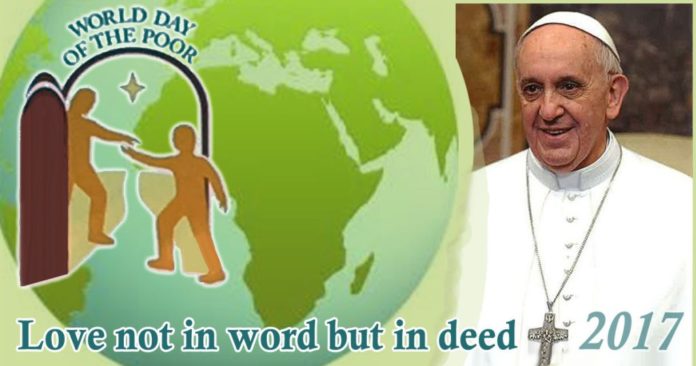
1st Annual World Day of the Poor – 19 November 2017

Pope Francis has announced the first World Day of the Poor to take place this Sunday, 19 November 2017.  The aim of this Day is to appeal to the consciences of believers, making them sensitive to the cries of the poor and their suffering.  The motto chosen for this year is, ‘Love not in word but in deed’.  We thank God for the volunteers of St Vincent de Paul locally in our parishes and the work they do in reaching out to the poor in our communities.  We give thanks also for the work of Trócaire which provides support to vulnerable people in the developing world.

Message of Pope Francis for 1st World Day Of The Poor – 19 November 2017

http://www.pcpne.va/content/pcpne/en.html


Address by Archbishop Eamon Martin at the launch of The Masses of Seán and Peadar Ó Riada: Explanations in Vernacular Chant by Dr John O’Keeffe

Go raibh míle maith agat, a Athair Uí Mhaoileanaigh, Uachtarán Choláiste Phadraig, Maigh Nuad, go raibh mile maith agat as an cuireadh cineálta a thug tú domh teacht anseo agus as an fhéile mhór a chuir tú romhainn an tráthnóna seo.

A chairde, nach sainiúil an teacht le chéile seo! Smaoinigí ar an fháth a thug orainn ‘theacht. Ár ndúil sa cheol ? Ár n-urraim don Ghaeilge? Ár suim sa liotúirge? Ár meas ar an Chanadh Greagóireach? Ár gchuimhne cheanúil ar an Ollamh Pádraig Ó Fiannachta? Agus ar ndóighe ár meas mór ar an obair iontach a rinne Seán Ó Riada, a mhac Peadar, agus Cór iomráiteach Chúil Aodha? Ár gcairdeas leis an Dochtúir Seán Ó Caoimh agus sinn ag smaoineamh ar a cheangal le ceol agus le canadh liotúirgeach?

Tráthnóna ceiliúrtha atá ar siúl againn, comóradh agus gabhail buíochais, agus is mór an phribhléid domh bheith ag comóradh in éineacht libh.

[Thank you Father Mullaney, President of Saint Patrick’s College Maynooth, for your kind words of welcome and for your hospitality this evening. Friends what a unique gathering this is! Consider what has brought us together this evening? Our love for music? Our respect for the Irish language? Our interest in the liturgy? Our appreciation for Gregorian chant? Our fond memory of Professor Padraig Ó Fiannachta? Our admiration for the magnificent contribution the late Sean Ó Riada, his son Peadar and the great Cór Chúil Aodha? Our friendship with Dr John O’Keeffe and our gratitude for his ongoing and unstinting commitment to liturgical music and chant? This is an evening of celebration, commemoration and thanksgiving and I feel privileged to be with you].

In 1973, my first year at Saint Columb’s College in Derry, I was introduced almost simultaneously to the beauty of Gregorian Chant and to the sacred music of Seán Ó Riada. As a twelve year old, I didn’t fully appreciate our music teacher’s insistence that in sacred music, the melody, however beautiful, must be the servant of the text, but it is a lesson that has stayed with me since. After all, the text in this case is God’s Word, the text is Prayer; the role of the melody is to lift the words up to God in praise or petition. And so when our schola sang the verses to the Christmas introit, Puer Natus Est, I sincerely believed we were not performing, but praying: Cantate Domino Canticum Novum – Sing a new song to the Lord! Likewise when we sang “agus maith duinn ar bhfiaca” from Seán Ó Riada’s brand new Mass, Ceol an Aifreann.

Speaking of new songs … we were proud to be singing the words of the Mass in our own language. Thanks to Seán Ó Riada we could now praise God in our mother tongue, as the Second Vatican Council had encouraged all God’s people to do. Ó Riada was already known to us – in the music room we loved to turn up the volume for Mise Éire – enjoying the quirkiness of Róisín Dubh played on the French Horn – but our teacher impressed on us that the greatest honour was to sing the prayers of the Mass in Irish words and melodies which were every bit as beautiful as the haunting and mysterious Latin chants that had been passed down to us over centuries.

Is amhlaidh is fearrde an onóir domh bheith páirteach sa seoladh an tráthnóna seo agus meas againn ar an obair scolartha atá déanta ag Seán Ó Caoimh ar a leaganacha cheoil, beagnach caoga bliain ó scriobh O Riada a chéad leagan cheoil den Ár nAthair. Agus is onóir eile domh sin a dhéanamh i mAlma Mater, Coláiste Phadraig Maigh Nuad.

[All the more honour it is for me, then, to be part of this launch evening for John O’Keeffe’s scholarly study of the Ó Riada Mass settings, almost fifty years since Seán first scribed his setting of the Ar nAthair. And to do so here in my alma mater of Saint Patrick’s College Maynooth].

Ó Riada’s Mass setting was a favourite during our seminary days – especially when Cardinal Tomás Ó Fiaich visited, drawing smiles all round with his gravelly intoning of the Ar nAthair! It is fitting that we should launch John’s work here in Maynooth, not only because of his tremendous enthusiasm and leadership of liturgical music here for the past quarter of a century, but also because of Maynooth’s unique connection with Ó Riada and Cór Chúil Aodha with names like Rev Professor Michael Sheehan (who composed the words of Ag Críost an síol in 1916), Professor Charles O’Callaghan whose lecture about Musicam Sacram at Glenstal Abbey inspired Ó Riada to think about composing for the liturgy, President Tomás Ó Fiaich (who invited the choir to sing here in the late 1960s), Professor Pádraig Ó Fiannachta (a great friend and encourager of the choir) and now of course Dr John O’Keeffe, whose foundational study of the music of Seán and Peadar Ó Riada is being launched here this evening.

Maynooth is proud of its distinguished history of sacred music and chant, going back to the time of Rev Heinrich Bewerunge and continued on by his successors – through Latin, into the vernacular, and down to the present day. Saint Patrick’s College and Maynooth University together remain at the heart of the practice and study of liturgical music and chant performance in this country.

Five years ago Pope Emeritus Benedict XVI spoke to a gathering of Church musicians. He reflected in particular on the relationship between sacred song and the new evangelisation. He pointed to the role that sacred music can have in helping others to rediscover God in their lives; how music can bring out the power of God’s word and the riches of the Christian message.

Pope Benedict spoke about Saint Augustine and many others who were attracted to God through the beauty of liturgical music and sacred song. He gave the example of Paul Claudel, the French poet and dramatist who at the age of 18 had a profound experience of God during Christmas Eve Vespers in Notre Dame in Paris. It happened during the singing of the Magnificat. He wrote: “At that moment, in a twinkling, my heart was touched and I believed. I believed … with such a strong conviction … that, after that moment, no reasoning, no circumstance of my troubled life, was able to shake or touch my faith.”

Of course we must realise that it is not our music or our singing that can convert others to God. It is God himself, working through the beauty and the words of our music and singing who can call people to him and give them the grace to respond to his love. Our role as music ministers, as music missionaries, is simply to bring the very best of our gifts, as Seán and Peadar have done, to the task of praising God, and then to leave the rest to God and the power of the Spirit to move others and build up their faith.

That is why Pope Benedict said we must try to “show how the Church may be the place where beauty feels at home”! The music we choose, the quality of our singing and our playing must be ‘prayer- ful’ and befitting of worship.

When music of beauty is chosen, which is inspired by our faith, and is offered to God from the very best of our efforts, God can work through it to touch the souls of others, nourish their faith, and bring them closer to him. And that is when our sacred music and liturgy becomes truly for the glory of God and the sanctification of the faithful!

Thank you Dr O’Keeffe, to Cork University Press, and to all who worked with you in helping to produce this important and scholarly work. Thank you Peadar and Cór Chúil Aodha in anticipation of the musical treat that is in store for us! Thank you Grainne and John’s family and friends who supported and encouraged him to complete this labour of love! And of course thank you John. Your unique combination of musical skills and interests, your vast expertise and keen insight into liturgical music, past and present, and your humble, warmth of character is a gift to Maynooth, to our country and to the universal Church. Continue to sing that new song to the Lord, continue to lift up our hearts and minds and souls to God, the source of all beauty and truth.

A chairde, is mór an onóir domh an leabhar seo ‘The Masses of Seán and Peadar Ó Riada: Explorations in Vernacular Chant’ leis an Dochtúir Seán Ó Caoimh, foilsithe ag Cork University Press a sheoladh, Comhghairdeachas leat, a Sheain, agus comhghairdeachas le gach duine a chuidigh leat.

[Friends, it gives me great pleasure to launch here at Saint Patrick’s College Maynooth The Masses of Seán and Peadar Ó Riada: Explorations in Vernacular Chant by Dr John O’Keeffe, and published by Cork University Press. Congratulations John, and to all who made this possible].

Speaking notes for the keynote address by Archbishop Eamon Martin for The Irish Catholic conference on education

Speaking notes for the keynote address by Archbishop Eamon Martin for The Irish Catholic conference on education

Gresham Hotel, Dublin


“Where is their soul? – Nourishing the evangelising mission of the family”

I have discovered that there is a setting on my mobile phone called “location services” which means that no matter where my mobile phone is, it can be tracked by satellite; my network knows I am here at the Gresham Hotel in Dublin.

I know a mother who keeps track on her teenage children via their mobiles – I suppose it is just the next step up from the baby monitor, or those reins you sometimes see harnessed to children on the beach to make sure they won’t stray too far!

In chapter seven of his 2016 Apostolic Exhortation Amoris Laetitia (The Joy of Love), Pope Francis cautions parents against being “obsessive” in wanting to control their childrens’ every experience and movement (AL 261).  Much more important, he says, is “the ability lovingly to help them grow in freedom, maturity, overall discipline and real autonomy … The real question, then, is not where our children are physically, or whom they are with at any given time, but rather where they are existentially, where they stand in terms of their convictions, goals, desires and dreams”.  Pope Francis continues: “The questions I would put to parents are these: ‘Do we seek to understand ‘where’ our children really are in their journey?  Where is their soul, do we really know?  And above all, do we want to know?”

“Where is their soul?” The question might seem old-fashioned but it lies at the heart of our discussions at this conference.  As Ireland prepares to host next year’s World Meeting of Families, it is appropriate to begin by reflecting on the role of family in education, and, in particular, on the calling of parents to be the “first teachers” of children in the ways of the faith.  Back in 1982, after the first Synod on the Family, Pope John Paul II described the right and duty of parents to be the first educators, as “essential”, “original”, “irreplaceable” and “inalienable”.  A loving family is therefore the “first school” for well-rounded personal and social development of children and young people (see F.C. 36).  Paul VI puts it in another way: Family life can be “an itinerary of faith”.  Family life can be “a Christian initiation and a school of following Christ” in which “all the members evangelize and are evangelized” (Evangelii Nuntiandi, 1976).

Two years ago I attended the Synod on the Family in Rome.  I heard delegates from all over the world speak about the importance of Family in the Church and in the world.  Going out to the Synod I was very conscious of the struggles and pressures that families face, and of the need for the Church today to minister pastorally to the Family.  What really impressed me at the Synod were those who spoke not just about mission TO the Family but also about the evangelising mission OF the Family – the Family as an agent of evangelisation.  It is primarily in the family that prayer, faith and values are nurtured, the choices between right and wrong are evaluated, that connections with parish and diocese are made and sustained.  In Amoris Laetitia 290, Pope Francis draws this out further:

“The family is thus an agent of pastoral activity through its explicit proclamation of the Gospel and its legacy of varied forms of witness, namely solidarity with the poor, openness to a diversity of people, the protection of creation, moral and material solidarity with other families, including those most in need, commitment to the promotion of the common good and the transformation of unjust social structures…”


When I came home from the Synod I reflected on the concept of an “intentional” Catholic Family.  An intentional Catholic Family might describe themselves like this:  “Our faith is obvious in our daily routines.  We go to Mass on Sunday and holy days; we pray together; we are conscious of the environment and we do not waste; we say the Rosary; we protect our children as much as we can from the influences of alcohol, drugs, internet addictions; we do our best to give good example; we have religious symbols displayed in our homes; we try to do penance of some kind every Friday; we regularly go to Confession; we fast for Lent and we abstain on Ash Wednesday and Good Friday; we visit the sick and elderly; we try to forgive one another after family quarrels; we do not tolerate violence or abuse of any kind in our home; we visit our family graves and we pray for our dead; we contribute to our parish, not just financially, but also by participating in the liturgy and in parish groups; we help the poor and marginalised at home and abroad; we support our Catholic schools; we talk about faith issues at home and we speak up for our faith at school, at work and in the community; we are pro-life and we support causes which promote Respect for Life; we pray for vocations and our children know that we would encourage any of them who felt called to serve God in the priesthood or religious life.

My description of an intentional Catholic Family might seem impossible to most, but I thank God that there are families like that in Ireland, families who try to have the courage to be different and who do so intentionally and deliberately because they are a Catholic family. Last month while celebrating Mass in one of our parishes, I was moved to see a young mother in the front row, cradling her infant daughter during the Post Communion hymn, and, as the choir sang, she rocked the baby to the music, all the time whispering prayer into the child’s ear. 

Such quiet confidence emerges when loving parents ask: Where is their soul?  Parents like this have a strong sense of their role in evangelisation and catechesis. Without becoming obsessed, they are vigilant about what their children are exposed to; they are conscious that they transmit the Gospel and influence the moral development of their children by their own witness and example.

Of course we all know that there are Catholic families who do not experience that enriching friendship with the person of Jesus Christ or have such an intentional relationship with the Church.  Ireland’s most recent Census (2016) figures confirm that we are moving from a society in which it was virtually impossible not to believe in God, to one in which faith seems to have become one human possibility among others.  In this context we must ask ourselves: “how can parishes and dioceses best support the evangelising mission of the family?”

Parish and diocese supporting the evangelising mission of the family
At the coffee stand in the airport recently the young pregnant woman who served me was reading a book about how to be a good parent.  It was touching to notice her apparent enthusiasm to learn all she could about motherhood – I wondered what opportunities and resources have we to help young Catholic parents like her to understand their role as ‘first educators’ of their children in the ways of faith.

Back in 1979,  the Irish bishops’ pastoral letter Handing on the Faith in the Home sketched out a pastoral strategy, built upon the three interdependent pillars of parish, home and Catholic school to sustain and consolidate the practice of the faith.  Almost forty years later, it is obvious that all three pillars have been rocked by the waves of secularisation which has swept across Ireland.

The landscape for evangelisation and catechesis has shifted dramatically.  Parishes are now called to support families across a broad spectrum of faith commitment: 

– the fervent, intentional family whose daily life is transformed by Christ; 

– the family which is supportive of Church, but has perhaps lost a living sense of the faith and does not practice regularly; 

– families who remain culturally Catholic but do not see themselves as active members of any parish community and who rarely attend Mass or the sacraments; 

– those who are indifferent or who passively no longer consider themselves members of the Church; and, 

– those who feel alienated and have chosen to reject the faith and actively resist all that it stands for.

“Where is their soul?” Our deliberations about Catholic education at today’s conference must not naively presume that home, school and parish are always adequately networking together to respond to the challenges of today’s Ireland.  Nevertheless, the Church is “Mission”.  It is our mandate and our privilege to put in place the infrastructure which will support handing on the faith and which can connect with the very diverse pastoral needs and situations of families today.

The National Directory for Catechesis, Share the Good News, emphasises that this task rests with the entire Christian community of parents and families, religious, deacons, priests, all exercising their particular callings in communion with the bishop.  It also calls for the introduction in every parish, or group of parishes, of lay catechists, suitably formed, who have a particular vocation or charism for catechesis.  The important conversations which Share the Good News encourages and inspires, have already begun in many dioceses and parishes, and the balance of home, parish and school in terms of contributing to evangelisation and catechesis, is being slowly reconfigured to meet the challenges of today.

Around the country new parish initiatives for catechesis and faith development are growing and developing – let me name a few: opportunities for RCIA, for lectio divina or Bible study; workshops on aspects of the social teaching of the Church; prayer groups, adoration apostolates, ‘Life in the Spirit’ seminars; adult Catechism and various theology courses; sacred music workshops and other opportunities to deepen the experience of worship.  It is true, however, that our efforts to introduce new catechetical resources and opportunities have been somewhat sporadic and experimental – the challenge now is to integrate these into a comprehensive and structured catechetical programme in each diocese.

There are moments in life when people are particularly open to deepening their knowledge and understanding of how to live the faith – I am thinking of pre-marriage preparation and supports during the early years of marriage and family life eg pre-baptismal courses; pre-sacramental formation (like Do This In Memory) for parents of First Communion and Confirmation children; Catholic ‘mother and toddler’ groups; Catholic parenting courses for parents of teenagers; youth retreats and associations; opportunities like the ‘Pope St John Paul II Award’ in which young people can grow in their faith journey whilst linking more closely to their parish community; networks like FOCUS (Fellowship of Catholic University Students) at Third Level; even our grandparents now have their own thriving association!

A coherent and systematic programme for catechesis in each diocese would help to structure, resource and maximise opportunities like these for people to grasp the whole truth about God’s plan for us; to deepen or recover their faith; to participate more fully in prayer and the liturgy; to draw out the moral and social consequences of witnessing to the Gospel.

The Catechism of the Catholic Church marks its 25th anniversary this year and it remains the doctrinal reference point for all catechesis.  Earlier this month Pope Francis described the Catechism as “an important instrument” which “presents the faithful with the perennial teaching of the Church so that they can grow in their understanding of the faith.  But it especially seeks to draw our contemporaries – with their new and varied problems – to the Church, as she seeks to present the faith as the meaningful answer to human existence at this moment of history”.

During his visit to Ireland in the summer, Cardinal Schonborn, the General Editor of the Catechism, explained how it is “an essential tool” for evangelising.  He explored how the Catechism is structured around the Creed, the Sacraments, the Decalogue and the Our Father; it holds in equilibrium: the ‘Church believing’, the ‘Church celebrating’, the ‘Church living’ and the ‘Church praying’.

Catholic Schools supporting the Evangelising Mission of the Family
It may be surprising that the keynote speaker at a conference on Catholic education would take so long to get to the point of discussing the role of Catholic schools!  However, by concentrating so far on the roles of parents, family and parish in handing on the faith and catechesis, I have been trying to emphasise that the Catholic school is not separate from, but integral to the mission and outreach of the family and the parish.  As the Congregation for Catholic Education put it, back in 1988, “the school as a whole is inserted into the evangelical function of the Church” (RDECS 69).

The question “Where is their soul?” is therefore a question for family, parish and school to ask TOGETHER, and to respond to, TOGETHER.  Perhaps in recent years we have come to rely too much on the Catholic school to be the ‘driver’ in this process, rather than affirming, embedding and building links between the family, the school and the local Church community.  It is little wonder that many teachers today speak of finding themselves left quite literally in loco parentis as the FIRST teachers of children in the ways of faith.

In choosing to send their children to a Catholic school, parents not only exercise their human and constitutional right to have their children educated in accordance with their religious beliefs, but they are also placing trust that the school community will assist THEM in accompanying THEIR children on their itinerary of faith.

For decades the Catholic schools of Ireland have played an essential role in supporting parents and families in their role as first educators of their children.  Despite a changed context, Catholic schools remain as vital centres for evangelisation and catechesis, closely linked to parishes and local communities.  It is reasonable, then, for boards of management of Catholic schools, in establishing their admissions criteria, to be concerned about ensuring that pupils from the local parish or group of parishes, are able to access their Catholic school.

There is no need to rehearse here our understanding of the distinctiveness of the Catholic school which has been well articulated, amongst others, by the Catholic Schools Partnership.  Just as there are ‘intentional’ Catholic families, so also there are ‘intentional’ Catholic schools.  An ‘intentional’ Catholic school is one which says loudly and clearly: This is who we are.  We are a Catholic school community inspired by Christ.  We know what that means for us; we celebrate our distinctiveness; we deliberately nurture and develop our Catholic ethos in the whole school community.  We can name and demonstrate the experiences, Gospel values, knowledge and understanding, attitudes and behaviours which we want to pervade everything that we do.

The difficulty for such schools, of course, is that young people are bombarded with messages that to be successful they have to be strong, powerful, popular, wealthy, self-reliant, healthy, fit, trendy and attractive; the world persuades them to focus so much on themselves and their personal interest; it holds up excellence and high achievement as the chief goals and dismisses, or even punishes, weakness or failure.  It is sometimes tempting for schools to buy into this prevailing culture, even to the extent of measuring their own success in terms of popularity or in league tables of examination results.

Catholic schools recognise however, that our young people will have to find their way in a world filled with aggression, war and torture, abuse, domestic violence, addiction, poverty, homelessness and austerity; they will have to cope as often with failure and disappointment as with success and achievement.

It is no surprise, then, that Catholic parents, families, and parishes will defend the importance of their school’s ethos, or ‘characteristic spirit’ against those who lack an understanding of it, or would actively seek to undermine it.  There is a reasonable concern that much of current educational policy in Ireland would promote a generic model of primary education and dilute the right of parents to have access to a school which unashamedly and intentionally lives by a faith-based ethos.

Catholic schools make no apology for asking, in turn, “Where is their soul?” and for valuing the spiritual, religious and moral dimensions of the person – they cannot stand back and allow faith and religion to be side-lined or privatised out of the realm of schools and education.

The Second Vatican Council explained it like this: “The Catholic School … tries to relate all of human culture to the good news of salvation so that the light of faith will illumine everything that the students will gradually come to learn about the world, about life, and about the human person (GE, 8).

The Catholic school is rightly described then as “a privileged place of intercultural dialogue” and of creative engagement between religion and the secular world.  (Educating to Intercultural Dialogue in Catholic Schools, 2013,6).  Of course Catholic schools are not simply ‘schools for Catholics’; the ethos of Catholic schools aims to be inclusive and welcoming; it is respectful of, and engages with, people of all beliefs and ideological backgrounds; it encourages the religious development of all in their own faith.

The founders of our Catholic schools were clearly inspired by inclusion, and in particular, a preferential option for the marginalised and poor.  I salute the role played by our Catholic schools as inclusive and caring communities throughout Ireland, and in many places leading the way in integrating migrants, pupils from disadvantaged backgrounds, and pupils with special needs.

It is important, however, that we continue to evaluate policies in our Catholic schools, like assessment and admissions policies, exclusion policies, special needs, uniform and bullying policies, to ensure that those who could be marginalised are not being neglected or unfairly disadvantaged.  We must always look out for those who are being ostracised or left behind.  Catholic schools must remain alert to inequalities in our educational system where too many of our young people, particularly the socially disadvantaged and those with greatest educational needs, leave without meaningful qualifications or opportunities, many of them in turn ending up marginalised or forgotten by wider society.  These are problems to be shared and tackled by all our schools, not just a few.

In a Catholic school, religion is therefore not an added extra to be fitted in during break time or twilight hours or during registration.  Everything that happens in the school community is rooted in the Gospel values of Respect for Life, Love, Solidarity, Truth and Justice; the Catholic school seeks to harmonise faith and culture.  In an ‘intentional’ Catholic school, Prayer and Worship form a natural part of the day; there will be opportunities during the year for Confession and for the celebration and adoration of the Eucharist.

The principals and boards in intentional Catholic schools will ensure that Religious Education is given a high priority in curriculum planning and resourcing.  In cooperation with diocesan advisers, it is important that there is a strong catechetical component to Religious Education so that all pupils can systematically learn the truths of the Catholic faith, be instructed in all aspects of the moral life and grasp the essentials of Catholic social teaching.  Other subjects can also help pupils engage in dialogue about the interaction of faith and culture, promote a culture of life, love and respect for creation and develop a sense of wonder through the beauty of religious art and music.

We should not neglect the contribution that faith schools make to society – as the Commission for Catholic Education and Formation of the Irish Bishops’ Conference put it recently (May 2017 response to NCCA Consultation, p 20): 

“The isolation of Religious Education from the rest of the curriculum also underestimates the ethical contribution that Religious Education can make by: promoting the dignity of the individual; developing personal identity in a way that also highlights the social dimension of human identity; promoting human rights and responsibilities; highlighting the importance of human relationships; developing social justice and climate justice, with its particular emphasis on the preferential option for the poor, and providing a foundation for social cohesion and solidarity”.  


One wonders how a State – which appears to recognise the importance of ERB and Ethics – at the same time appears to want to remove Religious Education from the core curriculum.

Concluding Remarks
I have presented in this address a vision of families, parishes and schools responding together to the question about our young people: “Where is their soul?”  It is a challenging task. Religious instruction or catechesis in a Catholic school will only mature as it is lived out in family and Church community of faith.  We should not ignore the fact that increasing numbers of Catholic children are no longer attending Catholic schools.  This presents clear issues for parents, families and parishes in ensuring that these children are receiving appropriate religious instruction and are being suitably prepared for the sacraments of Eucharist and Confirmation.  For example, as ETBI (Education and Training Board Ireland) has taken a decision to end faith formation during the school day in its Community National Schools, and as it has been determined that programmes such as the Goodness me, Goodness you are not adequate as a Catholic religious education programme or for Sacramental reception, the challenge remains for parishes and dioceses to support families whose children attend these, and other schools which are not Catholic schools.

Situations like this will perhaps be the catalysts to restore the core responsibility for evangelisation and catechesis in Ireland to parents and family, assisted appropriately by the living parish community.  As Ireland prepares to host the World Meeting of Families next August, we will all benefit from a renewed focus on that question: “Where is their soul?”, a question that is ultimately one for parents, who are the first educators of their children in faith, but not the only, and certainly not lonely ones.

In all of our deliberations, whether it be at home, or parish, or school, let us remember the ‘first proclamation’, which Pope Francis stated in his 2013 Apostolic Exhortation, must ring out over and over from the lips of the catechist: the proclamation that “Jesus Christ loves you; he gave his life for you; and now he is living at your side every day to enlighten, strengthen and free you” (Evangelic GaudierThe Joy of the Gospel, 164).

To conclude, may I invite you to join me now in the official prayer for the World Meeting of the Families:

God, our Father,
We are brothers and sisters in Jesus your Son,
One family, in the Spirit of your love.

Bless us with the joy of love.

Make us patient and kind,
gentle and generous,
welcoming to those in need.
Help us to live your forgiveness and peace.

Protect all families with your loving care,
Especially those for whom we now pray:

[We pause and remember family members and others by name].

Increase our faith,
Strengthen our hope,
Keep us safe in your love,
Make us always grateful for the gift of life that we share.

This we ask, through Christ our Lord,

Amen

Mary, mother and guide, pray for us.
Saint Joseph, father and protector, pray for us.
Saints Joachim and Anne, pray for us.
Saints Louis and Zeelie Martin, pray for us.
Pope John Paul II – Resources

Launch presentation to show to pupils before registration

JP2 Awards Launch Presentation

Awards booklet

Faith Award Handbook Updated 2020

Catechises Session Reflective Journal

ADYC_Award Info sheets


SESSION 1: Do not be Afraid video:

SESSION 2: Shine your light video &Talk that Pope John Paul II give to the young people of Ireland during his visit:


Pope John Paul 2 talk in Galway