Monday, February 9, 2026
Home Blog Page 161

Fr Matt Union

Fr Matt Union description here …

Deaf

Since the departure of Sr Carmel McEvoy who had worked with the deaf community in our Diocese for over 30 years, a new coordinator was appointed to serve the deaf community in the Northern dioceses. Ms Denise Flax was formally commissioned by Cardinal Sean Brady at a special Mass for the deaf in the summer of 2007. Denise works alongside the chaplains to the deaf in the Northern Dioceses. Since she was appointed she has worked very hard getting to know the deaf community, helping to plan the various masses. Denise has introduced recreational days, days out and workshops.

In our own Diocese there is a bi-monthly Mass for the deaf. These are arranged by Denise, the Chaplain, Fr Garrett Campbell, and the Clarke family. This Mass is celebrated in the Chapel of St Patrick’s Grammar School. To help facilitate the needs of the deaf community Denise has the text of the Mass on PowerPoint and Paula Clarke signs the Mass as Fr Campbell celebrates. These masses are not only prayerful but also social experiences for the community. After each mass there is good social interaction, where the community have a chance to communicate and share experiences. The Clarke family and friends always arrange tea, sandwiches and cakes after each celebration. At Christmas the Mass is celebrated by the Cardinal, followed by a Christmas dinner.


When there is no Mass in our Diocese, Dromore Diocese and the Diocese of Down and Conner offer Mass for the deaf community. There is much support between the Dioceses. We have been greatly supported over the years by Fr Paul Strain of Down and Conner. Fr Paul and Sr Carmel worked very well over many years and as a Diocese we are indebted to this work by Sr Carmel McEvoy.

The Chaplain’s contact details are:

Rev Garrett Campbell CC,
Parochial House,
17 Eagralougher Road
Loughgall,
Co Armagh, BT61 8LA
Tel (028) 3889 1231
Fax (028) 3889 1827
E-mail: [email protected]

Aras Mhuire

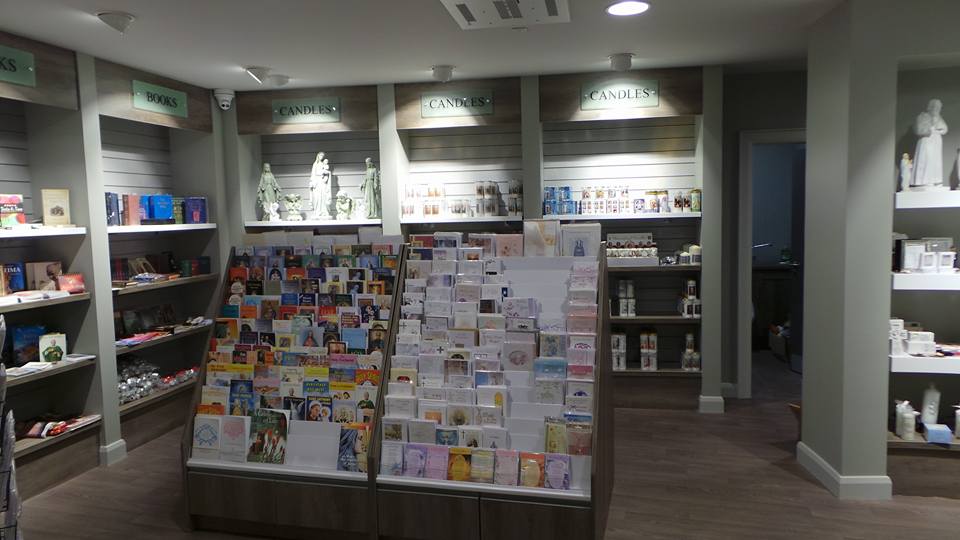
Aras Mhuire Oratory and Shop

Address                –   14 Irish Street, Dungannon
Tel no                   –   028-87726852
Email                    –   [email protected] 

Aras Mhuire shop supports the Oratory and Dungannon parish financially by the sale of a wide range of religious goods including books, candles, statues, religious pictures, rosaries, plaques, grave accessories, Christening robes, First Holy Communion and Confirmation goods.  It also offers a large selection of gifts for weddings and Christmas and other occasions.

There is Eucharistic Adoration in the Oratory from Wednesday to Saturday during shop opening hours.

Volunteers undertake one hour of worship each week, but many people call into the Oratory on an informal basis to light a candle, say a prayer and spend a few quiet moments with the Blessed Eucharist.

The hours of opening are Wednesday, Thursday, Friday  10:00am-4:00pm

Saturday – 10:00am – 3.00pm. The shop is closed 1.30pm-2.00pm daily for lunch.

Apostolic Work

Apostolic Work is a Voluntary Organisation made up of people who work in different ways to provide help for those who suffer and are deprived. It began in Belfast in 1923 to help missionaries in their work of Evangelization by supplying them with Vestments, Sacred Vessels etc. and with material and financial help to carry out their work of spreading the Gospel. It later spread to the Archdiocese of Armagh under the leadership of the late Margaret Colgan who started Branches in approx. 30 Parishes.

Eighty-five years later Apostolic Work continues to receive and respond to numerous appeals from such Missionaries whose work is still so necessary today. Dedicated members knit and sew and make Vestments etc. as well as garments, which can be used to fundraise. This money goes directly to where it is most needed for Churches, Clinics, Food, Water, Medicines, Street Children and those in great need. In this Archdiocese the centre is 13 College Street, Armagh, from where all materials and finances are dispatched.


Aifreann Gaeilige

Aifreann Gaeilige description here …

Accord

MISSION STATEMENT

Empowering People
Fostering Relationships
Caring for Couples facing the
Challenges of Christian Marriage
This is the work of ACCORD
In today’s world

VISION STATEMENT

ACCORD is an agency of the Catholic Church providing a nationwide service to couples preparing for or seeking a deeper commitment within the sacrament of marriage.

ACCORD is committed to providing a quality service. Personnel, coming from a wide variety of backgrounds, are appropriately trained.

ACCORD responds to the challenges facing Christian marriage today and affirms its value in an ever-changing world. It empowers couples to explore and reflect on:

  • the essential elements of their marriage.
  • the purpose and value of their choices within a committed relationship.

ACCORD serves the pastoral needs of couples at different stages in their relationship.
Preparation for marriage in a Christian context focuses on the essential components which foster a good couple relationship:

  • lifelong commitment.
  • communication and conflict resolution skills
  • responsible parenthood within a faith context.
  • time and resource management.

Ongoing support throughout marriage facilitates:

  • the development of strategies for the emotional, spiritual and psychological well-being of couples.
  • reflection on the Christian experience of love, commitment and family life.
Relationship counselling is provided for couples as well as individuals in a couple relationship in a caring and confidential manner. It is a twofold process enabling clients to identify and acknowledge difficulties in their relationship and to discover the inner resources to deal with them.
CONTACT US
Armagh Branch: 1 Tavanagh Avenue,
Portadown, Co Armagh, BT62 3AJ
Tel (028) 3833 4781
Chairperson: Edward Lavery
Chaplain: Rev Seán Larkin

Drogheda Branch: “Verona”, Cross Lane,
Drogheda, Co Louth
Tel (041) 984 3860 Fax (041) 983 1215
E-mail [email protected]
Chairperson: Rhona Kelly
Chaplain: Very Rev Martin Kenny,PP

Dundalk Branch: St Patrick’s, Roden Place,
Dundalk, Co Louth
Tel (042) 933 1731
Chairperson: Mary McDonnell
Chaplain: Very Rev Pádraig Keenan

Pastoral Plan

shepherdboy.gif
shepherdboy.gifOn May 20th 2004 Archbishop Sean Brady announced his intention to have a diocesan pastoral plan developed in the diocese.The Armagh Diocesan Assembly of Priests in Bundoran in November 2004 addressed this topic with the help of Fr Jack Finnegan who acted as facilitator. By the end of the conference the assembly had created a draft vision and mission statement.

This was followed by extensive consultation process, which was held during Lent, 2005. People from every parish were invited to a consultation gathering that was being held in their part of the diocese. The focus question for these gatherings was: what do we as Christian need to be attending to over the next three years? In all, over 2000 people participated. The outcome was the formation of nine working groups to address the major areas of concern identified in the consultation process. They are:

  • Faith Formation
  • Youth Ministry
  • Prayer and Spirituality
  • Meaningful Liturgy
  • Developing the Role and Ministry of Women in the Church
  • Family Ministry – Life Issues
  • Outreach to Others – Ecumenism and Interfaith Dialogue
  • Leadership and Training – (which includes: Diocesan / Parish Survey – Attending to Diocesan and Parish Structures – Parish Pastoral Councils.)

In presenting the pastoral plan to the people of the diocese, Cardinal Brady said:
I have no doubt that implementing this pastoral plan will be a learning experience for all involved, and that it may well lead us in directions totally unforeseen. Success will be slow and at times hard to quantify, but I know that with the assistance of people of faith and goodwill, much can be achieved to help spread the Gospel of Jesus Christ and make the presence of His love and the consolation of His truth more effective in our world through the mission of the Church.

The work of the nine working groups is ongoing and occasionally updates from the working group will be available in this section of the diocesan website.

Pastoral Plan Working Groups

Pastoral Plan Updates

Prayer for the Pastoral Plan

Pastoral Life

“They devoted themselves to the apostles’ teaching and fellowship, to the breaking of bread and the prayers” (Acts 2:42). This description of the activities of the first Christians has served as the basis for describing the key tasks to be carried out by the Christian Community. In our time these key tasks can be named as: liturgy and prayer, education and formation, community building, outreach, leadership and administration. The heart beat of the pastoral life of the diocese is found in the sixty-one parishes. As well as this there are many groups and agencies who are committed to supporting and promoting pastoral initiatives at parish, regional and diocesan level in service of the reign of God. Some are listed here, others, such as education, are found in other parts. If you belong to an agency enhancing the pastoral life of the diocese, but are not included on our site, please contact us for inclusion.

19 Aug – Mass for Justice and Peace – Milwaukee Irish Fest 2007

MASS FOR JUSTICE & PEACE
Milwaukee Irish Fest 2007

Sermon by
Cardinal Seán Brady

My dear friends in Jesus Christ,
It’s a pleasure to be with you this morning. We come together to give thanks to God for all his blessings but especially for the success of this year’s Irish Fest. As Archbishop of Armagh, it is an honour to be here as part of this celebration of all things Irish. It has been a spectacular event. I congratulate all those who organised it and wish you continued success for future festivals.

When I was growing up on the family farm in County Cavan, the name MILWAUKEE was already well known to me. It was the name of the mower, with which with we cut the grass. This grass made the hay, which fed the animals, which kept the family alive. All of this took place during the summer holidays, a time of great peace and care free enjoyment. It was a time when I really appreciated the joy of living on the land.

What a joy then to discover that the original meaning of the name Milwaukee is ‘a rich and fertile land, abounding in rivers and lakes.’ Looking around this beautiful place I can understand why. It not only reminds of my childhood but also words of the Psalm: ‘fresh and green are the pastures where he gives me repose, near restful waters he leads me, to revive my drooping spirit’. I can think of no more appropriate place to celebrate the things of Ireland, with its lakes and glens, its fields and mountains and – of course – its forty shades of green!

Ireland too is a beautiful place. I hope that many of you in future years will come and visit. The link with our relatives of Irish descent in the United States has been a critical part of Ireland’s success in recent years. I thank all of you who have kept those links alive. I also thank you this morning for ensuring that this Mass for Justice and Peace is the highlight of the Irish Fest celebrations. There is no more urgent task in our world today, than to build the structures of justice. There is no more pressing need than to find the way to peace – peace of mind, peace of heart, peace of soul – social, political and economic peace on an international scale.

And the good news I bring to you from Ireland today, is that such a peace is indeed possible. As many of you know, for centuries Ireland has been marked by conflicts over history, resources, power, land, identity, culture and religion. These are the fault lines around which all the conflicts of our world take place today. But in recent years we in Ireland have discovered how to set aside our centuries old conflict and create a better way. It is not a finished work – there are many challenges ahead – but with the disposal of paramilitary weapons by the IRA and the creation of a power-sharing government in Belfast in recent months, a real and substantial peace is emerging among us.

In the second reading the author tells us, ‘We are surrounded by so great a cloud of witnesses, let us… persevere in running the race that lies before us…’. We thank God today for those many witnesses who have persevered in the difficult work of justice and peace. I am thinking of people like Senator George Mitchell who brokered the peace in Ireland. I am thinking of those many peace-makers throughout the world and especially in the USA, who continue to work for peace in Ireland and across the world. I am also thinking here of that great crowd of witnesses who persevered in the faith when they came to Milwaukee at the time when the Diocese was founded in 1843. At first the Catholics came, mainly from Germany and then, after the Great Famine of 1847-48, from Ireland. Later the Italians and the Poles followed of course.

Wherever they came from, they all met opposition – fierce opposition – in the form of segregation, isolation and misrepresentation. This was an opposition sponsored by various groups such as the infamous ‘know-nothings’ and the ‘nativists’. It was an opposition that was confronted and eventually overcome by a Church that became well organised. It established parishes, schools and Catholic societies. These are the same parishes, schools and Catholic organisations that you continue to support so generously today. It was a Church that eventually, through a vigorous and informed Catholic press, succeeded in making Catholics respectable in the eyes of the public.

These heroic witnesses from your past remind us that the work for justice and peace can bear fruit. Things can change for the better. We also have the powerful witness of St. Patrick. As you will recall, he was kidnapped and cruelly dragged to our shores at the tender age of sixteen. After a number of years he escaped back to his family, only to return among us again as a great missionary, fired up by the call of the Gospel. Like Jesus, how he wished that fire of love would blaze in the hearts of the Irish people. And when, like Patrick, you are consumed by the love of God – all things are possible! He made peace with the people who had once held him captive. He forgave those who maligned him in his mission. He persevered to the end in following Christ’s call.

Another group of who persevered in following Christ’s call, another great cloud of witnesses set before us, are your fore fathers and mothers of generations back who set sail for this great land of freedom and hope. The first Catholics that came to this region from Ireland probably didn’t have a lot by way of formal religious education. One thing they did have was a strong and tender love of the Mother of Christ – the most loving and beloved of all women. They came from an Ireland where, due to the penal laws, their parents didn’t have the opportunity to go to Mass often. So the Rosary was their favourite form of prayer and devotion. They learned to love God and neighbour by meditating on the love and charity of Christ’s mother. Mary, who loved Jesus most, suffered more than all others on Calvary. In that immense suffering Mary learned compassion and shared compassion with others.

This compassionate love, this ability to feel and respect the needs of others, shown to us by Mary, is the road to the peace of Christ – to the civilization of love – of which Pope Benedict speaks so eloquently in his first encyclical Deus Caritas Est.

In our Gospel today, Jesus is impatient to see this civilisation of love take root among us. The fire which he seeks to bring to the earth is the fire of the Holy Spirit, the consuming fire of selfless, transforming love.

Of course Jesus has now suffered his passion and his saving death. He has triumphed over death and returned to the Father and from there he has sent his Holy Spirit – the Spirit of the Risen Christ. Because all this has happened, each one of us is now faced with the choice. Do we allow the fire of the love of the Spirit of the Risen Christ to be lit in our hearts or do we not? That is where the division comes in – some people will welcome that Spirit of Love – others will reject it. For, if we believe in Jesus Christ, and in his teaching, well there can be no room for prevarication. Each one of us has our responsibility to act in accordance with the grace of the Holy Spirit offered to us. And when we accept that grace, when the gifts and fruits of the Holy Spirit take hold among us – the gifts and fruits of love, joy, understanding, patience, perseverance – then peace can take hold more rapidly than we ever thought possible.

In Ireland we have seen this. The heroes of the peace process are those who, like Mary, have suffered and deepened their faith through their suffering. Because of their suffering, they are compassionate people – people who have learned through their own suffering to be sensitive to the sufferings of others.

I think of the example of a lady in my own diocese whose three sons were shot dead many years ago. They were not engaged in violence and now their mother prays often for those who shot her sons.
Tragically the opposite is also true. Some people choose to remain locked in isolation and fear. They put their trust in domination and threats. They look for safety and security in physical might. They put their hopes in one day defeating or controlling their opponents.

Of course this can become an almost unbreakable cycle. The search for military security generates further suspicion and fear. That is why it is always easier to talk your way into conflict than work your way out it. The question of who was right and who was wrong, what started the conflict and what the original issues were, becomes ever more confused in the fog of violence and revenge.

We desire peace from the depths of our hearts. But what kind of peace do we want? Peace is not the just the absence of war. It is not just a question of trade-offs such as “I will scratch your back if you will scratch mine”. It is not simply the maintenance of a balance of power between enemies. The peace of Christ is built on a correct understanding of the human person. It is basically a matter of truth and integrity. It is a matter of ‘I will do this because it is the right and true and loving thing to do; not for what I am going to get out of it’. The peace of Christ is built on justice and charity – on what is the right and loving thing to do.

Unfortunately, the link between justice and charity is often missing. It is too often missing from the purely secular and political view of conflict resolution. Of course politicians must, and do, call for fair play for their own constituency. There is absolutely no risk to their elected base in that. But that is not enough. That on its own will never deliver lasting peace. The courageous and loving thing is to call for mutual respect and understanding. We also have to appeal for compromise and forgiveness. We have to rise above our fears, our ignorance and our sectarianism. To do this we need to build relationships across the many divides in our society and in our world. We need to recognise the rights of the other side. All of this draws us well beyond the limits of self-interest towards the possibility of a shared future.

What can help to break this sometimes seemingly endless cycle of violence – a constant appeal for prayers for peace. The constant appeal to all that is best within the culture of those involved in the conflict. The appeal is to go back to our shared humanity and to remember that we do, in fact, depend on each other for so much.

In the Irish context, this creation of a culture of peace was critical. It arose from the shared Christian values of the Catholic and Protestant communities. Brave ambassadors for peace, both lay and clerical, crossed over the community divide. They did so often at great risk to themselves. They were trying to understand the other side through dialogue. They wanted to build trust and dispel suspicion. This culture was best illustrated by what I see as the real heroes of the Northern Ireland conflict. I am talking about the many, many totally innocent people who, in the midst of great tragedy and pain, issued heroic words of forgiveness.

I think of Gordon Wilson who lost his daughter in the Enniskillen Poppy Day bombing appealing to those responsible to desist. I think of Michael McGoldrick, whose son, Michael Jnr, was shot as he went about his taxi driving business appealing at the graveside for those in conflict to throw their hatred and their bitterness into the grave with his dead son. They appealed for no vengeance, no retaliation, no reprisals, towards those who had so cruelly harmed them. They echoed in our time, for our day, the words of the prophet Jeremiah “I myself know the plans I have for you, a plan of peace and not of war, to give you a future full of hope”.

The world stands today at a decisive crossroads. Some may wish to sensationalize the situation. They do so by speaking of a clash of civilisations. Others refer ominously to a final conflict between the great ideologies of the planet. I prefer to stick by Jeremiah’s description – a future full of hope. I believe we are at a moment of great opportunity, not of destruction. Nevertheless, a stark choice lies ahead –
Do we choose the things that build trust and reduce fear?
Do we opt for policies that deepen anger and increase suspicion?

One thing appears certain. The future for all of us is going to be global. The critical question is: Will it be a future of global solidarity or of global competition, a future of global compassion or of global aggression? That is the kind of question that will bring about the division of which Jesus spoke. In a world of finite resources, the answer to this question will determine the kind of peace that will follow – the peace of God or the illusory peace which the world brings.

However, I have the impression that something important is lacking right now in the international efforts at conflict resolution. Perhaps it is the shared understanding of peace. I mean an understanding that would be rooted in the values and beliefs of the three great traditional religions, Judaism, Islamic and Christianity. I believe that such a shared vision is not only possible but essential. Each tradition has much that is valuable to offer to it. Producing this vision and committing ourselves to living it, is a compelling priority. It is compelling because the future of our world depends upon it.

We need to agree an understanding of what that plan of peace might involve. We must give our wholehearted commitment to ensuring that the vision becomes a reality. Perhaps the United Nations could have a role in facilitating this dialogue between the faith traditions of the world and developing a vision for peace. I think this was part of the thinking of Pope John Paul II when he established the Inter-Religious Day of Prayer for Peace initiative. As Christians, Jews and Muslim, this is the greatest glory we could give to God and the greatest witness we could give to those who do not believe”.

The search for this peace will require our perseverance as we learned in Ireland. Like young Jeremiah, thrown into the well, the struggle for justice and peace will always suffer many setbacks along the way. But let us remember that those same people who threw Jeremiah into the well, eventually had a change of heart.

It is for that reason I say to you that while there are obviously many challenges facing our world today, there are more reasons to hope. In the words of the famous Wisconsin poet of the 19th century, David Fletcher Hunton, written as the gazed upon the beauty of this Lake Michigan beside us,

This is a grand prophetic time!
It gives us hope for joys sublime,.
Within a fairer, bright clime,
Where shadows are unknown!

Or in the words of the Irish mother to her fearful children as they left their beloved homeland for the promise of this great land:

Believe in hope because God is in your future
He will not let you down.

Perhaps your own forefathers shared those sentiments as they too left to come to this place. Believe in hope because God is in your future. He will not let you down.
Thank you and thank God that He is with us and will be with us to end of time.

17 Aug – The Catholic Church in Ireland in 2007 – Lecture given at Milwaukee Irish Fest 2007

THE CHURCH IN IRELAND
in 2007
A presentation by
CARDINAL Seán Brady
MILWAUKEE IRISH FEST 2007

Ladies and Gentlemen:
Thank you for your warm welcome. It is a great honour to be here as part of Milwaukee Irish Fest 2007. I would like to express my particular thanks to the Committee, to Fr Michael Maher and Jane Anderson for their invitation to be here and their very generous assistance in making all the preparations for my visit. Thanks also to Archbishop Dolan for his warm welcome and hospitality. I am honoured that you could be here this evening and that we will be concelebrating the Mass for Justice and Peace tomorrow.
I don’t think I have ever come across such a wide-ranging celebration of all that is best in Irish culture: music, dance, poetry, history, politics, art, literature and so much more – a truly outstanding programme of events. As an Irish man it makes we very proud to be here. Comhghairdeas agus go raibh mile maith agaibh go leir.

The festival itself, the Féile an Phobail, has a long and cherished place in Irish culture. At the heart of it is the joy of being with others. You cannot have a festival on your own! Irish people love to celebrate life with others. Whether in the Parish or the Ceili Mor, in the pub or at the football field, we have a strong tradition of getting together to enjoy the pleasure of each other’s company. Perhaps this is why our well known Patron Saint, Saint Patrick, was so successful in converting us with the shamrock. The idea of a God who was a community of persons living in what the Greek Fathers of the time called perichoresis – a circle of eternal dance – would have had an inevitable attraction to the Irish temperament! I don’t know if you knew that we were also the first to invent Karaoke – or the sing along – except we called it the ‘come-all yee’, songs written so that everyone could join in – whether you could sing or not! I am sure you heard at least a few of them over the last four days!

It seems that this reputation of the Irish as a people with a strong sense of community is not just the stuff of myth and legend! In 2005, the Intelligence Unit of the Economist magazine undertook a ‘Quality of Life’ survey. I covered the 111 most developed countries of the world. The survey combined data on incomes, health, unemployment, climate, political stability, job security, gender equality and what the magazine calls “freedom, family and community life.” To the surprise of many, it was Ireland which emerged with a top score of 8.33, well ahead of second-place Switzerland. The U.S. slipped to 13th place in the survey. Some big economies fared quite badly. China was in the lower half of the league at 60th, while Russia scraped in toward the bottom at 105th. The U.K. ranked the lowest out of the E.U. in terms of overall quality of life, chiefly due to the high rates of social and family breakdown recorded in official statistics.

What is worthy of note is the reason given by the report for Ireland’s success. “Ireland wins,” the survey said, “because it successfully combines the most desirable elements of the new (including the fourth highest gross domestic product per head in the world, low unemployment, political liberties etc.) with the preservation of certain cozy elements of the old, such as stable family and community life.”

There are echoes here of something I read about Milwaukee on an internet tourist site: ‘The city,’ it said, ‘is unique in the way it continues to blend the old and the new.’ There are also echoes of the parable in which Our Lord compares the Kingdom of God to the master of a household who brings out of his treasure what is new and what is old!’ (Mt 13:52).

It is certainly within this tension between old and new that the Catholic Church in Ireland, North & South, finds itself. Ireland is in the throws of a rapid transition between old and new at so may levels: economic, cultural, political, social and of course religious.

I thought the best way to proceed this evening is to describe some of the key elements of this transition in quite broad terms and then I am happy to take questions along with my two Colleagues here, Fr John Quinn and Fr John O’Donnell.

Together we have many years experience of priestly ministry and so together we would be happy to fill in some of the details about what is of most interest to you during the questions.
The first major axis of transition in Irish society in recent years, I would suggest, has been what I would describe as – ‘The erosion of external authority’;

The attitude to Polticians, Gardai, Financial Institutions, the Church and other traditional sources of social and moral authority in Ireland has changed dramatically in recent years.
This was a result, in part, of the multitude of investigations, many of them still ongoing, in to how these institutions had managed their affairs.

Nothing has yet emerged to replace the cohesion and stablity that these institutions once brought.
They have been partly replaced by the ‘authority’ and influence of the ‘mass media’ – the commentariat!
Though there may be signs that they too are losing their easy grip – people are becoming more cynical about the motives of the media. Afer all, the bottom line for the media is circulation and audience figures rather than the good of society. This may take time though.

In terms of the Church, the impact of the last thirty years has been particularly dramatic, no doubt because its role in society, at both religious and secular levels had been so comprehensive.
The Catholic Church in Ireland had always been characterised by a high level of religious practice, unique in Europe. A sense of Christian faith was woven into the Irish psyche. It even manifested itself in the day to day expressions of the Irish language which came as second nature to us. The authority of the Church was unquestionned. Bishops, priests and religious were treated with great reverence and respect. Too much revenece and respect! Polticians and the media would have been slow to go against the position of the Church on a given issue.

All of this has changed dramatically in the last thirty years and increasingly so in the last decade. The seeds of it were already evident in the challenges to the position of the Church in key public votes on social and moral issues in the 70’s and 80’s. The slow decline in the very high rates of weekly Mass attendance, the trauma and scandal around revelations of clerical child sexual abuse accelerated this process dramatically in 1990’s.

While at the beginning of the 1970’s weekly Mass attendance would have been as high as 90%, now it would be closer to 50% (though it is worth bearing in mind that this is still high by European standards) and vocations to the priesthood and religious life have fallen dramatically in the same period (though there are still more priests in Ireland than there were during the famine or the penal times). Major restructuring of Parishes is imminent in many Dioceses.

In this sense it may be accurate to say that in Ireland there is a crisis in religion. If we take religion as a body of doctrine and a system of practice, then we see the decline.

For this reason it is a time of great challenge for the Church and but also of great opporunity for the Church. There are also many signs of hope! I will come to these at the end.

The second axis of change I would describe as the challenge of ‘Peace and Prosperity’:

First of all let me say a little about the Peace Process In the North:

You will no doubt be aware of the dramatic and positive developments in the search for peace in Northern Ireland in recent months. I hope to speak a little more about it during my sermon tomorrow. But suffice to say for the present that the speed with which peace and stability has taken root has been remarkable. All the evidence is that the new Power-sharing Assembly at Stormont in Belfast is working very well. People are taken aback at how well former adverseries such as Ian Paisley and Martin McGuinness are working together in the common interest.

As some of you will know I had my own historic meeting with Doctor Paisley only a few months ago. It was a very positive experience. We discovered that we shared the same views on many social issues including poverty, the importance of marriage and the family, the right to religious freedom, to faith based education and so on. It was another example of how much is to be gained from simply meeting with others. Patient dialogue, developing mutual understanding was one of the keys to finding peace in Northern Ireland.

We have also had the quiestest marching season for many years. Just last week the British Army officially ended what was known as ‘Operation Banner’. This was the name for the British Army’s role in Northern Ireland since the start of the Troubles in 1969.

The tourist figures for Northern Ireland have risen dramatically this year. We should not be surprised – it is a very beautiful place. I hope that many of you will come and visit. It was the support of others from outside, especially those like yourselves with an interest in the Irish situation which made a critical difference in the search for peace.

I would like to take this opportunity to thank you for your support for the Irish peace process. For your prayers and for the active engagement of so many US citizens and political representatives in supporting initiatives for peace. You too deserve not only the credit for what has been achieved but also the gratitude of people like myself and others who now enjoy a whole new atmosphere of peace and stability in Northern Ireland.

I would also like to take this opportunity to commend the Irish Government for establishing an intiative on International Conflict Resolution by which the lessons of the NI peace process can be shared across the world.

You can actually feel the better atmosphere around cities like Belfast and Derry. You can really sense the new optimism.

What we now need to do is build on the peace. We need to address the legacy of the past, particularly in terms of the legacy of poverty. Northern Ireland remains one of the most deprived parts of Europe because of the legacy of conflict. Yet it has one of the most highly qualified workforces and one of the best infrastructures to support development of any part of Ireland or the UK. I hope that many of you will encourage US companies and entrepeneurs to invest in Northern Ireland. I call on the British Government to provide further incentives to such investment, including bringing Corporation Tax into line with the rate in the South of Ireland.

Northern Ireland is part of the good news of modern Ireland. I believe that there are many lessons about making peace there which can contribute to the search for peace in other parts of the world. You may wish to ask me more about this during the questions!

Now let me say a litte about the growth of prosperity in the South:

Ireland, as the Economist ‘Quality of Life’ survey suggests, has experienced unprecedented economic growth in the last twenty years. This is fantastic and very welcome achievement for a country that for too long was marked by economic emigration, not least to the United States. We should thank God for this prosperity and its manifold benefits. I am confident that, despite the normal ups and down of economic fortune, Ireland will continue to be one of the most prosperous countries of the world because its prosperity is rooted in the great talent of its young people and in the standard of our education.

This present prosperity has certainly lifted the burden of hopeless impoverishment from many families. It has provided and enhanced social services to the public and fuelled much investment on infrastructure. We now see Irish people displaying talents of enterprise and business acumen quite unsuspected a generation ago. We have also experience the benefits of increased economic migration into Ireland of people from across the expanded European Union. It is estimated that there are over 300,000 workers in Ireland who have come from Poland in the last ten years. That is very sizeable when one considers that we have a population of 4 million. Other migrant and ethnic groups are also increasing rapidly in number making Ireland much more ethnically diverse.

One of the many benefits of this increased migration is that many of the new Irish who have come to our shares come with a very strong faith commitment. In many of our inner city Parishes it is the new migrant communities who have brought new life to the faith of these parishes.

However, for all the benefits of our new found prosperity, there is a real danger that we are becoming intoxicated with it and with the confidence it instills that there is more of the same ahead. It is the ideal atmosphere. Prophets of doom will not get a hearing. We currently have a young generation which has not had to cope with hardship or with any downturn on their life expectations.

And this brings me to the third axis.

The third axis of change I would describe as ‘The new challenges to old values’:
Along with increased prosperity, have come new challenges to the very values which the Economist ‘Quality of Life’ survey suggested gave us the highest score – the values of family and community.

While it would be wrong to exaggerate it, there is growing concern about evidence of a gradual breakdown in social cohesion. This comes from a cultural shift from emphasis on community and family to an emphasis on the happiness of the individual, particularly of the individual as a consumer. It is also tied up with a notion of freedom of the individual without reference to our responsibility to the common good that is so prevalent in Western culture at the moment.

Some of the evidence of this gradual breakdown in social cohesion is the dramatic increase in the levels of violent crime, including the number of murders committed on an annual basis. There is also evidence of increasing use of illegal drugs and with it has come the phenomenon of gangland killings, something largely unknown in Ireland’s past.

In addition to to increasing use of illegal drugs, you will not be surprised to know that our young people have some of the highest levels of alcohol addiction in Europe. There is a dangerous and alarming culture of binge drinking in which it is assumed by so many young people that you cannot go out and enjoy yourself for the evening without getting drunk!

I am conscious that Milwaukee is known for its association with some of the biggest beer brewing companies in the world. I hope you forgive me for taking this opportunity for saying that I do not believe that companies producing alcohol and making huge profits from it, whether in Ireland or the US, are doing enough to promote responsible drinking or to provide support for those trying to recover from addiction!
One other factor which is undermining the values of family and community is the phenomeon of ‘Time Poverty’. To keep up with the consumer demands associated with our new levels of prosperity, people now have to have two incomes in the home, have to travel further and for longer to get to work and have less time to spend with family or doing ‘community’ based activities. All of this is adding to the stress and pressure of life. People may have more, but there is a danger that they may not have time to enjoy it.

It may be that underlying the prosperity, what should be the gains in quality of life and happiness are being lost to stress and the pressure of consumerism! At its most serious, this can lead to a despair about the effort needed to keep up with others, to buy a home (Ireland has some of the highest house prices in the world). It can lead to increasing social isolation, the breakdown of community.

Perhaps the most tragic evidence that something fundamental is changing in terms of the ‘Quality of Life’ in Irish society, is the unprecendented levels of suicide, notably among the young. The reasons for this tragic increase in suicides is complex and needs further detailed analysis. However, it is difficult to believe that is not connected, at least to some extent, by the move away from those values which give meaning and purpose to life beyond the material. It is a real warning sign, along with the increase in violent crime, in alcohol and drug abuse, that any cosy assumption that our wealth will bring us a better quality of life is unfounded.

Other critical issues including the increasing between the rich and the poor. It is one thing to achieve prosperity. It is another thing to ensure that it is distributed fairly!

Similarly, while the new ethnic and cultural diveristy of Ireland brings with it many benefits, many people find living with such diversity a real challenge. Trajically Ireland, north and South, is not without its quota of hate crimes based on ethnicity and country of origin!

The Economist survey tells us what the Church, through the message of the Gospel, has always held was true, that we need wealth with values that challenge us and draw us into community, if we are to find happiness.

We need to avoid the danger of a shift to superficiality in Irish life and culture and to value those things which bring depth and meaning to our lives such as family, faith, friendship and community. These too are worthy of our investment!

And this brings me to the fourth and final axis.

The fourth and final axis I would describe as ‘Signs of Hope for the New Millennium’;
Some of these I have mentioned already, including the developments in the peace process in the North, the faith brought by many of the new migrant communities and the welcome benefits of increased prosperity.

A number of others, however, are worthy of mention:

– The new Church-state dialogue.

– The efforts to deal with the past in Northern Ireland – the efforts to move beyond political agreement into the deeper and more Christian concepts of reconciliation and the healing of memory – Commission established to do this – work of NICCOSA.

– Level of joint work between the Churches, not least because of need to work together for Peace in Northern Ireland – IICM, Four Church leaders etc.

In terms of the many signs of hope within our own Church:

We think of the Society of St. Vincent De Paul, with its 10,000 volunteers, 900 Conferences, 132 shops for very inexpensive clothes and its 920 housing units.

We think of the work of ACCORD, the Catholic Marriage Advisory Service and find that most people do a pre-marriage course before getting married.

We think of the renewal in growth of the Pioneer Total Abstinence Association and the Legion of Mary.
The Church also continues to make a huge contribution to Education and Health. Much of Ireland’s economic success has been due to the quality of our education system in which the Church plays a key part.

The Church also has a key role in developing many community facilities and events in terms of sport, recreation and charitable activities.

There are increasing numbers of local prayer groups, scripture meetings, the development of programmes of Family Ministry and Adult Faith development.

A recent Government survey on ‘Active Citizenship’ acknowledges that it is the Church and sporting organisations which are contributing most to building a sense of community at the local level. Bearing in mind the Economist surveys link between quality of life and values of family and community, this influence of the Church on social cohesion is a critical factor in ensuring that quality of life into the future.
First Confession, First Communion and Confirmation continue to be very big events. One of the most popular events is Cemetary Sunday.

I heard recently of a group of over 1000 young people attending a weekend retreat at our National Marian Shrine in Knock, Co. Mayo. Many young people enthusiastically volunteer as helpers to the sick on Diocesan Pilgraimges to Lourdes.

Ø We also have increasing numbers of lay people who are qualified in the study of theology at University level and large numbers of young people applying to do theology.

Ø Compared to thirty years ago we have so many more lay people actively involved in various ways in their local Parish – on Pastoral Councils, Finance Committees, as lay readers, extraordinary ministers of the Eucharist, catechists and so on.

Ø In short, there are many signs that the seeds of future growth of the faith are firmly taking root in the new Ireland. The exact shape and direction of that growth may not yet be clear but its presence is without doubt.

Ø Elements of the media give the impression that the Church is dying. In the words of Tom Sawyer, I would reply that ‘All rumours of our death are greatly exaggerated!’

Ø Perhaps somoetimes we forget that our greatest strength is that we have the answer to the deepest questions of peoples lives: who am I? why am I here? What ought I to do? What will happen to me when I die? These questions have not gone away and lurk behind the façade of what often appear to be contented but actually quitre stress filled Irish lives. I am always mindful myself amidst the challenges of change in Ireland of those powerful words of St. Peter – ‘Lord to whom shall we go, you have the message of eternal life’. Young people in Irleand, as elsewhere, have a very global sense. These also have a sense of the fragility of the planet in terms of Global Warming and the nuclear threat. They have a moral sense of the need for solidarity and a passion for Justice. This is deep soil in which the Gospel, presented and lived with confidence and conviction can take root.

There is clear evidence to my mind that many people are getting tired of the emptiness and stress of a life built predominantly on secular and consumerist values.

It may be smaller Church in future but it may also be a more authentic one – ironically, a smaller but more authentic Church may have more influence, more impact because of the integrity of its witness.

Conclusion: Drawing our future treasure from what is both old and new!

So, perhaps the best way to summarise the overall situation of the Church in Ireland at at the moment is in the words of Charles Dickens – ‘It was the best of times and the worst of times’. We have unprecedented properity, the Celtic Tiger, and we have unprecedented political stability in Northern Ireland. All of this is really good news, a solid foundation for a better future. But just as the darnel can grow up alongside the wheat, it is clear from what I have described that many new challenges also lie ahead.

The fundamental challenge in my view is for modern Ireland to retain the balance between the best of the old and the best of the new. This includes taking steps to build community and support for marriage and the family. It requires moving to a new maturity in public and media debate, where the importance of faith in the lives of so many Irish people, including many of the new Irish, is given due recognition and respect by the new forces of Irish culture.

I believe that there are increasing signs that the secular project in Ireland has failed. It has failed to bring the happiness it promised or the answers to the really important questions of people’s lives. I also believe that the inherent beauty and depth of the Catholic faith and the timeless message and example of its founder, is once again appealing to the hearts and minds of many, not least the young.

has been its ability to hold together the best of the old and of the new. The Church, which draws from the Scriptures a treasure which is both old and new, has an indepensible part to play in maintaining this quality of life.

In this regard the words of your own President Theodore Rosevelt, whose name is forever linked to this city, have a timely relevance for the people of Ireland, indeed of the world:

‘In this actual world a churchless community, a community where people have abandoned and scoffed at or ignored their religious, is a community on rapid downgrade…. The person who does not in some way connect with some active, working Church, misses many opportunities for helping his neighbours, and therefore, incidentally, for helping himself.’
Thank you for your attention.