“THE WINTER IS PAST”
RELECTIONS ON FIFTY YEARS OF
ROMAN CATHOLIC – JEWISH DIALOGUE
Northern Ireland Branch of the Council of Christians and Jews, Belfast
ADDRESS BY CARDINAL SEÁN BRADY
WEDNESDAY, 3 FEBRUARY 1999
It is indeed a great honour for me to be invited here and to be asked to speak some words to you this evening. For this, I am deeply grateful to Mrs. Dawn Quigley, Honorary Secretary, and to the Executive Committee of the Northern Ireland Branch of the Council of Christians and Jews. I also wish to thank for their presence, the Chief Rabbi of Ireland, Rabbi Broder and Mrs. Broder, the Reverend Denis Campbell, Chairman of the Irish Council of Christians and Jews, the Honorary Secretary, Sister Carmel Niland, as well as Sister Margaret Shepherd, newly appointed Director of the Council of Christians and Jews in the United Kingdom. May the Almighty bless your work and especially your efforts to bring together Christian and Jewish communities in a common initiative to fight discrimination between different religions. And now let me quote you some words from the Song of Songs, which I hope aptly describe the present state of Catholic-Jewish dialogue.
Now the winter is past,
The rain is over and gone!
The flowers appear on the earth.
The time of singing is come.
The voice of the Turtle-dove is heard in our land
The fig tree puts forth its figs
And the vines are in blossom;
They give forth a fragrance.
These images from the Song of Songs – The Song of Solomon (Chapter 2) are a reminder that we are in many ways moving from winter into spring. I rejoice very much at this development. I have always had the greatest admiration for the Jewish people and for their struggles, which, in many ways, are not dissimilar to our own struggles. We both have an immense Diaspora. Millions of our people have been forced to live outside their homelands. These are bonds that unite us very deeply.
The Last Half-Century
Half a century has passed since the end of the Second World War and the creation of the State of Israel. As we approach the third millennium of the Christian era a new age has begun in the history of humankind. The relationships between Jews and non-Jews have been deeply changed over the past fifty years. First of all, immense changes have taken place geographically. Most of the Jews who have been living in regions which became Islamic countries have returned to Israel or emigrated to lands with a western, mostly Christian culture. Now no nation has a greater number of Jewish residences today than the United States. France is one European country where many Jewish communities survive and flourish, thanks to immigration from North Africa.
This change in the concrete conditions of Jewish existence took place alongside a very different change in our Church, namely the Aggiornamento, initiated by the Second Vatican Council, You are well aware, I am sure, of the Declaration Nostra Aetate, which was solemnly adopted by the Second Vatican Council on October 28, 1965. I was a young priest studying in Rome at that time and I rejoiced at the new wind of change that swept through the Church, and particularly with the publication of that ground-breaking document. It set relations with the Jewish people on a new footing. There was a lot of excitement and a lot of heated debate prior to its publication. In it the Catholic Church gives glory to God for His enduring faithfulness towards His chosen people, the Jews.
ORIGINS OF AETATE NOSTRA
The origins of that Declaration go back quite a distance to the time of Pope John XXIII. It was he who, on 18 September 1960, asked that a draft declaration be prepared on the inner relations between the Catholic Church and the people of Israel. On the following October, that is October 1960, Pope John XXIII greeted a group of American Jews on a study trip to Europe with these words: “I am Joseph, your brother”. This greeting taken from the story of Joseph and Egypt, (Genesis 45:4), gave the Pope the opportunity to use his baptismal name, Joseph, instead of his official name, John. It shows that he wanted to break the divisions that had, for centuries, divided Christians and Jews. This study group had come to Rome in order to thank Pope John for his many efforts to save Jews, for as Apostolic Delegate in Turkey, he had succeeded in saving thousands.
Further significant improvements in Catholic/Jewish relations have taken place since then, notably the guidelines on Jewish/Christian dialogue of 1974, the Pope’s visit to the Synagogue in Rome and the establishment of diplomatic relations between Israel and the Vatican. Then last year, the Vatican document on the Shoah was published for which the Church has requested of its faithful to perform an act of Teshuvah (repentance) for the failures of our sons and daughters in every age, (p. 13). During these past years there have been significant improvements also in the area of Catholic education, particularly in seminaries, in cultivating a deeper understanding of our Jewish roots.
WE REMEMBER: A REFLECTION ON THE SHOAH
I want to say something more about the Vatican’s document from the Commission for Religious Relations with the Jews entitled, We Remember: A Reflection on the Shoah. This document was published last year and is the result of a process of reflection that began with the preparations for the visit of Pope John Paul II to the United Stated in September 1987.
In the intervening years, the Holy See’s Commission for Religious Relations with the Jews has engaged in a process of consciousness-raising and of reflection on the Shoah at several levels in the Catholic Church and in different local Churches. In the meantime, the Bishops’ Conferences in Germany, Poland, the Netherlands, Switzerland, Hungary and France went ahead and each issued a statement that referred, in a special way, to the particular experience of the Jewish people in their countries. Italy followed by presenting, on March 16 last, a formal letter to the Italian-Jewish community strongly condemning anti-Semitism and deeply regretting the past treatment of Jews in Italy. So, the way was opened for the Holy See to speak to and on behalf of the Universal Church.
LOOKING TO THE FUTURE
In his letter of 12 March 1998, to Cardinal Cassidy, approving of the Roman document entitled, We Remember: A Reflection on the Shoah, Pope John Paul wishes to turn our minds towards the future as well as to the past. After expressing the hope that the document in question will help to heal the wounds of past misunderstandings and injustices, he goes on to say: “May it enable memory to play its necessary part in the process of shaping a future in which the unspeakable iniquity of the Shoah may never again be possible. May the Lord of history guide the efforts of Catholics and Jews and all men and women of goodwill as they work together for a world of true respect for the life and dignity of every human being, for all have been created in the image and likeness of God.”
While the Vatican statement is addressed to our brothers and sisters of the Catholic Church throughout the world it invites all Christians to join us in meditating on the catastrophe which befell the Jewish people. It concludes with an even wider invitation, to all men and women of goodwill, to reflect deeply on the significance of the Shoah, “since the victims from their graves, and the survivors through the vivid testimony of what they have suffered, have become a loud voice calling the attention of all of humanity.
For to remember this terrible experience is to become fully conscious of the salutary warning it entails: The spoiled seeds of anti-Judaism and anti-Semitism must never again be allowed to take root in any human heart”.
The Commission saw in this initiative the possibility of promoting among the Catholics in those countries that were far removed by geography and history from the scene of the Shoah an awareness of past injustices by Christians to the Jewish people. It encouraged their participation in the present efforts of the Holy See to promote throughout the Church a new spirit in Jewish-Catholic relations, a spirit which emphasises cooperation, mutual understanding, reconciliation, goodwill and common goals to replace the past spirit of suspicion, resentment and distrust.
NAZI ANTI-SEMITISM
The document raises the question of the relationship between the Nazi persecution and the attitudes, down through the centuries, of Christians towards Jews. It acknowledges the “erroneous and unjust interpretation of the New Testament regarding the Jewish people and their alleged culpability”. It recognises that there was a “generalised discrimination” in their regard which “ended at times in expulsions or attempts at forced conversions, attitudes of suspicion and mistrust”.
The document makes clear that the Nazi persecution of the Jews was made easier by the anti-Jewish prejudices imbedded in some Christian minds and hearts. However, there were members of the Church who did everything in their power to save Jewish lives, even to the point of placing their own lives in danger, though many did not. Let me quote the document on this. “As Pope John Paul II has recognised, alongside such courageous men and women (those who did their best to help) the spiritual resistance and concrete action of other Christians was not that which might have been expected from Christ’s followers. We cannot know how many Christians in countries occupied by or ruled by the Nazi powers or their allies were horrified at the disappearance of their Jewish neighbours and yet not strong enough to raise their voices in protest. For Christians this heavy burden of conscience for their brothers and sisters during the Second World War must be a call to penitence. We deeply regret the errors and failures of those sons and daughters of the Church”.
AN ACT OF REPENTANCE
At the end of this millennium the Catholic Church desires to express our deep sorrow for the failures of our sons and daughters in every age. This is an act of repentance a “teshuvah”, since as members of the Church we are linked to the sins as well as to the merits of all her children”. The Vatican document looks to a new future in relations between Jews and Christians. Taking up a point made by Pope John Paul II in his speech at the synagogue of Rome on the 13th April, 1986, it reminds members of the Church of the Hebrew roots of their faith and that the Jews are their dearly beloved brothers indeed, in a certain sense, their elder brothers. It ends with this magnificent prayer, “that our sorrow for the tragedy which the Jewish people have suffered in our century will lead to a new relationship with the Jewish people. We wish to turn awareness of past sin into a firm resolve to build a new future in which there will be no more anti-Judaism among Christians or anti-Christian sentiment among Jews but rather a shared mutual respect as befits those who adore the one Creator and Lord and have a common Father in faith, Abraham.
REACTION TO THE DOCUMENT
On the part of the Catholic Church, to which the document was primarily addressed, the reactions have been very positive. The document was meant to teach and to arouse interest in the questions discussed and cause reflection within the worldwide Catholic community.
Many of the early comments from the Jewish community were rather negative. “It is too late, after 53 years, and it is not enough” was the reaction of Chief Rabbi Yisreal Lau. Other Jewish reactions were more positive however. They stated that Jews didn’t get everything they wanted but what they got was so significant and it doesn’t prejudice other important steps. The Philadelphian Enquirer called it, “at once an acknowledgement, an apology and a repentance. We remember, A Reflection on the Shoah stands as a clear rebuttal to the holocaust denial and revision.”
DECLARATIONS ARE NOT ENOUGH
We are looking to a common future: so what about the future? Declarations are not enough. The coming Christian Jubilee calls for a real conversion, internal and external, before God and before our neighbour. The history of the past questions us. The persecution of past centuries weighs upon us. In an address to the American Jewish community in Washington last May, Cardinal Edward Cassidy asked this question: “Is it possible for us as human beings and as Christians to kneel before God, in the presence of the victims of all times, to ask pardon and to hope for reconciliation?” He answers his own question as follows: “I believe that it is. And if it is possible, then we should do it without waiting or losing any time. If we could heal the wounds that bedevil Christian-Jewish relations we would contribute to the healing of the wounds of the world which the Talmud considers to be a necessary action in building a just world and preparing for the Kingdom of the Most High”. Writing in the Jewish Advocate David Gordis expressed the hope that the Jews would see the document as a true act of Christian repentance and welcome it as another step in making the world a better place, safer and more secure for all people. This is the challenge which faces Jews and Christians in the face of growing secularism, religious apathy and moral confusion, a place where there is little room for God. Whenever we can give united witness to our common values, we should do so, for example, on the theme of the family. In fact the International Catholic-Jewish Liaison Commission during its 1994 meeting in Jerusalem issued a joint statement on the importance of the family in society. The recent meeting of the Commission which was held in Vatican City last March issued a similar document on the environment. In the final statement of the Prague 1990 meeting of the International Catholic-Jewish Liaison Committee the Committee called for cooperation and mutual respect and understanding, goodwill and common goals. Jews and Christians must learn to listen to each other, to seek to understand the other as the other understands himself rather than approach the other with an attitude of criticism or wish to argue or enter into debate.
LIFE IN ISRAEL TODAY
Remarkable progress has been made, more needs to be made. Friends of mine who visit Israel tell me that in Israel itself, apart from a few groups committed to the cause of inter-religious dialogue, there is hardly any dialogue between the local Christians and the majority of the Jewish population. It is true that Christians are a small minority in Israel but yet there are nevertheless some 166,000 Christians there. There is an impression that most Jews in Israel are not aware of the Christian presence in their midst.
Perhaps you can correct me but friends of mine who visit and work in Israel also tell me that there is little if anything taught about Christianity in Israeli schools. At best they say it is taught as part of the history syllabus with an emphasis on the Crusades. I admit there is much that we can do, as Catholics, to improve the education of our young people in Jewish history. The world rejoiced with the State of Israel during the celebrations held last year marking the 50th anniversary of its foundation. We all need to remove preconceptions and prejudices that have been built up on both sides down the centuries. There should be a better understanding as to how Christians express their Christianity in the Holy Land, many of whom trace their descent back to the time of Christ. Almost all streams of Christianity are represented there. There should be a greater understanding as to how the Israeli-Christians live and as to what motivates the millions of Christian visitors who make up nearly 70% of all tourism to Israel. That number is likely to increase towards the year 2000, for the Jubilee year of the birth of Christ.
I was surprised to read that a Hebrew language newspaper in Israel published an article just a few days ago in which it said that the ultra-orthodox parties on the Jerusalem Municipal Council are demanding that the Christian festivities be downplayed in the millennium year. It seems the Ultra-Orthodox were furious when they leaned that the Director General of the Jerusalem Municipality went to Rome with the objective of bringing thousands of Christian pilgrims to Rome.
A GRACIOUS INVITATION
We hope that one of the Christian pilgrims to the Holy Land in the year 2000 will be Pope John Paul II. We know how ardently he wants to do so. His decision will largely depend on two factors, his own health and the health of the peace process. The Pope wants to come to the land of Christ’s birth as a pilgrim of peace and reconciliation. Prime Minister Benjamin Netanyahu graciously extended an invitation when he visited the Holy Father in the Vatican in early February of last year. I certainly hope and pray that, God willing, his pilgrimage will mark a new stage in Catholic-Jewish understanding so that we can work together as true brothers and sisters in the new millennium, that is almost upon us.
There are many reasons why we should be working together. The Passover festival, that ancient venerable biblical festival of spring and new year, offers a benchmark to both Jews and Christians from which to estimate where we are coming from, where we are headed, and what is the quality of the peace and freedom we speak about. A perennial privilege is laid on us to visit again and again the ancient testimonies and institutions. We are called to return out of the dark and despairing places of our contemporary world carrying our shields with laughter. Two people come to mind who made that journey into the dark of winter and back. The first is Jacob. He struggled all the night until the new dawn so that he could leave the narrow place and cross the ford at last. He walked forward with his community, touched by death but more so touched by blessing. The other is our own Patrick. He lived fully out of the biblical paradigm of exodus. At first he was a stranger here in a strange land but in all his darkness and solitude he was always sustained by the one who brings out of enslavement. May the Bible we share be ever more valued and make us ever more fruitful in our evolving society.
LESSONS FOR IRELAND
One is tempted to speculate as to what lessons we can learn from this experience for our own situation here in Northern Ireland. I suppose the first is that we remember the past but we must not be enslaved by it. We can make our own the prayer that our memories may be healed so that they can play their part in the process of shaping a better future. May we all help in building a society of true respect for the life and dignity of every human being. I will leave the other lessons for your further discussion and invite you to consider how the influence of just one man, namely Angelo Giuseppe Roncalli, who lived from 1935-1944 in Istanbul as Papal Nuncio, contributed to the building of good relations between Jews and Christians.
There he came to know many Jews and respect them and did all in his power to save their lives. By 1959 he was Pope John XXIII and in many respects I think he laid the foundations for the progress which has been achieved over the past 40 years. He knew of course that there was an inevitable tension between the beliefs of Christians and Jews but he was convinced that this division must and ought not degenerate into hostility. In Turkey he was kept informed, to an extent not generally realised, of the horrors of the Nationalist Socialist Extermination Camps and of the anguish of Jews threatened with deportation to the East. He tried to ward off these dangers wherever and however he could. When reports of atrocities were brought to him he received them with hands folded in prayer and tears in his eyes. He always wanted to know all the details concerning deportation orders and noted them down carefully. He always saw to it personally that they were dealt with and in this way he succeeded in preventing deportations from Slovakia, Hungary and Bulgaria. He saved the lives of thousands and rescued them in their hour of direst need. When he became Pope he purged liturgical texts of wounding or even misleading expressions. The power of the kind actions in time of need, the removal of the hurtful word, the careless phrase, the rash judgement; the refusal to be diverted from the search for peace and harmony; the determination to press on for greater mutual understanding: these are the foundations of dialogue. Tonight we salute the memory of Angelo Josephi Roncali, later John XXIII who did so much to help Catholic-Jewish dialogue.
Last October the Archbishop of Paris received an award in New York in Sutton Palace Synagogue. I make my own his words on that occasion: There is no steering away from the direction we are now following. This is part of the movement in which humankind is being united. The Catholic Church is determined to carry out her mission in the service of this world to do the will of the Creator of Israel and Redeemer of humankind.
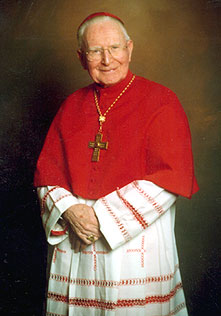 Cardinal Daly, was a native of Loughguile, Co. Antrim, Diocese of Down & Connor, was born in October 1917. He was educated at St Patrick’s National School, Loughguile, St Malachy’s College, Belfast and Queen’s University, Belfast. He was ordained Priest in June 1941. He studied philosophy and theology in St Patrick’s College, Maynooth where he received a Doctorate in Divinity in 1944. In 1953 he received a Licentiate in Philosophy at the Institut Catholique in Paris.His first appointment was as Classics Master in St Malachy’s College, Belfast (1945-6). In 1946 he was appointed Lecturer in Scholastic Philosophy at Queen’s University, Belfast. He became a Reader in Scholastic Philosophy at Queen’s in 1963, a post he held until 1967 when he was appointed Bishop of Ardagh & Clonmacnois. In 1982 he was appointed Bishop of Down & Connor in succession to Bishop William Philbin. On the 6th of November 1990 he was appointed Archbishop of Armagh and Primate of All Ireland in Succession to Cardinal Tomás Ó Fiaich, and was later created a Cardinal on the 28th of June 1991. Cardinal Daly retired as Archbishop of Armagh on the 1st of October 1996. He died on 31 December 2009 and was buried in the grounds of St Patrick’s Cathedral, Armagh.
