Monday, December 22, 2025
Home Blog Page 157

History of the Cathedral

St Patrick founded his first stone Church in Ireland on the site now occupied by St Patrick’s Church of Ireland Cathedral, known as Sally Hill, in the year 445. But the hill where the twin-spired Catholic Cathedral now stands is not without Patrician associations. The Book of Armagh, relates a beautiful tradition which is also depicted in the lower portion of the Cathedral’s great east window (See floor plan of cathedral n. 17). When St Patrick took possession of Sally Hill a deer with her fawn allegedly leaped from the bushes. His companions wanted to catch and kill the fawn but the Saint would not allow them. He himself took the animal on his shoulders and carried it, followed by its mother, to Tealach na Licci (Sandy Hill), the site of the present Catholic Cathedral. The incident has been fondly construed as a prophetic reference by Patrick to the building of another Cathedral in his honour 1400 years later.

Archbishop William Crolly (1835-1849) negotiated the current site for the Catholic Cathedral of St Patrick in Armagh from the Earl of Dartrey. The original architect was Thomas J. Duff of Newry. The work of construction lasted from St Patrick’s Day 1840, when the foundation stone was blessed and laid, with occasional intermissions until the year 1904 when the solemn ceremony of consecration took place. One of the longest gaps in construction took place during the years of the Great Famine. With the dreadful spectre of hunger and disease stalking the land, Cathedral funds were understandably diverted to the more pressing cause of famine relief. Indeed the cholera disease claimed the primate himself and in 1849 his body was laid to rest, at his own request, under the sanctuary of his unfinished Cathedral.

Primate Joseph Dixon (1852-1866) declared Easter Monday 1854, ‘Resumption Monday’. Financial contributions for the Cathedral came from across the Atlantic and to raise extra funds Dr Dixon took the step, rare in those days, of organising a great Bazaar. ‘The First Bazaar’ of 1865 became a household word in Armagh, not alone for its material success (over £7,000 was raised, a remarkable sum for the times), but also for the unique character of some of the prizes. Pope Pius IX sent a beautiful ivory carving of Raphael’s ‘Madonna Di Foligno’. The Emperor of Austria sent a table of rare inlaid work specially designed for the occasion, while Napoleon II chose from the Tuileries Staterooms two magnificent vases of Old Sevrés. An interesting relic of the Bazaar is the grandfather clock now standing in the Cathedral Sacristy. This was a prize which has never been claimed!!

When work resumed in 1854 the original architect Thomas Duff had died and the famous Irish neo-Gothic architect, J. J. McCarthy, was appointed to complete the work. He proposed a different design. The original plan had proposed a perpendicular Gothic church. However, since the original plan of Duff had been adopted for Armagh, an architectural renaissance had taken place and there was a growing tendency to favour a return to purer styles of which perpendicular Gothic was seen as a decadent modification. What McCarthy drew up was a continuation design in the old fourteenth century style of decorated Gothic.

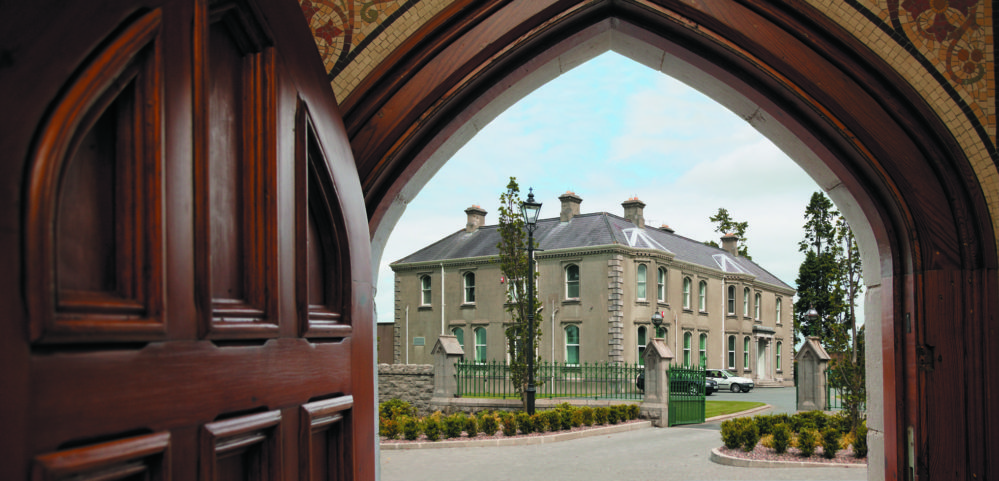
Under Archbishop Daniel McGettigan (1870-87) the Cathedral was completed and dedicated on 24 August 1873 attended by an estimated 20,000 people. Prior to the great occasion Dr McGettigan had seen to the construction of the seven-terraced flight of steps leading from the Cathedral gates to the piazza in front of the west door. In the years following the ceremony he continued to make additions. He built the Archbishop’s house in 1876-77 and in 1884-86 the sacristan’s lodge just inside the Cathedral gates.

The adornment of the interior of the Cathedral was completed under Cardinal Michael Logue (1887-1924). At that time the southern transept was still being used as an impoverished sacristy and assembly room for diocesan purposes. Cardinal Logue corrected this undesirable state of affairs which greatly detracted from the symmetrical beauty of the building’s interior by having constructed to the north east of the Cathedral the Synod Hall which houses the present sacristy. At this time the interior of the Cathedral was dull and undecorated. Cardinal Logue issued a pastoral letter, On the National Cathedral, out of which grew the famous ‘National Cathedral Bazaar’ of 1900 which realised a record sum of £30,000. It can be said that everything in the inside of the Cathedral, except for the Stations of the Cross and some windows in the Lady Chapel, dates from Cardinal Logue’s time.

At his own expense he went abroad and visited the Cathedrals of Italy. He went to the workshops of Rome and Cararra in his search for precious marbles for the construction of the reredos and pulpit as well as the altars. In an exquisite example of artistic workmanship a magnificent Gothic altar was erected in purest statuary marble. On the front it carried in high relief Leonardo Da Vinci’s Last Supper by the distinguished Roman sculptor, Cesare Aureli, which in the rearrangement of the sanctuary following Vatican II, was transferred to St Patrick’s Church, Stonebridge, in the historic parish of Kilmore, where it still stands.

It was also the achievement of Cardinal Logue to have decorated with mosaic the entire walls from the floor to the groining. The materials used were pottery and glass of various colours in dice-shaped cubes. The ceilings are painted in oils, the artist being Oreste Amici. The stained-glass windows, almost all of which date from Cardinal Logue’s time, are mostly the work of the German firm, Meyer. The great window in the Lady Chapel, which was erected at a cost of £920 by Dr McGettigan, at his own expense, came from Dublin.

It was with fitting pride, with his work of decoration complete, that Cardinal Logue announced 24 July 1904 as the solemn day of consecration. And when Pope Pius X deputed Cardinal Vincent Vannutelli, a distinguished member of the Roman Curia, to represent him at the ceremony in Armagh, Ireland felt herself signally honoured in her ecclesiastical capital.

No restructuring of the Cathedral was contemplated until the Second Vatican Council’s decree on Sacred Liturgy in the 1960s called for the redesigning of sanctuaries. In the competition for the best design, first prize was awarded to architect, Liam McCormick of Derry. By raising, enlarging and opening the sanctuary area the architect, to a great extent, restored the Cathedral to its original form, as proposed by Duff. The new sanctuary area was finished in Wicklow granite and the same material is used in the altar, ambo and tabernacle stand. All these sanctuary furnishings are the work of sculptor Peter McTigue of Dundalk. The new tabernacle door is a product of Kilkenny Design Workshops and the richly coloured sanctuary carpets were manufactured in Killybegs. Thus, as far as possible, Irish workmanship and materials were used. A new crucifix, the Cross of Christ was affixed to the huge pillar to the right of the sanctuary. This was the work of Imogen Stuart and relies heavily on St John’s theology of the life-giving death of Jesus, the structure of the cross reminiscent of the shoots from a sprouting seed, a theme popular in medieval crucifix carvings. The new sanctuary was dedicated on Sunday, 13 June 1982.

Abstracted from St. Patricks Cathedral, Armagh. Tomas Ó Fiaich. The Irish Heritage Series: 58, Eason & Sons Ltd, Dublin, 1987

Restoration 2003

The 2003 restoration arose out of the necessity for major
structural repairs to the Cathedral. To
oversee the project, Archbishop Seán Brady appointed a Diocesan committee whose
members took the opportunity of reviewing the sanctuary area, of restoring and
enhancing the interior decoration and of upgrading existing facilities.

The restoration work was undertaken by the established firm
of McAleer & Teague of Dromore, Co. Tyrone, under the supervision of
Gregory Architects, Belfast. The firm of Rooney and McConville, also from Belfast, was commissioned
to redesign the sanctuary.

In line with tradition pertaining to Cathedrals and in
accordance with liturgical norms, the Tabernacle has been relocated to a new
Blessed Sacrament Chapel in the South Transept. By doing so, a private space for prayer and meditation has been created.

To the rear of the new altar is the Archbishop’s chair, or ‘Cathedra’, from which the name
‘Cathedral’ comes.

The Lady Chapel, under the Great East Window, has been
enhanced as a shrine area and is now known as the Marian Shrine. It is separated from the sanctuary by a new
brass screen reminiscent of the marble and brass screen installed by Cardinal
Logue.

The Baptistery with its rich imagery in mosaic and stained
glass has been restored and is again used for baptisms.

An Evangelarium has been created in the space to the right
of the entrance doors. Here the Gospel
of the day may be read in quiet contemplation. On the walls are two marble plaques commemorating the consecration of
the Cathedral, 20th July 1904.

The total cost of the 2003 restoration amounted to £6
million pounds. In excess of £1 million
was grant-aided by the Heritage Lottery Fund and £300,000 from the Environment
& Heritage Service. The balance of
the cost was generously covered by parishioners and friends throughout the diocese
and beyond.

Since the building of the Cathedral was commenced in 1840,
thirteen primates, including seven cardinals, have each contributed in his own
way to its history. Its commanding site
overlooking the City gives it an enduring presence, a reminder to each
generation of the sacrifices of those who have gone before. The now restored building is a further
realisation of Dr Crolly’s vision of a Great National Cathedral of St Patrick
and one worthy of the Primatial See of Armagh.

Abstracted from ‘Official Cathedral Guide, St Patrick’s Cathedral, Armagh,’ 2003

Cardinal Tomás Ó Fiaich

Cardinal Tomás Ó Fiaich

Born on 3 November, 1923, in Cullyhanna, South Armagh, in the Archdiocese of Armagh, Tomás Ó Fiaich was educated at St Patrick’s College, Armagh, St Patrick’s College, Maynooth, and St Peter’s College, Wexford. He was ordained a priest on 6 June, 1948 for the Archdiocese of Armagh. He spent his first year of ordination as assistant priest in Clonfeacle parish. He undertook post-graduate studies in University College Dublin, (1947-50), receiving an MA in early and medieval Irish history; he also studied at Louvain University, Belgium, (1950-52), receiving a licentiate in historical sciences. During this time he travelled widely across Europe researching the work and influence of the early Irish monks in Europe, a topic on which he was an acknowledged authority. In 1953 he was appointed lecturer in modern history at St Patrick’s College, Maynooth, and professor of same in 1959. He became Vice-President of the College in 1970 and President in 1974. He was appointed as Archbishop of Armagh on 18 August, 1977. He was ordained a Bishop on 2 October, 1977 in St Patrick’s Cathedral, Armagh. He was created a Cardinal in Pope John Paul II’s first consistory on 30 June, 1979. He died on 7 May 1990 and was buried in the grounds of St Patrick’s Cathedral, Armagh. His episcopal motto was Frates in Unum (Brothers in Unity).

A renowned historian who published widely Cardinal Ó Fiaich had a particularly love of Irish history. As Cardinal he received Pope John Paul II on his Papal visit to Ireland in 1979 but deeply regretted that due to the political situation the Holy Father was unable to visit Armagh City. He was Archbishop during the particularly difficult time of the H-Block hunger strikes. Cardinal Ó Fiaich will long be remembered as a very pastoral man with the extraordinary capacity to remember names and faces of people he may have only met once and to make connections with their relatives. He was a man who liked nothing better than to sit among his flock sharing stories with them. He constantly maintained that much more united Catholics and Protestants in Northern Ireland than divided them, and declared himself ready to meet any person, anywhere, at any time, if the cause of peace and reconciliation could be served.

Abstracted from Bishops of Ireland 1870-1987, by Rev. Bernard J. Canning

Cardinal William Conway

Cardinal William Conway

Born on 22 January, 1913 on the Falls Road, Belfast, William Conway studied at St Mary’s Christian Brothers’ School, Belfast, St Malachy’s College, Belfast, Queen’s University Belfast and St Patrick’s College, Maynooth. He was ordained a priest on 20 June, 1937 for the Diocese of Down and Connor. He spent the next four years doing post-graduate studies obtaining a Doctorate in Divinity in 1938 in Maynooth and a Doctorate in Canon Law at the Gregorian University, Rome in 1941. He served on the staff of St Malachy’s College, Belfast, 1941-42 teaching Latin and English. He taught in St. Patrick’s College, Maynooth 1942-58 as professor of Moral Theology and Canon Law. He was elected in 1947 dean of the faculty of Canon Law and Vice-President in 1957. He was named as Auxiliary Bishop to Cardinal D’Alton in 1958 and received Episcopal ordination on July 27, 1958. He was named Archbishop of Armagh on 9 September, 1963 and installed on 25 September. He was created a Cardinal on 22 February, 1965. He died on 17 April 1977 and was buried in the grounds of St Patrick’s Cathedral, Armagh. His episcopal motto was Praedicare Evangelium (To Preach the Gospel).

Cardinal Conway was Archbishop during the start of the ‘troubles’ and during some of the most horrific periods of the Northern Ireland conflict. He was strongly opposed to violence in all its forms. He said at Drogheda in July 1971 that “Violence can make the road to justice much longer and leave it strewn with innocent lives”. He pleaded with those who inflicted violence or injustice on their fellow men and women and repeatedly pointed out the incompatibility of this with Christian living. His compassion for those who suffer was not confined to the North of Ireland – the founding of Trócaire on his initiative, an agency to help the poor of the Third World is one of his lasting monuments.

Abstracted from Bishops of Ireland 1870-1987, by Rev. Bernard J. Canning

Cardinal John D’Alton

Cardinal John D’Alton

Born on 11 October, 1882, in Claremorris, Co. Mayo, John D’Alton studied at Blackrock College, Dublin, Holy Cross College, Clonliffe, University College, Dublin, and the Irish College, Rome. He was ordained a priest for the Archdiocese of Dublin on 18 April, 1908, in St John Lateran’s Basilica, Rome. He undertook post-graduate studies (1908-10) gaining a Doctorate in Divinity in Rome and an MA in UCD. He was a member of the staff of St Patrick’s College, Maynooth from 1910 to 1942, during which time he held the chairs of Ancient Classics (1912), and Greek (1922), and the offices of Vice-President (1934), and President (1936). He was appointed coadjutor Bishop of Meath with right of succession on 7 April, 1942. He was ordained a Bishop on 29 June,1942 and became Bishop of Meath on 16 June, 1943. He became Archbishop of Armagh on 13 April, 1946, and was named a Cardinal on 12 January, 1953, and was assigned the Titular Church of St Agatha, Rome. He died on 1 February 1963 in Dublin and was buried in the grounds of St Patrick’s Cathedral, Armagh. His episcopal motto was Judicium Sine Ira (Judgment Without Anger).

In 1952 he became the first member of the Irish Hierarchy to receive an honorary degree from Queen’s University, Belfast, when he was conferred with a Doctorate in Literature. Six years later the National University of Ireland conferred on him the honorary degree of Doctor of Laws. His name is included on a marble tablet in the Portico of St. Peter’s Basilica, Rome, naming the Bishops who attended the definition by Pope Pius XII of the Dogma of the Assumption of the Blessed Virgin Mary into Heaven on 1 November, 1950.

Abstracted from Bishops of Ireland 1870-1987, by Rev. Bernard J. Canning 

Cardinal Joseph MacRory

Cardinal Joseph MacRory

Born in March 1861 in Ballygawley, Co. Tyrone, in the Archdiocese of Armagh, Joseph MacRory studied at St Patrick’s College, Armagh and St Patrick’s College, Maynooth. He was ordained a priest in 1885 and undertook post-graduate studies in Maynooth in 1884-86. He served on the staff of Alton Seminary, Birmingham, as Professor of Moral Theology and Sacred Scripture in 1886-87. He became the first president of St Patrick’s Boys’ Academy, Dungannon in 1887 where he served until 1889 when he became a member of the staff of St Patrick’s College, Maynooth. He served on the staff of Maynooth in 1889-1915 during which time he held the chair of Sacred Scripture and Oriental Languages (1889), chair of Hermeneutics and New Testament Exegesis (1905) and Vice-President (1912). He was appointed Bishop of Down & Connor on 9 August, 1915, and ordained Bishop on 14 November, 1915. He was appointed Archbishop of Armagh and Primate of All Ireland on 22 June 1928. He was named a cardinal on 12 December, 1929, and assigned the titular church of San Giovanni a Porta Latina. He died on 13 October 1945 and was buried in St Patrick’s Cemetery, Armagh. His episcopal motto was Fortis in Fide (Strong in Faith).

Throughout his long episcopate both in Down and Connor and in Armagh, he was foremost in promoting the ‘Cause’ of Beatification of Oliver Plunkett, the martyred Archbishop of Armagh. He was also devoted to the work of the foreign missions.

Abstracted from Bishops of Ireland 1870-1987, by Rev. Bernard J. Canning

Cardinal Patrick O’Donnell

Cardinal Patrick O’Donnell

Born on 28 November, 1855, near Glenties, Co. Donegal, Patrick O’Donnell studied at the old diocesan seminary, Letterkenny, and St Patrick’s College, Maynooth. He was ordained a priest on 29 June, 1880, and served on the staff of St Patrick’s College, Maynooth, 1881-88, holding the chairs of Dogmatic and Moral Theology and office of prefect of Dunboyne (1884-88). He was appointed Bishop of Raphoe on 21 February, 1888 and ordained Bishop on 25 March, 1888. On 14 January, 1922, he was appointed coadjutor Archbishop of Armagh with right of succession and became Archbishop on 19 November, 1924. He acted as Apostolic Administrator of Raphoe in 1922-1923. He was created a Cardinal on 14 December, 1925, and was assigned to the Church of St Mary of Peace, Rome. He died on 22 October, 1927, and was buried in St Patrick’s Cemetery, Armagh. His episcopal motto was In Hoc Signo Vinces (By this Sign (Cross)you Shall Conquer).

Gifted as scholar, preacher and administrator, he brought his influence to bear not only on diocesan affairs but also on all the important issues that came before the country.

Abstracted from Bishops of Ireland 1870-1987, by Rev. Bernard J. Canning

Links

We collected some links for you to follow in these categories:

Cardinal Michael Logue

Cardinal Michael Logue

Born on 1 October, 1840, in Carrigart, Co. Donegal, Michael Logue studied in St Patrick’s College, Maynooth. Although not yet ordained a priest he was appointed in 1866 by the Irish Hierarchy to the chairs of theology and Belles Lettres in the Irish College, Paris. He was ordained a priest in December 1866 in Paris and remained on the staff of the Irish College, Paris, until 1874. He was administrator in Letterkenny in his native Raphoe Diocese from 1874-76. He then joined the staff of St Patrick’s College Maynooth, 1876-79, where he held the chairs of Dogmatic Theology and Irish and the post of Dean. He was appointed Bishop of Raphoe on 13 May 1879 and ordained Bishop on 20 July 1879. He was named coadjutor Archbishop of Armagh with right of succession on 19 April 1887 and he succeeded to the Primacy on 3 December 1887. He was named Cardinal on 16 January, 1893 and given the Church of St Mary of Peace, Rome, on 19 January, 1893. He died on 19 November, 1924 in Ara Coeli, Armagh, and was buried in St Patrick’s Cemetery, Armagh. His episcopal motto was In Patientia Salus (Patience is a Virtue).

The completion, through his energy in raising over £50,000, of St Patrick’s Cathedral, Armagh, and its dedication on 24 July, 1904, was perhaps the crowning event of his primacy. He was an advocate of Home Rule and opposed to the partition of Ireland; however, he did favour the Treaty of 1921. In 1923 he and the Northern Bishops felt obliged to issue a statement on the treatment of the Catholic community by the Stormont administration.

Abstracted from Bishops of Ireland 1870-1987, by Rev. Bernard J. Canning

Homily given at Funeral Mass of Mgr John McGrane 10 February 2008

Homily at the funeral Mass for the Rt. Rev. Mons. John McGrane

Church of St. Mochua, Derrynoose
Sundsay 10th. February, 2008.
The Most Rev. Gerard Clifford.
Auxiliary Bishop of Armagh.

Monsignor John McGrane was ordained priest for the Archdiocese of Armagh on 21st June, 1953. He served in the parishes of Darver, Togher, Cooley, Ardee and was appointed Parish Priest of Mullaghbawn in August 1981. He was appointed Parish Priest of Cooley in 1991 from where he retired to become Pastor Emeritus in Derrynoose in 2000 as Pastor Emeritus. I use the word ‘retired’ with some caution because it was in his so-called years of retirement that John McGrane did some of the most challenging work of his life.

John was first and foremost a pastor. He was a man who set high standards for himself and for others. In many ways he was a mentor to the young priests of the diocese. As Parish Priest people often commented that John McGrane was so lucky always to have young priests around him. That was not altogether an accident. In fact repeatedly he was sent young priest because he was well known to be an outstanding mentor and teacher. In previous times young priests were sent out to their new parishes under the guidance of wise and learned men. John fulfilled that role admirably. In fact I remember as a young Bishop visiting John on many occasions and going on long walks to be guided and directed by a man of wisdom. Today many priests of the diocese owe much to the encouragement and direction given them by John McGrane.

John McGrane was one of the outstanding priests of the Archdiocese of Armagh, a pastor, mentor, iconic figure for generation after generation of priests. Parish after parish he was exemplary in his ministry and in his work. His commitment as a priest was total. At Diocesan Assemblies, Conferences, gatherings of all kind John was first in the field and last to leave.

All his life he was surrounded by family and friends. His native Parish of Kilmore may not be the biggest parish in the Diocese but Kilmore and Mullavilly were given unparalleled prominence in any discussions and debates at diocesan level. Mullavilly was home. It would be the arbiter and judge of all projects. All plans were assessed on how the people of Mullavilly would react. That was the esteem John had for his native parish. Family gatherings were part and parcel of weekly life. There were the calls home, the family celebrations and, of course, the football. Wherever John ministered the GAA was an important part of parish and community life but Armagh County was in a totally different sphere. Armagh was the love of his life and Armagh’s victory in the All-Ireland in 2002 was the highpoint of his involvement in football over many years. It was all reflected in the new wave of enthusiasm for the County team and was celebrated handsomely the length and breadth of the county.

John Mc Grane is remembered in the parishes where he served as a man of vision. He had a vision for renewal of the Church and was proud to be involved in renewal at parish and diocesan level. He saw the need for change and he was first to point out the need for structural reorganisation in the parishes he served. If Vatican II changes in liturgy were to be implemented then structural changes had to be made to the fabric of the Church. If we were to have full participation of lay people in the liturgy then reorganisation of the Church was part of that.

He took that work seriously. So much so that everywhere he went the churches, parochial houses, the Church plant, the schools were of the highest standard. John was a superb architect. He knew what was wanted and he addressed the need. It was all done efficiently and efdfectively. Nothing was too good for God’s house. Only the very best was good enough.

When the restoration and refurbishing of St. Patrick’s Cathedral in Armagh was begun by Cardinal Brady it was obvious that John McGrane was the ideal man to head up the work. He was appointed chairman of the Restoration Committee. It was an inspired choice. From the beginning of the work John McGrane applied himself with an energy and enthusiasm that inspired the rest of us. This was an enormous undertaking. There were sensitive decisions to be made, work of previous generations to be respected, architects to be employed, plans to be drawn, sites to be cleared, builders to be instructed, engineers to oversee the work and endless meetings. It was an awesome task. The great ceremony of rededication on 25th May, 2003 will be remembered for generations to come. The groundswell of admiration was a clear affirmation of the work done. All of it was done in the name of God. When it came to the Cathedral nothing was too good for the house of God. Today the completed work is regarded as one of the most successful restorations of our time.

Today we thank Cardinal Brady for that. We also thank Mons John McGrane for his commitment and dedication in seeing that work brought to fruition. As a token of appreciation for his outstanding work in the restoration of the Cathedral John was appointed a Prelate of Honour, ‘Monsignor’, on 1st. October 2003.

One might have thought that the work of restoration of the Cathedral was sufficiently challenging and exhausting to suffice for one lifetime. Mons McGrane went on to refurbish and renew this beautiful Church of St Mochua here in Derrynoose to include the ambo, tabernacle and altar brought from the Cathedral in Armagh. It was an opportunity he could not resist and we see the results in this beautiful Church today.
Today we thank God for the example and dedication of a priest who was dear to all of us. We have lost one of the men who inspired and directed generation after generation of priests and lay people here in the Archdiocese. To his sisters, brothers and wide circle of family and friends we extend our deepest sympathies. We pray that he may be with God in Heaven.

World Peace Day Homily given at St Patrick’s Cathedral Armagh 1 January 2008

World Day of Peace – 1st January, 2008.
St. Patrick’s Cathedral, Armagh.
Homily by the Most Rev. Gerard Clifford.
Auxiliary Bishop of Armagh.

Every year on the first of January Christians throughout the world are asked to pray for peace and every year the Holy Father selects a theme in the whole area of peace and reconciliation and encourages Christians worldwide to reflect on it. The practice began in 1968 when Pope Paul VI called for a World Day of Peace. Today we celebrate the fortieth anniversary of that event.

Over the years here in Northern Ireland we have celebrated that day and repeatedly we have had to call for peace in our country. The so-called ‘troubles’ in Northern Ireland began in 1969 and year after year we have reflected on how peace might be brought to Northern Ireland and to the world. This year we can look back in thanksgiving and say, for the first time in many years, we now have solid foundations in place that will hopefully ensure that a lasting peace is established in our country. Today is an opportunity to thank God for that. It is an opportunity to thank politicians and people of goodwill who worked tirelessly over the years to ensure there would be a new beginning for Northern Ireland. The signs are positive that a brighter future lies ahead for all. However, we cannot take it all for granted. Our politicians, our leaders, our communities need our continual support and encouragement. They need our prayers.

The political progress has been described by some as a real miracle and we thank God for that but forty years of strife and division in Northern Ireland has left its own legacy of bitterness, hatred and distrust. For some the hatred of the past has cheapened life. We have seen the awful destruction of life and property over the years. The results remain with us today. The taking of life in the past has desensitised us to the value of life. Punishment beatings remain the unacceptable face of a hang-over from past violence. We condemn such punishment beatings and violence of any kind as totally unacceptable, totally unchristian.

This year his Holiness Pope Benedict XVI has chosen the theme ‘the human family, a community of peace’ as the focus for our reflection. He reminds us that the family is at the very heart of society. The family is the first teacher of peace in the world. We have an obligation to support family, to encourage legislation that supports the family unit. Any legislation that threatens to weaken the family unit is totally unacceptable.

Pope Benedict reminds us that as families we live in our common home, this world, and we have a responsibility not just to family but to all of society, those alive today and also to generations to come. We have an obligation to care for society and for our world.

In the nineteen sixties and seventies society began in a new way and with a new urgency to talk about our responsibilities to the world around us. The concept of ecology was given a new priority. The word derives from the Greek for house or home. We have responsibilities to those who share that home with us but also to future generations. We have a moral responsibility to protect and to preserve our world so that we can hand it on intact to those who come after us. The resources of this world like water, fuels, land and air are not unlimited. We have responsibilities towards the environment and the world around us. Greed, avarice and careless waste of the world’s resources damage all of us.

That presents a challenge to all. It demands a change of life-style for many. In today’s world we stand condemned for the waste of natural resources given to us in trust. We see the waste of energy and materials on a daily basis. We see it in the waste of scarce resources like water and fuel and the pollution of the air that we breathe. We see a major part of the world suffering from hunger, malnutrition, disease and want. All of the deprivation in family and community is linked in one way or another to the abuse by society of the resources given to us in trust. The call to all of us is to live simply so that others may simply live.
When the Apollo XI astronauts started on their historic journey to the moon they brought recorded messages from leaders throughout the world. The messages were deposited on the surface of the moon. Pope Paul VI sent his own message, a quotation from Psalm VIII. The words, recorded on a small disk of indestructible metal, are now embedded in the surface of the moon. They are a reminder to us that God’s own word in Sacred Scripture is forever new, it does not pass away. His words stand as a sign of lasting hope for all of us. The words of the Psalm challenge all of us;

‘O Lord Our God, how wonderful is your name over all the earth…
When I see the heavens, the work of your hands
the moon and the stars which you arranged
What is man? That you keep him in mind
Mortal man? That you care for him’.

Every one of us is called to care for our home in this world. It is a gift given to us in trust. I pray that all of us may recognise that and live accordingly.