Friday, February 27, 2026
Home Blog Page 158

24 Jan – St Francis de Sale Mass – St Eugene’s Cathedral Derry

ST FRANCIS DE SALE MASS

ST EUGENE’S CATHEDRAL, DERRY

HOMILY GIVEN BY

CARDINAL SEÁN BRADY

THURSDAY 24 JANUARY 2008

St Francis de la Sale was born frail and in delicate health because of his premature birth. However, with care he gradually grew in strength and became active and energetic. His father wanted him to get himself a job and sent him to University to gain the right education but Francis had other ideas. He wanted to give his life to God. Francis was afraid that he would lose his vocation at the University and so he begged to be sent to a College which was well known for its religious ethos.

At College, Francis studies philosophy, Arts, Theology and the Law of the Church. In order to satisfy his father, he also took lessons in horse-riding, martial arts and dancing but Francis did not really care for any of these because he still yearned to give his life to God. Francis had not talked to his father about his desire to become a priest but his mother and a few close friends knew.

Eventually he was ordained a priest the religious condition of the people was deplorable and so the Bishop sent him to one of the toughest parishes in his diocese. Francis’ father was less than pleased. Along with his cousin, Francis set out to preach as often as he could to try and win back the people to the practice of their faith.

One evening he was attacked by wolves and he escaped by spending the night in a tree. Several times he was waylaid by assassins who had sworn to kill him and almost miraculously he always managed to escape.

Time went by and his work apparently was meeting with very little success. His father was no help to him as all he did was to write letters either begging him or commanding him to give it all up, have a bit of sense and return home. Francis, however, had no intention of quitting. He was always on the look out for new ways of reaching the hearts and minds of his people.

He began writing leaflets explaining the teaching of the Church. Every spare moment he had was spent writing these little papers which were then copied and distributed.

In the summer of 1595, he was attacked by a very hostile crowd who insulted and beat him. But soon after this bigger crowds began to come to listen to his sermons. His patient perseverance, despite every type of persecution, began to pay off. Conversions became more frequent and soon there was a steady stream of lapsed Catholics tip-toeing their way back to the Church. The Bishop was made welcome and was able to administer Confirmation and even presided at the 40 hour devotion – something which previously was unthinkable.

His untiring work of bringing back the lapsed Catholics to the fold was rewarded when he was made Bishop of Germany. As bishop he organised the teaching of the Catechism all over the diocese. He taught the lessons himself and children loved him and followed him.

His favourite subject was the devout life and his most famous book Introduction to the Devout Life arose from letters written to his cousin. He led a very austere life but the people were eager to see him. All the converts wanted him to come and preach. In 1622, even though he was exhausted, he kept on preaching and working. He died, while working, on the Feast of the Holy Innocent.

Real living – living devotion – presupposes the love of God. It is, in fact, that very love.
· When this love adorns the soul and make us pleasing to God, the love of God is called grace.
· When it gives us the power to do good, we call it charity.
· When it inspires us to do good often and readily and carefully it is called devotion.

Ostriches never fly. Hens fly sometimes with difficulty but eagles, swallows and doves fly swiftly and frequently. In the same way, sinners – like ostriches – never fly towards God. They roam about the earth seeking earthly things and never finding happiness. Those who are good but not devout fly sometimes on the wings of occasional good deeds but slowly and sluggishly. Those who are ready and willing to do good often, glide gracefully to God on high.
6 Feb – Ash Wednesday – Dundalk Institute of Technology

ASH WEDNESDAY 2008

DUNDALK INSTITUTE OF TECHNOLOGY

HOMIILY GIVEN BY

CARDINAL SEÁN BRADY

WEDNESDAY 6 FEBRAURY 2008

Last week I was in schools in Portadown. The juniors sang about each and everyone being special – special in the eyes of God. Each one of us has our own qualities – talents – which make us special. But the very special thing about each one of us is that we are loved by God. The children sang with such enthusiasm.

I sometimes wonder how it is that we lose that enthusiasm as we move in life for recognising that we are special and specially loved by God. We seem to lose the ability to respond to that. We become listless and indifferent and anaemic in our response to God. Well, Lent is the time when we try to do something about all of that. We are ambassadors for Christ. St Paul appeals to us. He says: “Be reconciled to God because for our sake God made Christ the sinless one into sin so that we might become the goodness of God”. St Paul begs us once again “not to neglect the grace of God that you have received”. Now is the favourable time – this is the day of salvation.

So, I beg you to use this time, this special time, well. By all means use the ways the three traditional ways of spending Lent:

1. Pray
2. Fast
3. Give to the poor

Don’t parade it. Don’t blow the trumpet. Don’t let it become an ego trip. Exercise a strong willpower. I wish you a gracefilled Lent.

Lent is not a time in which the Church asks us to put on a sort of organised gloom. We are not to take on suffering for the sake of suffering. The ashes are also a sign of penance and conversion. Once the conversion was achieved, the prophets called for putting off the sack-cloth; washing away the ashes and getting into festive dress.

We do not have unlimited time to change our lives. God and His Church do not want us to have a Lenten face but rather to have an about face today; an about turn – change of direction.

I wish you all a very happy Lent.

9 Feb – 150 Anniversary of the Apparations at Lourdes – Our Lady of Lourdes Church Drogheda

150th ANNIVERSARY OF APPARATIONS AT LOURDES

HOMILY GIVEN BY

CARDINAL SEÁN BRADY

OUR LADY OF LOURDES CHURCH, DROGHEDA

SATURDAY 9 FEBRUARY 2008

Lourdes is a town of about 18,000 inhabitants. Where does that leave it in comparison with Drogheda? Lourdes is about 1,200 feet above sea level at the foot of the Pyrenees. But wait for it! Lourdes has about 410 hotels – with sixteen and a half thousand bedrooms. That means that for many weeks of the years there are about 33,000 visitors to Lourdes, billions of visitors every year.

What takes them there?
· As tourists? – not really – although the scenery is breath-taking.
· To see the beautiful paintings and statues? I don’t think so – although there are many lovely churches.
· To see the candlelight processions or the Procession of the Blessed Sacrament? possibly – but not really.

In my opinion, people go there for another reason.

v They go there to keep an appointment with God – which Mary has made for them.
v They go to meet their brothers and sisters, especially those who are sick, and who share the same faith as Jesus Christ so that they can understand better what it means to be a sick Child of God.

v They go there to take care of the health of their spiritual life; to look into the spiritual mirror and spot the wrinkles and the grey hairs of the soul.
v They go to get a bit of rest and respite from the conflicts and trials and troubles of life.
v People go there to get some inner peace and quiet and to clear their head and to see what is life all about and to see where God fits in.

Why Lourdes?
Yes, it is a beautiful but backward enough sort of place. It all began in 1854 when Pope Pius IX declared that it was an article of our faith that Mary, the Mother of Jesus, was conceived – untainted, untouched by sin, the sin of our first parents. He said that she was, in fact, the most highly favoured daughter of God – full of grace – unstained by sin. The short-hand for all of that is: she was conceived immaculately. Her feast, commemorating that event, is the 8 December – Feast of the Immaculate Conception.

Then, four years later, on 11 February 1858 – 150 years ago on Monday next – Mary, the Mother of Jesus – appeared to Bernadette Soubirous at the Face of the Rock in Lourdes. She said: “I am the Immaculate Conception”.

Who is or who was Bernadette Soubirous?
Ø Bernadette was the daughter of a poverty-stricken miller.
Ø A simple peasant girl living with her foster mother because her parents were too poor to nourish and feed her.
Ø She became an unknown religious sister. Humble and obedient in a convent far away from Lourdes at Nevers.
Ø She was a woman who suffered a huge amount which she accepted with all humility and became a wonderful witness to the teaching of the immaculate conception.
Ø Her father was a miller but in 1856 he was bankrupt, ruined. Unable to feed his family and pay the rent of his mill they had to leave their house and go to live in a kind of dump.
Ø That winter, Bernadette contracted Cholera and later Asthma and Tuberculosis. That is what brought her to her grave at the age of 35 years.

Spiritually, she was little better off. She had not yet made her First Communion by the age of fourteen. She had a lot of difficulty learning the Catechism. The only prayer she knew was the Rosary. So, when the Blessed Virgin said: “I am the Immaculate Conception” Bernadette really didn’t have a clue what she was on about.

That is the girl to whom Our Lady appeared several time 150 years ago at various stages, with a very simple message of prayer for the salvation of the world and penance for the conversion of sinners and a special message for the clergy – to get up and build a church on the spot.

Eventually and gradually, the message got through. Not alone the churches but the hotels and the hospices were built to accommodate the millions of people who, over the last 150 years, have heeded the call of Mary to pray and to repent of our sins.

The song and message of Bernadette has certainly caught the imagination of Catholics, all over the world.

County Louth Radio

LMFM is the local radio station serving Louth, Meath, north County Dublin and East Monaghan. Mass is broadcast every Sunday morning from either Meath Diocese or Armagh Diocese. Our Diocesan Liaison person is Canon Jim Carroll

Family of God Catholic Community

The community has its origins in a Charismatic Prayer Group which began in Dundalk, in 1974. Sr. Briege Murphy, a mercy sister based in Dundalk began with a small group of second level students. The prayer group expanded and a leadership team emerged to co-ordinate the activities of the weekly prayer meeting.

Sr. Briege was released by her Mercy Order to open a house of prayer in St. Mary’s Road with the generous help of the Marist Fathers and that became the home of the community for three years. It proved too small for the burgeoning activities with which the community became involved and they moved to the former Mercy orphanage in Castle St.

As the community became established it became obvious that its character was lay and that its spirituality should reflect this dominant feature. Statutes were written to seek approval from the Bishop to be recognised as a Private Association of the Church and these were duly granted in 1992 by Cardinal Daly. In 1995, the community was also granted Council membership of the Catholic Fraternity. This is an international association of communities from every continent, all of whom are formally recognised by their Bishop and by the Pontifical council for the Laity.

In 2000, the Community moved its headquarters to The Oratory. The Oratory was officially blessed and opened by Archbishop Sean Brady on June 8th 2000 and he entrusted the Oratory and its ministry to the Community. It is highly significant in the context of the Irish Church that a public Oratory, with the Blessed sacrament present, is entrusted to a lay community.
The current leader of the community is Teddy Lambe.

OPENING HOURS: MON-SAT 10.00am-5.00pm.
The oratory is a quiet place of prayer and reflection and most of the day is given over to silent adoration of the Blessed Sacrament. However, there are a number of regular services as listed below. 
Morning Prayer of the Church at 11 am each morning.

A weekly mass on Monday at 12.45pm.
In addition there is a weekly prayer meeting in the Oratory at 7.30pm on Thursday evenings (except for the Thursday after the first Friday of each month)

SOS Prayer. A brother or Sister listens and prays with you for your intentions. Phone 042- 9339888.

CONTACT INFORMATION

Director:
Teddy Lambe, The Oratory, Carroll’s Village, Dundalk, Co Louth. Tel (042) 933 5566, Fax (042) 933 5566.

Northern Representatives:
Brendan Conway, 98 Church St, Cookstown, (028) 8867 6418;
Roisín & Raymond Glackin, 8 Springfield Park, Mullaghmore, Dungannon, (028) 8772 4603.

Opening of the New Pastoral Centre in Dundalk

The Diocesan Pastoral Centre, first opened by Cardinal Daly in 1993, recently moved from Mount Oliver to the Magnet building in St. Patrick’s parish in Dundalk.
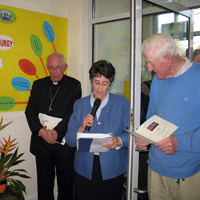
Welcoming the guests to the Pastoral Centre for the opening, Sr Rhoda, the Centre’s director said:
There are two very special groups of people, who really create the ambience of hospitality and care for all who use the centre. First our very able staff most of whom are employed by Mount Oliver and District Community Employment Scheme and have worked tirelessly to prepare the building for today.

I would like to pay special tribute to our second group of people: our Volunteers in the various programmes – Beginning Experience, Rainbows, Bereavement Support, and Wider Circle. These people are the backbone of the Centre. Without them a spark of life would be extinguished. They are a beacon of hope for many people, embodying the message of Jesus in their lives and carrying it out in their service to others.

My Dream for all who use this lovely new centre now and in the future is that we will all be imbued with a new enthusiasm that will enkindle in our hearts and minds a loving compassionate creativity that will enable us to journey beyond our old limits toward new frontiers some of which are already emerging. The message of Jesus says this much more succinctly when He said ‘I have come that you may have life and have it to the full’.
We wish Sr. Rhoda and all connected with the Armagh Diocesan Pastoral Centre every blessing in the days, months and years ahead.

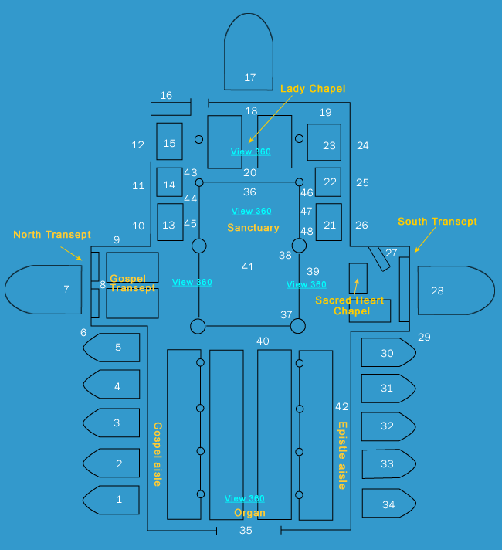
Plan of Cathedral Old

CATHEDRAL FLOOR PLAN

1. Stained glass window – St Patrick receives his mission from Pope Celestine. The death of St Patrick.

2. Stained glass window – The flight and martyrdom of St Dympna and her companions.

3. Stained glass window – The dream of St Patrick. St Benignus places flowers on the sleeping saint.

4. Stained glass window – The espousal of the Blessed Virgin.

5. Stained glass window – St Patrick and the two Princesses at the Fountain of Clebach.

6. Stained glass window – St Malachy is received by St Bernard & Cistercian monks.

7. The great five-light window in the Gospel-side Transept.

8. Wooden Funeral Door at the Gospel Transept.

9. Stained glass window – St Mel giving the religious veil to St Brigid & other holy women.

10. Stained glass window – St Theresa, St Brigid with the crozier and St Dympna.

11. Stained glass window – St Benignus, St Joseph and St Malachy.

12. Stained glass window – Madonna and Child, St James the Less & St Elizabeth.

13. Mosaic – The Presentation of the Blessed Virgin Mary.

14. Mosaic – The espousal of St Joseph and the Blessed Virgin Mary and the Presentation of Our Lord in the Temple.

15. Mosaic – Dream of St Joseph & two Mosaics of the Flight into Egypt.

16. Stained glass window – St Malachy, St Michael, St Elizabeth.

17. The Great Window in the Lady Chapel.

18. The Lady Altar Reredos.

19. Lady Chapel window – Sacred Heart with St Clare & St Veronica.

20. Sanctuary Lamp.

21. Mosaic – St Brigid herding the cattle of the Druid.

22. Mosaics – The Consecration of St Brigid and St Brigid before the King of Leinster.

23. Mosaic – St Brigid founding her monastery and healing the Lepers.

24. Stained glass window – The Immaculate Conception.

25. Stained glass window – St John, St Peter, and St James the Greater.

26. Stained glass window – The Sorrows of the Blessed Virgin Mary.

27. Stained glass window – The Blessed Virgin.

28. Sacred Heart Altar window shows apparition of Sacred Heart to St Margaret Mary.

29. Window of Sacred Heart Altar with words of Jesus, “Come to me all you who labour and are heavily burdened and I will refresh you” (Matthew 11:28).

30. Our Lady with Divine Infant gives Rosary & Scapular to St Dominic & St Catherine.

31. Stained glass window – St Patrick preaches at Tara.

32. Stained glass window – St Malachy receives the Last Sacraments before the altar.

33. Stained glass window – Apparition of the Blessed Virgin Mary at Lourdes.

34. Stained glass window – The Martyrdom of St Catherine of Alexandria.

35. The main Cathedral Entrance and Organ Gallery.

36. The Tabernacle.

37. Crucifix.

38. The ‘Cathedra’ is the Bishop’s chair in the cathedral church.

39. The Baptismal Font.

40. The Cathedral pews in the main nave.

41. The Altar.

42. The Stations of the Cross.

43. The Cardinals’ Hats. Cardinal Patrick O’Donnell, 1924-1927.

44. The Cardinals’ Hats. Cardinal William Conway, 1963-1977.

45. The Cardinals’ Hats. Cardinal Michael Louge, 1887-1924.

46. The Confessional.

47. The Cardinals’ Hats. Cardinal John D’Alton, 1946-1963.

48. The Cardinals’ Hats. Cardinal Joseph MacRory, 1928-1945.


MAIN DATES1840 Foundation stone laid
1848 Work partially ceased
1854 Work resumed. New design
1873 Dedication
1904 Consecration

DIMENSIONS

Height 210′
Length 212′
Height of crosses 10′
Breadth across transepts 120′
Length of nave 114′
External roof height 100′
Internal roof height 81′
Sanctuary 58′ square

MAIN MATERIAL

Main structure Armagh Limestone
Dungannon Freestone
Groining of aisles Bath stone
Altar Irish granite
Sacred Heart Altar & organ
loft support Italian marble
Decoration of floor & walls Mosaic
Gates Brass
Woodwork Austrian oak
Nave ceiling Oil painting
Architectural style Decorated Gothic

History of the Cathedral

St Patrick founded his first stone Church in Ireland on the site now occupied by St Patrick’s Church of Ireland Cathedral, known as Sally Hill, in the year 445. But the hill where the twin-spired Catholic Cathedral now stands is not without Patrician associations. The Book of Armagh, relates a beautiful tradition which is also depicted in the lower portion of the Cathedral’s great east window (See floor plan of cathedral n. 17). When St Patrick took possession of Sally Hill a deer with her fawn allegedly leaped from the bushes. His companions wanted to catch and kill the fawn but the Saint would not allow them. He himself took the animal on his shoulders and carried it, followed by its mother, to Tealach na Licci (Sandy Hill), the site of the present Catholic Cathedral. The incident has been fondly construed as a prophetic reference by Patrick to the building of another Cathedral in his honour 1400 years later.

Archbishop William Crolly (1835-1849) negotiated the current site for the Catholic Cathedral of St Patrick in Armagh from the Earl of Dartrey. The original architect was Thomas J. Duff of Newry. The work of construction lasted from St Patrick’s Day 1840, when the foundation stone was blessed and laid, with occasional intermissions until the year 1904 when the solemn ceremony of consecration took place. One of the longest gaps in construction took place during the years of the Great Famine. With the dreadful spectre of hunger and disease stalking the land, Cathedral funds were understandably diverted to the more pressing cause of famine relief. Indeed the cholera disease claimed the primate himself and in 1849 his body was laid to rest, at his own request, under the sanctuary of his unfinished Cathedral.

Primate Joseph Dixon (1852-1866) declared Easter Monday 1854, ‘Resumption Monday’. Financial contributions for the Cathedral came from across the Atlantic and to raise extra funds Dr Dixon took the step, rare in those days, of organising a great Bazaar. ‘The First Bazaar’ of 1865 became a household word in Armagh, not alone for its material success (over £7,000 was raised, a remarkable sum for the times), but also for the unique character of some of the prizes. Pope Pius IX sent a beautiful ivory carving of Raphael’s ‘Madonna Di Foligno’. The Emperor of Austria sent a table of rare inlaid work specially designed for the occasion, while Napoleon II chose from the Tuileries Staterooms two magnificent vases of Old Sevrés. An interesting relic of the Bazaar is the grandfather clock now standing in the Cathedral Sacristy. This was a prize which has never been claimed!!

When work resumed in 1854 the original architect Thomas Duff had died and the famous Irish neo-Gothic architect, J. J. McCarthy, was appointed to complete the work. He proposed a different design. The original plan had proposed a perpendicular Gothic church. However, since the original plan of Duff had been adopted for Armagh, an architectural renaissance had taken place and there was a growing tendency to favour a return to purer styles of which perpendicular Gothic was seen as a decadent modification. What McCarthy drew up was a continuation design in the old fourteenth century style of decorated Gothic.

Under Archbishop Daniel McGettigan (1870-87) the Cathedral was completed and dedicated on 24 August 1873 attended by an estimated 20,000 people. Prior to the great occasion Dr McGettigan had seen to the construction of the seven-terraced flight of steps leading from the Cathedral gates to the piazza in front of the west door. In the years following the ceremony he continued to make additions. He built the Archbishop’s house in 1876-77 and in 1884-86 the sacristan’s lodge just inside the Cathedral gates.

The adornment of the interior of the Cathedral was completed under Cardinal Michael Logue (1887-1924). At that time the southern transept was still being used as an impoverished sacristy and assembly room for diocesan purposes. Cardinal Logue corrected this undesirable state of affairs which greatly detracted from the symmetrical beauty of the building’s interior by having constructed to the north east of the Cathedral the Synod Hall which houses the present sacristy. At this time the interior of the Cathedral was dull and undecorated. Cardinal Logue issued a pastoral letter, On the National Cathedral, out of which grew the famous ‘National Cathedral Bazaar’ of 1900 which realised a record sum of £30,000. It can be said that everything in the inside of the Cathedral, except for the Stations of the Cross and some windows in the Lady Chapel, dates from Cardinal Logue’s time.

At his own expense he went abroad and visited the Cathedrals of Italy. He went to the workshops of Rome and Cararra in his search for precious marbles for the construction of the reredos and pulpit as well as the altars. In an exquisite example of artistic workmanship a magnificent Gothic altar was erected in purest statuary marble. On the front it carried in high relief Leonardo Da Vinci’s Last Supper by the distinguished Roman sculptor, Cesare Aureli, which in the rearrangement of the sanctuary following Vatican II, was transferred to St Patrick’s Church, Stonebridge, in the historic parish of Kilmore, where it still stands.

It was also the achievement of Cardinal Logue to have decorated with mosaic the entire walls from the floor to the groining. The materials used were pottery and glass of various colours in dice-shaped cubes. The ceilings are painted in oils, the artist being Oreste Amici. The stained-glass windows, almost all of which date from Cardinal Logue’s time, are mostly the work of the German firm, Meyer. The great window in the Lady Chapel, which was erected at a cost of £920 by Dr McGettigan, at his own expense, came from Dublin.

It was with fitting pride, with his work of decoration complete, that Cardinal Logue announced 24 July 1904 as the solemn day of consecration. And when Pope Pius X deputed Cardinal Vincent Vannutelli, a distinguished member of the Roman Curia, to represent him at the ceremony in Armagh, Ireland felt herself signally honoured in her ecclesiastical capital.

No restructuring of the Cathedral was contemplated until the Second Vatican Council’s decree on Sacred Liturgy in the 1960s called for the redesigning of sanctuaries. In the competition for the best design, first prize was awarded to architect, Liam McCormick of Derry. By raising, enlarging and opening the sanctuary area the architect, to a great extent, restored the Cathedral to its original form, as proposed by Duff. The new sanctuary area was finished in Wicklow granite and the same material is used in the altar, ambo and tabernacle stand. All these sanctuary furnishings are the work of sculptor Peter McTigue of Dundalk. The new tabernacle door is a product of Kilkenny Design Workshops and the richly coloured sanctuary carpets were manufactured in Killybegs. Thus, as far as possible, Irish workmanship and materials were used. A new crucifix, the Cross of Christ was affixed to the huge pillar to the right of the sanctuary. This was the work of Imogen Stuart and relies heavily on St John’s theology of the life-giving death of Jesus, the structure of the cross reminiscent of the shoots from a sprouting seed, a theme popular in medieval crucifix carvings. The new sanctuary was dedicated on Sunday, 13 June 1982.

Abstracted from St. Patricks Cathedral, Armagh. Tomas Ó Fiaich. The Irish Heritage Series: 58, Eason & Sons Ltd, Dublin, 1987

Restoration 2003

The 2003 restoration arose out of the necessity for major
structural repairs to the Cathedral. To
oversee the project, Archbishop Seán Brady appointed a Diocesan committee whose
members took the opportunity of reviewing the sanctuary area, of restoring and
enhancing the interior decoration and of upgrading existing facilities.

The restoration work was undertaken by the established firm
of McAleer & Teague of Dromore, Co. Tyrone, under the supervision of
Gregory Architects, Belfast. The firm of Rooney and McConville, also from Belfast, was commissioned
to redesign the sanctuary.

In line with tradition pertaining to Cathedrals and in
accordance with liturgical norms, the Tabernacle has been relocated to a new
Blessed Sacrament Chapel in the South Transept. By doing so, a private space for prayer and meditation has been created.

To the rear of the new altar is the Archbishop’s chair, or ‘Cathedra’, from which the name
‘Cathedral’ comes.

The Lady Chapel, under the Great East Window, has been
enhanced as a shrine area and is now known as the Marian Shrine. It is separated from the sanctuary by a new
brass screen reminiscent of the marble and brass screen installed by Cardinal
Logue.

The Baptistery with its rich imagery in mosaic and stained
glass has been restored and is again used for baptisms.

An Evangelarium has been created in the space to the right
of the entrance doors. Here the Gospel
of the day may be read in quiet contemplation. On the walls are two marble plaques commemorating the consecration of
the Cathedral, 20th July 1904.

The total cost of the 2003 restoration amounted to £6
million pounds. In excess of £1 million
was grant-aided by the Heritage Lottery Fund and £300,000 from the Environment
& Heritage Service. The balance of
the cost was generously covered by parishioners and friends throughout the diocese
and beyond.

Since the building of the Cathedral was commenced in 1840,
thirteen primates, including seven cardinals, have each contributed in his own
way to its history. Its commanding site
overlooking the City gives it an enduring presence, a reminder to each
generation of the sacrifices of those who have gone before. The now restored building is a further
realisation of Dr Crolly’s vision of a Great National Cathedral of St Patrick
and one worthy of the Primatial See of Armagh.

Abstracted from ‘Official Cathedral Guide, St Patrick’s Cathedral, Armagh,’ 2003

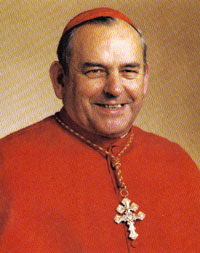
Cardinal Tomás Ó Fiaich

Cardinal Tomás Ó Fiaich

Born on 3 November, 1923, in Cullyhanna, South Armagh, in the Archdiocese of Armagh, Tomás Ó Fiaich was educated at St Patrick’s College, Armagh, St Patrick’s College, Maynooth, and St Peter’s College, Wexford. He was ordained a priest on 6 June, 1948 for the Archdiocese of Armagh. He spent his first year of ordination as assistant priest in Clonfeacle parish. He undertook post-graduate studies in University College Dublin, (1947-50), receiving an MA in early and medieval Irish history; he also studied at Louvain University, Belgium, (1950-52), receiving a licentiate in historical sciences. During this time he travelled widely across Europe researching the work and influence of the early Irish monks in Europe, a topic on which he was an acknowledged authority. In 1953 he was appointed lecturer in modern history at St Patrick’s College, Maynooth, and professor of same in 1959. He became Vice-President of the College in 1970 and President in 1974. He was appointed as Archbishop of Armagh on 18 August, 1977. He was ordained a Bishop on 2 October, 1977 in St Patrick’s Cathedral, Armagh. He was created a Cardinal in Pope John Paul II’s first consistory on 30 June, 1979. He died on 7 May 1990 and was buried in the grounds of St Patrick’s Cathedral, Armagh. His episcopal motto was Frates in Unum (Brothers in Unity).

A renowned historian who published widely Cardinal Ó Fiaich had a particularly love of Irish history. As Cardinal he received Pope John Paul II on his Papal visit to Ireland in 1979 but deeply regretted that due to the political situation the Holy Father was unable to visit Armagh City. He was Archbishop during the particularly difficult time of the H-Block hunger strikes. Cardinal Ó Fiaich will long be remembered as a very pastoral man with the extraordinary capacity to remember names and faces of people he may have only met once and to make connections with their relatives. He was a man who liked nothing better than to sit among his flock sharing stories with them. He constantly maintained that much more united Catholics and Protestants in Northern Ireland than divided them, and declared himself ready to meet any person, anywhere, at any time, if the cause of peace and reconciliation could be served.

Abstracted from Bishops of Ireland 1870-1987, by Rev. Bernard J. Canning

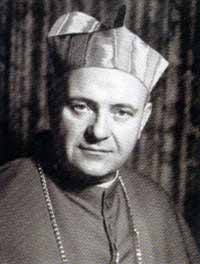
Cardinal William Conway

Cardinal William Conway

Born on 22 January, 1913 on the Falls Road, Belfast, William Conway studied at St Mary’s Christian Brothers’ School, Belfast, St Malachy’s College, Belfast, Queen’s University Belfast and St Patrick’s College, Maynooth. He was ordained a priest on 20 June, 1937 for the Diocese of Down and Connor. He spent the next four years doing post-graduate studies obtaining a Doctorate in Divinity in 1938 in Maynooth and a Doctorate in Canon Law at the Gregorian University, Rome in 1941. He served on the staff of St Malachy’s College, Belfast, 1941-42 teaching Latin and English. He taught in St. Patrick’s College, Maynooth 1942-58 as professor of Moral Theology and Canon Law. He was elected in 1947 dean of the faculty of Canon Law and Vice-President in 1957. He was named as Auxiliary Bishop to Cardinal D’Alton in 1958 and received Episcopal ordination on July 27, 1958. He was named Archbishop of Armagh on 9 September, 1963 and installed on 25 September. He was created a Cardinal on 22 February, 1965. He died on 17 April 1977 and was buried in the grounds of St Patrick’s Cathedral, Armagh. His episcopal motto was Praedicare Evangelium (To Preach the Gospel).

Cardinal Conway was Archbishop during the start of the ‘troubles’ and during some of the most horrific periods of the Northern Ireland conflict. He was strongly opposed to violence in all its forms. He said at Drogheda in July 1971 that “Violence can make the road to justice much longer and leave it strewn with innocent lives”. He pleaded with those who inflicted violence or injustice on their fellow men and women and repeatedly pointed out the incompatibility of this with Christian living. His compassion for those who suffer was not confined to the North of Ireland – the founding of Trócaire on his initiative, an agency to help the poor of the Third World is one of his lasting monuments.

Abstracted from Bishops of Ireland 1870-1987, by Rev. Bernard J. Canning