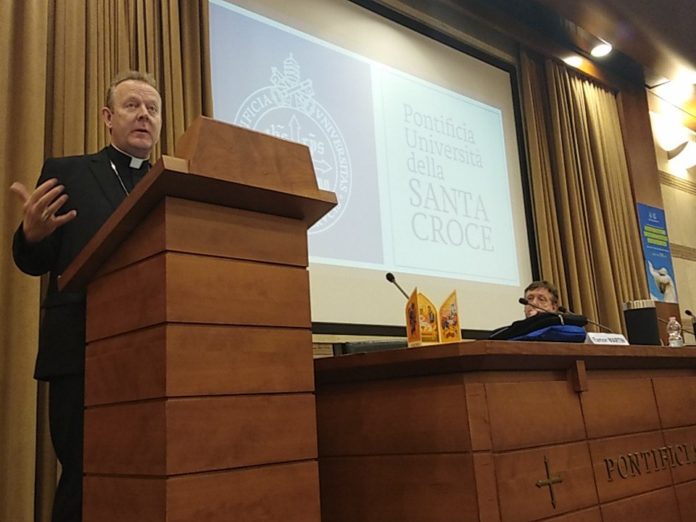
Address by Archbishop Eamon Martin at the Pontifical University of the Holy Cross, Rome
“Any strategy for communicating the family ought to begin with the conviction that it is primarily families who minister to other families, married couples who minister to other married couples” – Archbishop Martin
Introduction
Irish eyes were smiling on the 26 September 2015 when Pope Francis announced that Dublin would host the ninth World Meeting of the Families in 2018. They smiled all over again, last month, when it was confirmed that Pope Francis himself will attend the event. My brother Archbishop, Diarmuid Martin of Dublin, tells us that it was Pope Francis himself who chose to bring this great gathering of the universal church to Ireland. Despite challenging times for the Church in Ireland in recent years, family remains very important in the psyche of the Irish people. Family in Ireland is all about ‘connection’– family connects us to a home, to ‘ár muintir féin’ (as we say in the Irish language) – to the people who are our flesh and blood. Family also links us to a community, a parish, a county, to a history and culture, a language and tradition, our past, present and future. For many people in Ireland family also connects them to faith and values, to baptism and the community of believers.
The huge Irish diaspora across the world from the United States, to Australia, Britain and beyond, has been sharing our joy at hosting WMOF2018. Irish connections, of course, extend also to other distant continents where the Irish missionary movements carried the joy of the Gospel. The organising team of WMOF2018 is already delighted at the many thousands of people from overseas who have registered to join us in Dublin next August – we hope to offer you all, as we say in Ireland ‘céad míle fáilte’ – one hundred thousand welcomes.
The theme for the ninth World Meeting of the Families in Dublin is: The Gospel of the Family – Joy for the World! The communication of this joy-filled message about family has its roots in Amoris Laetitia. This is the first World Meeting of the Families since the conclusion of the 2014-2015 Synodal process and the publication of Pope Francis’ exhortation on ‘The Joy of Love’. The World Meeting will therefore be an invaluable opportunity for families of the world to come together to reflect on key aspects of Amoris Laetitia. They will do so with the conviction that the Church’s teaching on the family is not a ‘problem to be solved’, but is a gift for the world – a message that is positive, liberating, and humanising!
Communicating a Clear, Positive and Challenging Vision of Family
The ‘Gospel of the Family’
The World Meeting will seek to communicate and distil for our times the beautiful and prophetic vision of God’s plan for marriage and the family which was celebrated at the Synods and enunciated so positively in Amoris Laetitia. This so-called ‘Gospel of the Family’ has its origins in ‘the creation of humanity in the image of God who is love and who calls man and woman to love according to his own likeness’ (Relatio Synodi, 35).
Amoris Laetitia traces the Gospel of the Family from Sacred Scripture to Church tradition and the teachings of the magisterium. I particularly like the way Pope Francis reminds us how God chose to save us by sending his Son into the world in a human family which was open to receive him in love.
Facing Cultural Challenges
We believe that the Church’s proclamation of the family – founded on a faithful loving relationship between a man and a woman which is open to the gift of children who are the fruit of that love – is Good News for society and the world. There is no getting away, however, from the fact that communicating the family in this way can appear increasingly counter-cultural in many parts of the world, including Ireland. This has been accelerated by the departure in public discourse from the philosophical and anthropological underpinning of marriage and the family in natural law and the erosion of social supports for traditional marriage in the form of constitutional guarantee and positive legislation.
How difficult it must be for young people preparing for marriage to hear the still, small voice of faith amidst all the contradictory messages presented to them by the secular world. They are easily drawn towards an overly emotional and romantic concept of love and marriage that, ‘can be constructed and modified at will’ (Evangelii Gaudium, The Joy of the Gospel, 66).
There is also considerable pressure on young people to resist becoming ‘tied down’ by commitments, relationships or attachments – to delay or avoid lifelong commitments, including marriage and having children for as long as possible. Employers will often expect them to be flexible, movable, able to travel and work long, unsocial hours. On the one hand they are surrounded by a contraceptive, anti-birth mentality with its increasing indifference to abortion, whilst on the other they are offered a technocratic, commodification of child-bearing which, if necessary, can be accessed independently of any sexual relationship.
Good News for Today
Into this ‘soul-less world’ we have the joy and challenge of communicating a clear and positive vision of family and marriage: the Good News that human life is sacred, that each human being comes from God, who created us, male and female; that we are willed by God who loves each and every one of us; that self-giving love and commitment in the marriage of a man and a woman open to life is not only possible, but is a beautiful and fulfilling gift with the power of God’s grace; that chastity is achievable, healthy and good for our young people; that the giving of oneself to another in marriage for life is special, rewarding and a wonderful symbol of Christ’s forgiving, faithful love for his Church.
For Catholics, the expression: ‘What God joins together’ rings out as an exclamation of hope in the midst of a sometimes shallow and fickle world. We proclaim the Gospel of the Family because we believe in it, and we also believe that, with the help of God, it is attainable.
Pope Francis put it powerfully when he said: ‘The Church, with a renewed sense of responsibility, continues to propose marriage in its essentials – offspring, good of the couple, unity, indissolubility, sacramentality – not as ideal only for a few – notwithstanding modern models centred on the ephemeral and the transient – but as a reality that, in the grace of Christ, can be experienced by all the baptized faithful’ (to Roman Rota Tribunal, 22 January 2016).
Connecting with the Vocation and Mission of Family
It is one thing to have a joyful message to proclaim and propose – it is another to find effective ways of communicating this message. If no one is listening, it is difficult to communicate! For a while I thought that the task of proclaiming the Gospel of the Family in the Church was primarily up to me as a bishop or as a priest, but I have become more and more convinced that the Church’s vision of the family is best communicated by families, and in families, to families.
Evangelisation
At the 2015 Synod on the Family; I learned that the family is not simply the object of ministry and evangelisation, but it is a powerful agent of evangelisation.
As the ‘school of humanity’ and the ‘domestic Church’, it is in the family that values are transmitted, the wisdom of generations is passed on, the choices between right and wrong are evaluated, connections with the past are made, links with other families are made and upheld. It is in the family that we first are loved and where we first learn how to love. It is in the family that we discover who we are, where we have come from, our inter-generational relationships, our links with a place, with the land and a worshipping community, our rootedness in culture and language.
At the Synod we heard of movements, associations, basic Christian communities and many other networks which guide and nourish the marriage and family ‘vocation’. The World Meeting in Dublin will give us another opportunity to celebrate, communicate and share these initiatives with others. Any strategy for communicating the family ought to begin with the conviction that it is primarily families who minister to other families, married couples who minister to other married couples.
Take for example the importance of prayer in, and for, the family. In seeking to provide prayer guidance and support for families the best place to look is to other families! Family spirituality is best facilitated by family associations, groups and movements which have been established by and for families. As a priest and bishop I have come to know and admire the wonderful work of new evangelisation that is carried out in Ireland by, for example, communities of families who are following the neo-catechumenal way of renewal and catechesis, the witness of the Syro-Malabar community to the importance of family catechesis of children and young people, the enthusiasm of the Catholic Grandparents Association, Retrouvaille, ACCORD, Marriage Encounter, Couples for Christ, and many others.
Points of Contact and Communication Resources
It is very helpful for the Church to consider what are her points of contact with the daily reality of family life, to consider where and when we connect with families – in addition, of course, to the many contacts we have with individuals as members of families. I recently asked the priests and pastoral workers of my diocese to identify some of the points of contact or interaction between the Church and families.
Preparation and celebration of the sacraments of baptism, First Holy Communion, First Confession and Confirmation were all mentioned as providing opportunities for contact with families, and times to affirm, celebrate and teach the Church’s vision about the family – Marriage preparation and the ceremony of marriage are other obvious examples. In Ireland customs and rituals surrounding death remain strong in most communities, including the traditional ‘wake’ where the body of a loved one is brought home before the funeral. These times, and the funeral Mass itself, are powerful opportunities for the Church to accompany families in grief, touching their lives with the love and mercy of God.
One of the most moving Church gatherings in Ireland is the annual blessing of the graves ceremony, where families gather at the grave of their loved ones for Mass or a blessing service – often with family members travelling long distances home for the occasion. This is another grace-filled opportunity for the Church to teach and communicate the vision of love in family life.
The team working on World Meeting of Families has been preparing resources to support these moments of grace, including an especially composed prayer and hymn which is being used extensively throughout the parishes of Ireland and elsewhere.
A menu of practical parish initiatives is offered for popular moments like New Year’s Day, Saint Patrick’s Day and even on Saint Valentine’s Day to help communicate key messages from The Joy of Love. These are supported by a range of online resources including animations, studio discussions and interviews.
Last Christmas tens of thousands of copies of the commissioned Icon of the Holy Family were distributed to all parishes for display in their homes and church buildings. The icon-card includes the official WMOF prayer.
A commemorative card is also available for each child baptised and each couple getting married in the year leading up to the World Meeting of Families 2018.
The Amoris cube is a flat-packed toy with the six sides of the foam cube displaying simple messages from The Joy of Love to provoke conversation and practice in families.
All our Confirmation candidates are being challenged this year to show acts of kindness to their family, friends and community. Young people are encouraged to log their acts of kindness online as we are aiming to meet the target of one hundred thousand acts of kindness to present to the Holy Father when he visits in August.
Our development agency, Trócaire, is calling upon parishes to take on the Romero Award as part of their preparations for the World Meeting of Families. Inspired by Blessed Óscar Romero and his concern for the poor and oppressed, the Romero Award is awarded to those families and others who can show how they have highlighted some form of injustice in our world, thereby inspiring families and communities to live more justly.
This Easter time we are encouraging families to rekindle the practice of blessing their homes. I remember well as a young boy bringing home the ‘Easter water’ from a big barrel outside our parish Church. This water, in which the Paschal Candle had been dipped at the Easter Vigil, was sprinkled by our parents and grandparents to ask God’s protection and ward off evil, and so to bless family members and homes, outbuildings, cars and tractors, and of course the graves of our loved ones.
During May we will be promoting the age-old custom of the ‘May Altar’ to Our Lady in the homes and schools of Ireland and at Pentecost we are encouraging parishes to conduct a parish audit of how the parish is engaging with the diversity of family life in its midst. It invites the parish to come up with ideas on how to be more welcoming, supportive and inclusive of families in different situations.
In Amoris Laetia Pope Francis expresses his hope that the faithful will study his exhortation carefully and patiently. The Amoris: Let’s Talk Family! Let’s Be Family! programme includes a six-session Parish Conversation exploring some of the key messages in the papal publications of Amoris Laetitia, Evangelii Gaudium, and Laudato Si in an accessible and practical way using ICT, video and audio messages and testimonies. Local volunteers have been trained to deliver the Amoris programme and all these resources are available online at www.amoris.ie<http://www.amoris.ie> or www.worldmeeting2018.ie<http://www.worldmeeting2018.ie>.
Pastoral Challenges – Discernment and Accompaniment
At the Synod on the Family in 2015 it was moving for me to hear the bishops as shepherds of the Church describing the hopes and anxieties that face their flocks – the families of the world. We heard passionate, first-hand accounts of forced migration, persecution and war; we were shocked by the extent of human trafficking and the exploitation and commodification of women and children. We heard about ‘wombs for hire’, child soldiers, forced prostitution and the exploitation of street children in large cities. We shuddered at the prevalence of abuse and domestic violence. We considered the challenges presented in some cultures by polygamy, arranged marriages, mixed and inter-faith marriages. We spoke about the pressures on family life from individualism and isolation and the spread of abortion, euthanasia and gender ideology. We faced the reality that in many countries the majority of marriages take place without any reference to faith or to God. At the same time, however, we shared our tremendous admiration and gratitude for the many families who do their best in complex situations to persevere, to grow in love and to generously witness to commitment, forgiveness, and lifelong faithfulness.
The overwhelming sense among the bishops at the Synods was a desire to be with all families, and especially with those whose homes are visited by tragedy or violence and those who, for whatever reason, have experienced breakdown in their relationships and may feel excluded from the Church. The Synods and Amoris Laetitia were clear that we need to be mindful of those who have begun new relationships and unions, and find sincere and truthful ways of welcoming and including them in the life and worshipping community of the Church.
What do we do in these situations? Do we sit outside and judge? Or do we accompany all our people, presenting the truth and joy of the Gospel of the Family in a loving, charitable way? The World Meeting of Families will provide another opportunity for us to propose forms of pastoral discernment and accompaniment in these and other difficult situations, and a ministry of care to those whose marriage relationships have broken down, conscious that the Christian message of truth and mercy converges in Christ.
As the Bishops at the 2015 Synod concluded: “we have a responsibility to help all God’s people find God’s plan for them, knowing that no one is excluded from God’s love and that all are included in the Church’s pastoral activity” (see Relatio Synodi, 34).
WMOF2018 in Ireland – a Changed Context
Almost forty years on from the last papal visit to Ireland in 1979, the Church now seeks to communicate its vision of family in an entirely different context. The role of religion and faith in Irish society, north and south, has been hugely impacted by secularisation and is evidenced by a steady decline in Church attendance and in vocations to the priesthood and religious life. Like other parts of Europe and the Western world, more people in Ireland are now living their lives without reference to God or to religious belief.
We are steadily moving from a society in which it was virtually impossible not to believe in God, to one in which faith is considered by many to be simply one human possibility among others. There are ongoing calls from some quarters for the removal of the Church’s perceived remaining influence in schools, healthcare and public policy making.
In the aftermath of child abuse scandals and other shameful episodes of the past, we have to be aware, in communicating the family, that there are those who feel they can no longer trust our message, because they have been hurt and betrayed in their families by their experience of Church. The sins and crimes of sexual abuse in the Church have not only had tragic consequences in the lives of victims and their families, but have also, as Pope Benedict XVI put it in his Pastoral Letter to the Faithful of Irelandin 2010, ‘obscured the light of the gospel’.
In this complex and often negative environment we are challenged to learn new ways of communicating our sincerely held perspectives about family and other matters. We realise that we must do so now alongside those of other faiths and none, and thereby continue to encourage conversations at a national level on the challenges and opportunities in family life.
The Report of the President of Ireland’s ‘Ethics Initiative’, issued in February 2016, identified that what Irish society needs is a debate on what ethical values and principles we want to uphold and strengthen; we need to have a conversation(s) on our understanding of what constitutes a ‘good life’ or a ‘flourishing life’ not just for individuals but also for communities (On the Importance of Ethics, A Report on the President of Ireland’s Ethics Initiative, Section 4, ‘Broader Challenges for Society’, Aras an Uachtaráin, February 2016)
In entering this kind of dialogue, we in the Church must be cautious about thinking that people who disagree with us are necessarily hostile. Bishop Donal Murray writes: “Civilised discussion should begin from the presumption that all concerned are honestly seeking the truth … We should remain open to recognising the elements of truth that are present in the convictions of someone we disagree with … Honest convictions are the fruit of a search for truth and for God, the search in which those on both sides of the argument are involved” (Donal Murray, In a Landscape Redrawn pp 65-66, Veritas 2017).
The French bishops recently raised similar points: “Many of our fellow citizens, some out of confusion, wonder: who am I really? What do I believe in? What are the values which made me and matter to me? Where do they come from?” (Dans un monde qui change retrouver le sens politique, Bishops Conference of France (CEF) October 2016, translation international.la-croix.com<http://international.la-croix.com).
What is interesting about the French bishops’ statement is that they speak not only as people of faith, but also as fellow French citizens, pastorally accompanying their troubled people with empathy and concern. The bishops caution against any aspiring to be a “Church of the pure, a counterculture removed from society, posing as a judge from above”.
The engagement of people of faith together with all people of goodwill in conversations about family, marriage and other critical life matters is to be encouraged and welcomed. Drawing upon its rich tradition of social teaching, the Catholic Church will sometimes bring uncomfortable questions into such a dialogue. However, in an atmosphere of respectful encounter, it is possible for two-way, critical interaction and conversations to take place between religious traditions and the broader culture, including constructive critiques of social, political, legal, and economic practices.
For example, taking inspiration from the powerful 1983 Charter of the Rights of the Family, we might ask: To what extent does public policy support Family and Life, freedom of education and conscience, a proper work-life balance, which respects the role of mothers and fathers? What do our economic and social policies say to poorer families, particularly those policies which impact directly on family: the needs of children and the elderly; tackling the proliferation of drugs, alcohol, gambling and other addictive behaviours which can destroy home and family life? How do welfare policies and benefit programmes support families who are most in need and who are so easily targeted and exploited by loan sharks and other criminal elements? How can we better assist young people who wish to establish a family, mortgage a home, take out insurance, but who may sometimes be convinced by economic policy to remain single?
Towards a Culture and Language of Engagement
I am convinced that a constructive culture of engagement, rather than a pointless culture war, is the best way to ensure that the voice of faith, communicating the Family, can be heard. It begins with our conviction that, among the many types of family that are out there, the Catholic Church’s vision of the uniqueness of a faithful and exclusive union between a married man and a woman and their children, is not simply for the privacy of our homes and churches. The Gospel of the Family is meant for mission. It is not to be cloistered away from the cut and thrust of public discourse.
Pope Francis has said, “The family deserves special attention by those responsible for the common good, because it is the basic unit of society, which brings strong links of union that underpin human coexistence and, with the generation and education of children, ensure the renewal and the future of society.” As the Synod final report put it: “A society that neglects the family has lost its access to the future.”
The World Meeting of the Families gives us a privileged opportunity to communicate the Gospel of the Family ad intra, and ad extra, as good for society and good for the Church; in short, a message of Joy for the world!
Thank you for listening.


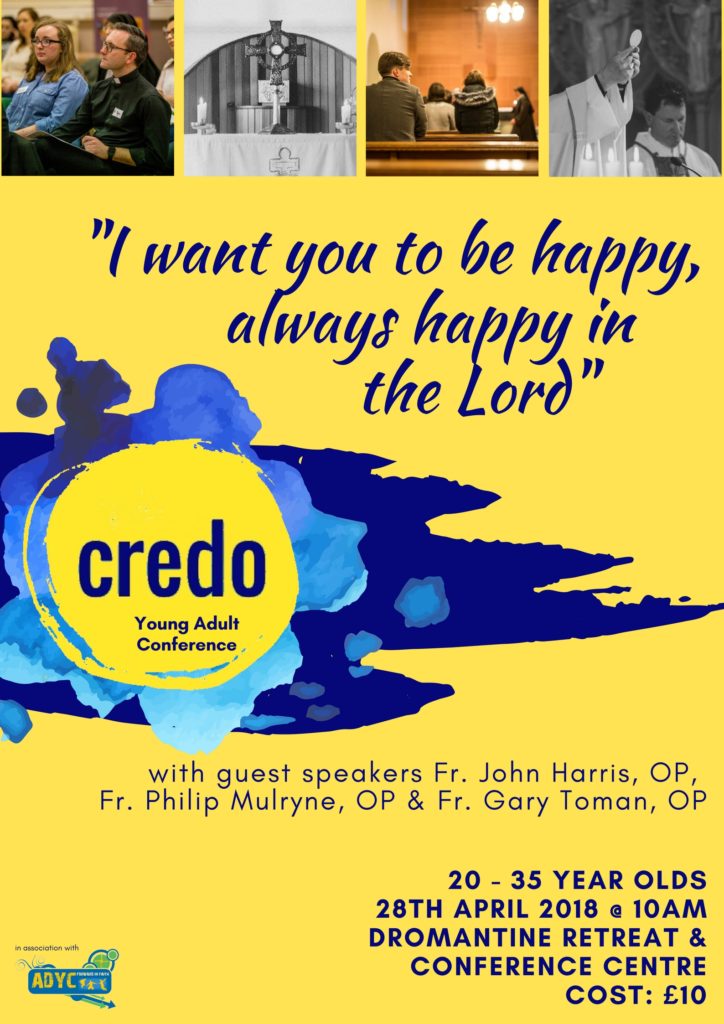 The theme of the conference is “I want you to be happy, always happy in the Lord” (Phil 4:4). This event will be an opportunity for young adults, aged 20-35, to grow in confidence knowing that they are enough, that God loves them and that their role within the Church is valued. It is our hope that participants will leave the conference enriched, empowered and ready to face the challenges of life with Christ by their side.