Home Blog Page 36

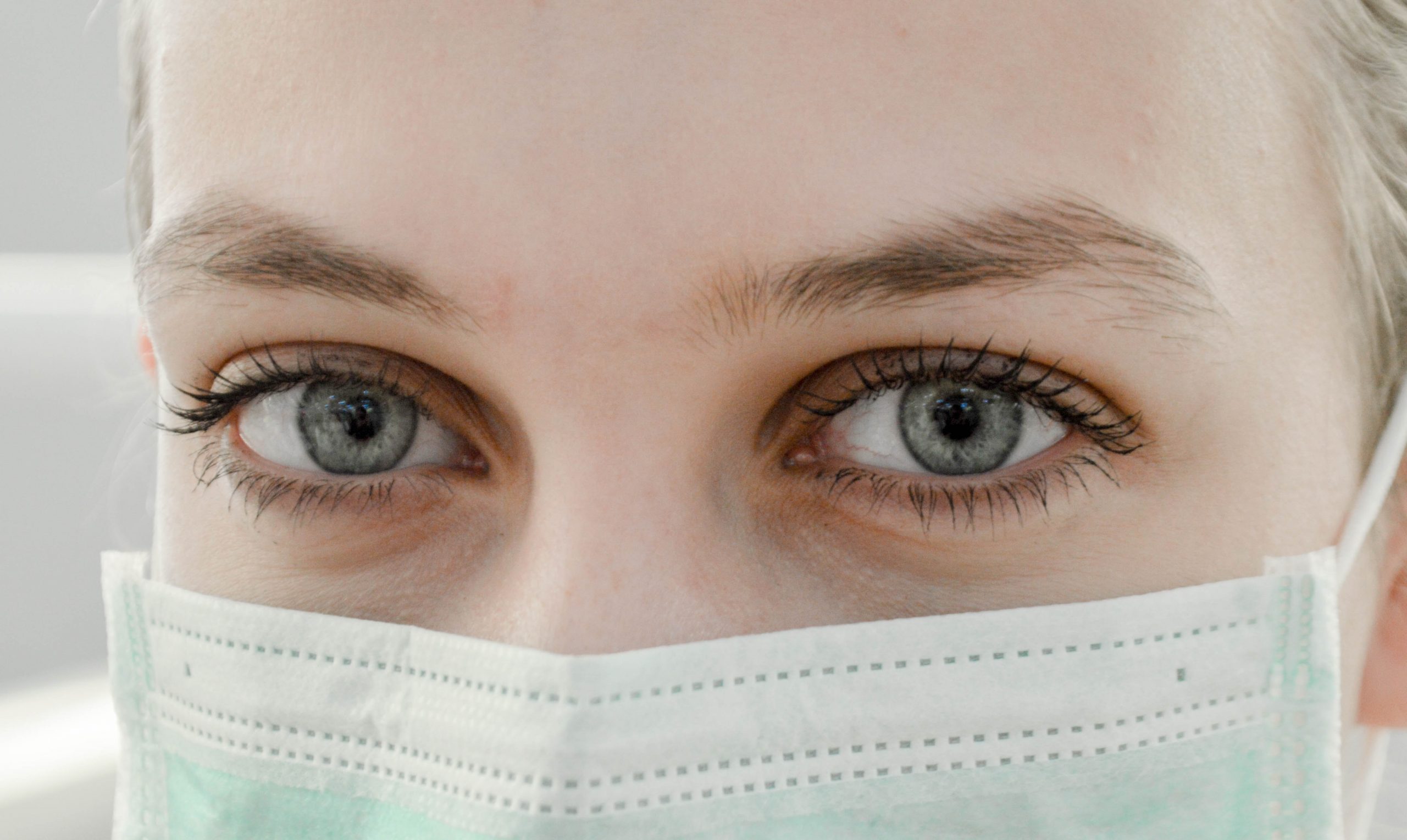
Church leaders urge worshippers to wear face coverings to reduce the spread of Coronavirus

Church leaders urge worshippers to wear face coverings to reduce the spread of Coronavirus


The following statement has been issued by the Roman Catholic and Church of Ireland Primates of All Ireland, the Moderator of the General Assembly of the Presbyterian Church in Ireland, and the President of the Methodist Church in Ireland:

At this time, both in Northern Ireland and in the Republic of Ireland, the governments have not formally made mandatory the wearing of face coverings at services of worship. This is, in part, due to the fact that as churches we are committed to maintaining 2 metre physical distancing between household groups and strict adherence to all government guidance on hand hygiene, cleaning, ventilation etc.

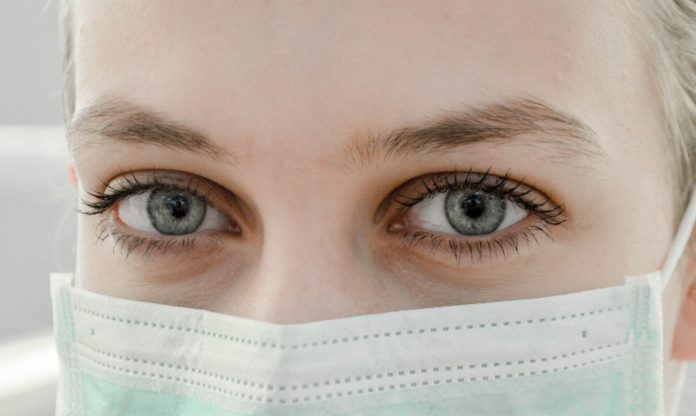
It, however, remains our responsibility to ensure that our services of worship are safe places for all who join with us. It has become increasingly clear that the wearing of face coverings, in conjunction with hand washing etc., is likely to reduce the spread of Coronavirus, thus helping to protect others. Their use is therefore one way in which we can evidence protection for the most vulnerable, support for our health workers, and practical love for our neighbours.

Following further recent consultations with public health authorities, we join with Christian church leaders all over this island in formally recommending and encouraging the use of face coverings at all services of worship, along with the ongoing maintenance of 2 metre physical distancing, from Sunday 30 August 2020, and earlier if practicable.

We understand that some people are exempted from the wearing of face coverings, as outlined in the two jurisdictions.

We also recognise that whilst it may not be appropriate for those who are leading from the front during worship, including preaching, to wear face coverings, they should at all times continue to maintain at least 2 metre physical distancing from one another, and 4 metre physical distancing from the front row of the congregation.

The Most Revd Eamon Martin

Roman Catholic Archbishop of Armagh and Primate of All Ireland

The Most Revd John McDowell

Church of Ireland Archbishop of Armagh and Primate of All Ireland

The Rt Revd Dr David Bruce

Moderator of the General Assembly of the Presbyterian Church in Ireland

The Revd Dr Tom McKnight

President of the Methodist Church in Ireland

Message for Nagasaki Day by Archbishop Eamon Martin

Message for Nagasaki Day by Archbishop Eamon Martin given at Saint Patrick’s Church, Pennyburn, Derry

“The development of atomic energy for war and the possession of atomic weapons is immoral and incompatible with our faith”

Archbishop Eamon


It was around this time seventy five years ago that an atomic bomb was detonated above the Japanese city of Nagasaki. Three days earlier another atomic bomb had devastated Hiroshima. Together these attacks caused more than two hundred thousand immediate deaths, and led in the years to come to tens of thousands of others who perished from direct injuries, cancers and other effects of radiation. The bombs of Hiroshima and Nagasaki seventy five years ago are still seen by many as among the worst examples of what we humans can do to each other. The devastation caused on the ground was unimaginable – last Tuesday’s horrific explosion that ripped through the port in Beirut, causing such terrible death and destruction, was small in comparison. And yet, several countries continue to hold, develop or test weapons of mass destruction which are capable of unleashing many times over the horrors of 1945.

Last November Pope Francis visited Hiroshima and Nagasaki as a pilgrim for peace. He passionately pleaded for an end to the development and threat of such armaments, including the use of the deterrence argument – that having such weapons helps to guarantee world security and peace.  He said “the possession of nuclear and other weapons of mass destruction is not the answer”. Instead it fosters “a false sense of security sustained by a mentality of fear and mistrust, one that ends up poisoning relationships between peoples and obstructing any form of dialogue.” It is “incompatible” he said to try to build and sustain peace “upon the fear of mutual destruction or the threat of total annihilation.”

Pope Francis also strongly denounced the arms race pointing out that “in a world where millions of children and families live in inhumane conditions, the money that is squandered and the fortunes made through the manufacture, upgrading, maintenance and sale of ever more destructive weapons, are an affront crying out to heaven.”

In today’s readings at Mass we contemplate the presence of God, not in the earthquake wind and fire, but in the still, small voice spoken to Elijah out of the gentle breeze on Mount Horeb.

We hear the words of Jesus in the midst of the storm holding out his hand  to Peter who was losing confidence, encouraging him: ‘Do not be afraid, you of little faith‘. 

The palmist sings of justice and peace embracing, mercy and faithfulness meeting as he cries out ‘Let us see o lord your mercy and give us tour saving help’.

This week here in Derry we have laid to rest one of our greatest sons, the Nobel laureate John Hume who throughout his whole life urged people never to see violence as a way to solve differences and achieve aspirations.

On this Nagasaki day, it is worth reminding ourselves that the development of atomic energy for war and the possession of atomic weapons is immoral and incompatible with our faith in Christ the Prince of Peace. Pope Francis urges us to pray and work every day for the abolition of nuclear weapons, “for the conversion of hearts and for the triumph of a culture of life, reconciliation and fraternity.” And so we pray:

Lord, make me an instrument of Your peace; 
Where there is hatred, let me sow love; 
Where there is injury, pardon; 
Where there is doubt, faith; 
Where there is despair, hope; 
Where there is darkness, light; 
And where there is sadness, joy. 

O Divine Master,
Grant that I may not so much seek
To be consoled as to console; 
To be understood, as to understand; 
To be loved, as to love; 
For it is in giving that we receive, 
It is in pardoning that we are pardoned, 
And it is in dying that we are born to Eternal Life. 

Amen.

Theology Programme

Do you want to learn more about your faith?

If you are interested, why not consider joining our Theology programme.  The course takes two years with one night per week and two weekends over the academic year and is accredited by St Patrick’s College, Maynooth. There are no educational entry requirements, and completion of the course is based on submitted work and does not include sitting exams. Our Theology course will be continuing this year with predominantly online classes, starting on 8th September.

If you are interested and would like more information contact Milanda on 00353 429336393 or [email protected] (9am – 2pm). All are welcome.

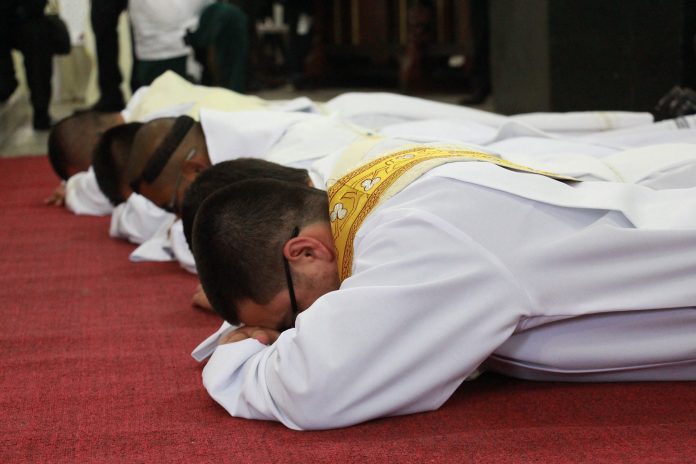
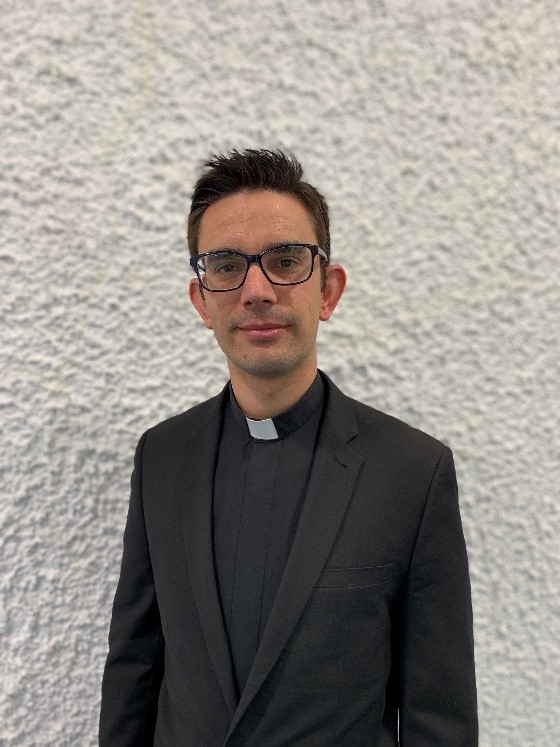
Diaconal Ordination of Callum Douglas Young and Juan Jesus Gonzalez Borrallo. Redemptoris Mater Seminary.

Diaconal Ordination of Callum Douglas Young and Juan Jesus Gonzalez Borrallo.
Redemptoris Mater Seminary.

Friday, 28th August 2020 at 12:00 noon, St Patrick’s Cathedral Armagh.  Friday, 28th August 2020 at 12:00 noon

Archbishop Eamon Martin will ordain Callum Douglas Young and Juan Jesus Gonzalez Borrallo deacons for the Archdiocese of Armagh.

Callum was born in 1991 in London. He is the first child of Neil and Bernadette. He has five younger brothers and sisters. He began his formation for the priesthood in the Redemptoris Mater Archdiocesan Missionary Seminary in Dundalk in the year 2012.

He completed
his philosophical and theological studies at St Patrick’s Pontifical University, Maynooth. He has done pastoral placements in the parishes of Cookstown, Coalisland and Newry Cathedral. As part of his missionary formation, he spent some time in the Middle East, in the Holy Land, Dubai and Bahrain.

Juan Jesus was born in 1991. He comes from El Repilado (Spain). He is the first child of Jose Antonio and Maria de las Nieves. He has three younger siblings.  He started his formation to the priesthood in the Redemptoris Mater Seminary in Dundalk in the year 2013.

He completed his studies for the priesthood at St Patrick’s Pontifical University, Maynooth. Juan Jesus has done pastoral placements in the parishes of Dungannon and Newry Cathedral. As part of his formation in the Seminary, he has been in mission in
the Holy Land, Mozambique and Argentina.

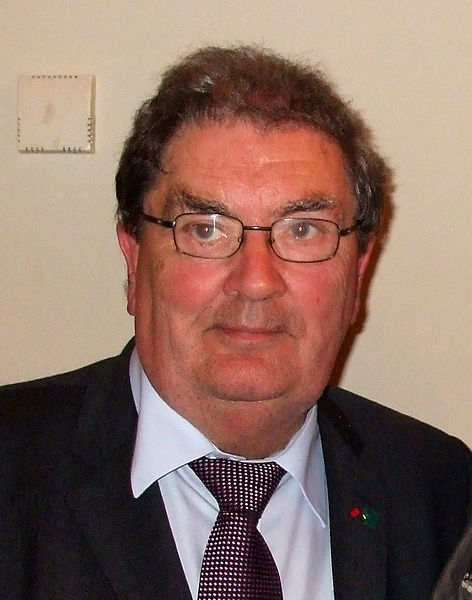
Archbishop Eamon Martin’s tribute to John Hume RIP: “A paragon of peace”

Archbishop Eamon Martin’s tribute to John Hume RIP: “A paragon of peace”

A great sadness has descended on my home city of Derry today as we learn of the death of one of our greatest sons, Mr John Hume. That sadness ripples out to every corner of Ireland and all around the world where the mere mention of the name of John Hume evokes admiration, respect and thanksgiving for a life dedicated to peace and social justice. Today we are remembering a paragon of peace, a giant of a statesman whose legacy of unstinting service to the Common Good is internationally acclaimed, even though it is still perhaps only unfolding.

As a young person growing up in Derry I was hugely influenced by this man of principle. For me, like many other pupils of Saint Columb’s College, John Hume was considered one of our heroes and role models. When I went to study for the priesthood at Maynooth I was happy to know that he too had once been a seminarian for the Diocese of Derry. But John’s vocation was to serve God and his community as a layman, and he totally devoted his energies to that vocation – to relieving poverty, challenging injustice and providing decent living conditions for all.

Later, as a priest working in Derry, I came to know John as a man whose convictions were rooted in a deep faith, in prayer and practical Christianity. I was honoured to announce eight years ago that Pope Benedict XVI had conferred on him a papal knighthood in recognition of his commitment to peace, reconciliation, non-violence and social justice. John put Catholic Social Teaching into practice – sometimes at great personal cost and risk – working ceaselessly for a process of reconciliation through which the dignity of every human person is recognised and upheld. For me, this is best summarized in the words of his Nobel Laureate speech (1998):

“I want to see Ireland as an example to men and women everywhere of what can be achieved by living for ideals, rather than fighting for them, and by viewing each and every person as worthy of respect and honour. I want to see an Ireland of partnership where we wage war on want and poverty, where we reach out to the marginalised and dispossessed, where we build together a future that can be as great as our dreams allow.”

Every so often we come across a person of vision, who lifts us up to see and think beyond the confines of our own, much narrower, perspectives. John Hume was such a man of vision, whose dreams were challenging but always achievable – whether it was ‘people helping people’ in a credit union or ‘countries assisting countries’ in the European project – he lived out the principle of “Ní neart go cur le chéile” (there is no strength without working together). His secret was to encourage the pooling of ideas and resources to raise the hopes and opportunities for all. B’fhéidir nach bheidh a leitheid aris ann – it is now up to the rest of us to step up and be as courageous and determined as he was to deliver (in the words of his favourite song) that “bright brand new day”!

Our prayers and thoughts are especially with his dear wife Pat and Family. Pat was such a rock of support to John, and is an inspiration to all of us. We ask that God will comfort her and John’s extended family circle, friends, former colleagues and loved ones in the knowledge that John was someone special – one in a million!

Ar dheis Dé go raibh a anam dílis.


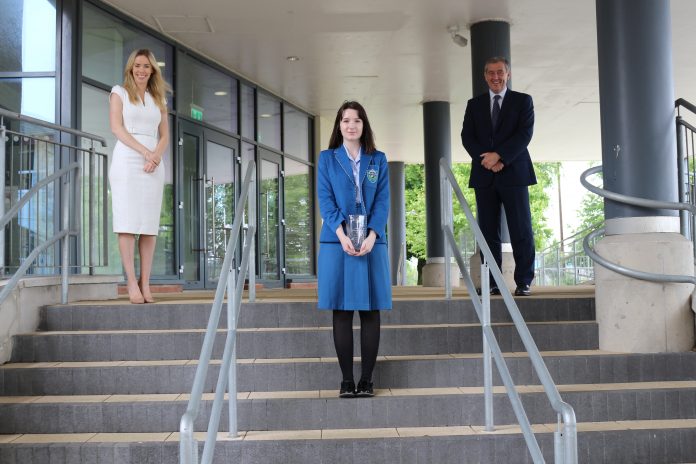
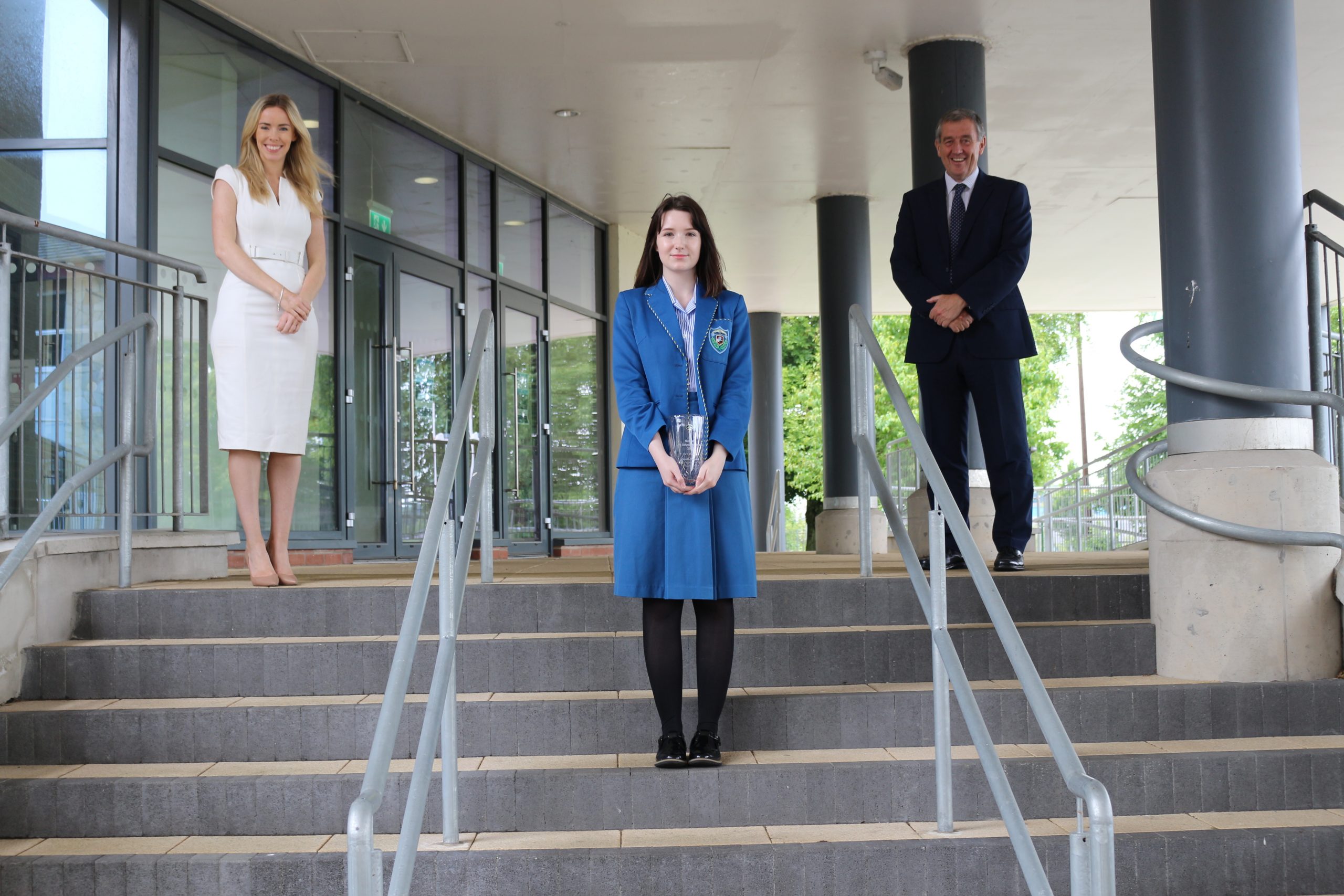
Life Advocate Awards 2020 Winner, St. Mary’s Grammar Magherafelt

Life Advocate Awards 2020 Winners


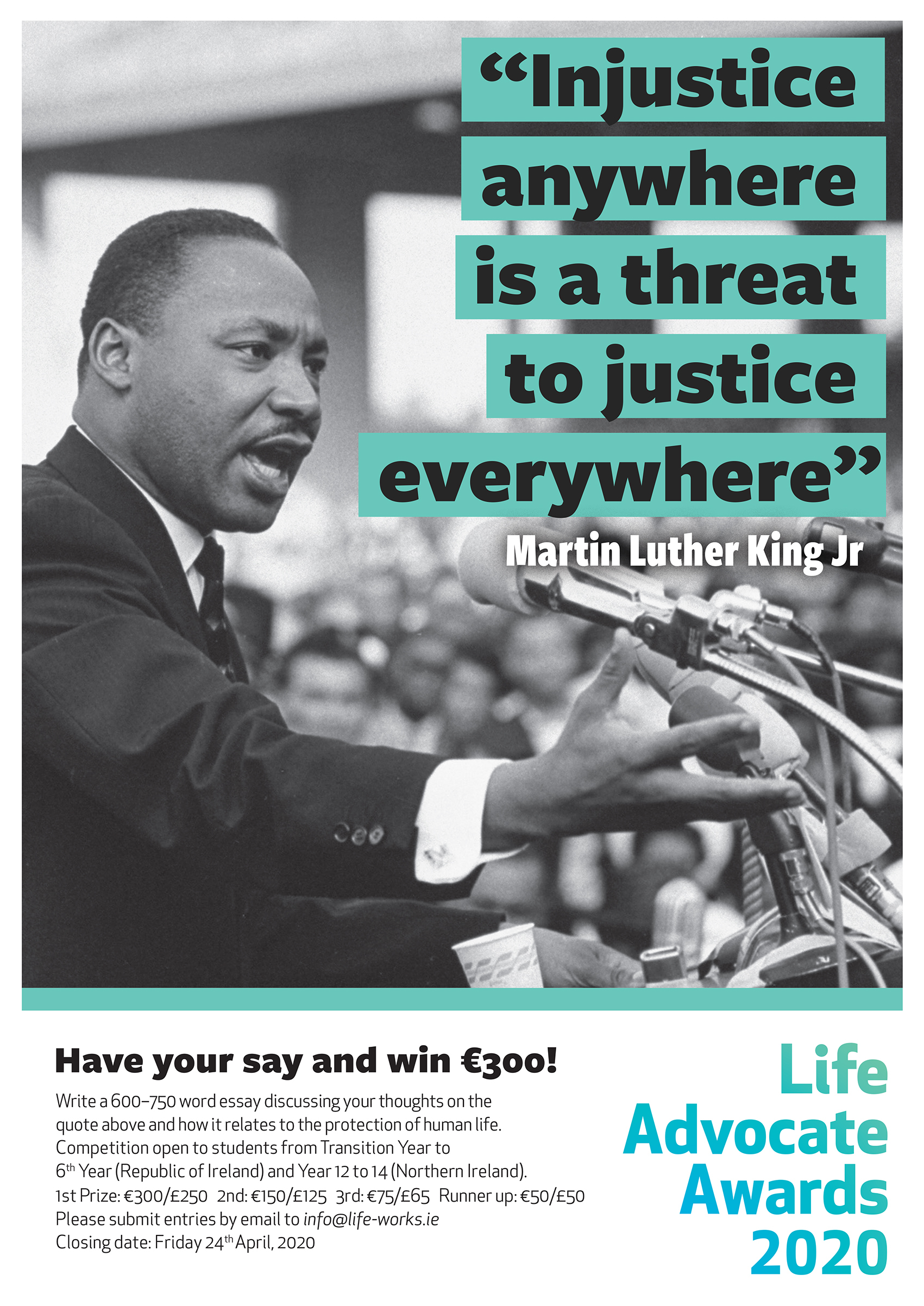
LifeWork’s ‘Life Advocate Awards essay writing competition’ received a tremendous response to this year’s  competition, despite school closures, and the challenges presented by Covid-19 restrictions.  

The annual award programme – which is now in its fifth year – was designed to encourage research and critical-thinking on human rights and the right to life. The entries were of a very high standard and reflected a growing interest and awareness in human rights.

This year students are asked to submit a 600-750 word essay discussing the following words of Martin Luther King Jr: “Injustice anywhere is a threat to justice everywhere”.

This year’s winner Orlaith McAuley, is a Year 14 student from one of our Archdiocesan schools, St. Mary’s Grammar School, Magherafelt.  Orlaith won first place for her excellent and thought-provoking essay. In discussing the theme, she wrote: “All life is sacred and should be valued and protected, particularly those who are most marginalised and vulnerable”.


Orlaith was honored to receive a personal video from Dr Alveda King – a niece of Martin Luther King Jr – congratulating her on the winning entry.


Drumalis Retreat and Conference Centre Online Programmes

Drumalis Retreat Centre in Larne are offering the following programmes in the coming days and months.

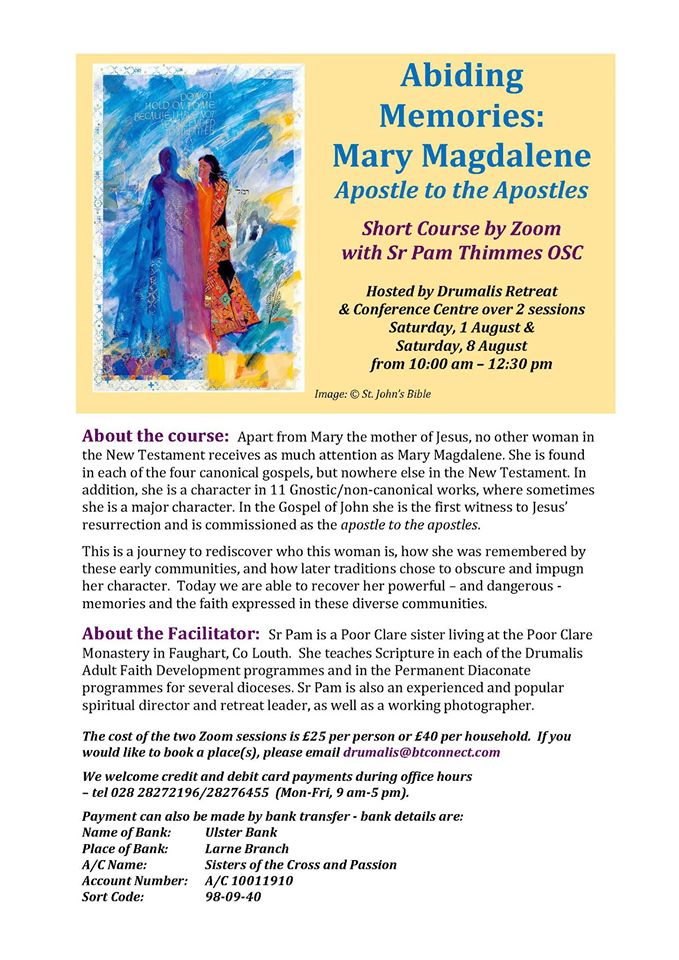
The first programme is a two session Zoom input by Sr Pam Thimmes on ‘Abiding Memories: Mary Magdalene, Apostle to the Apostles’.  This will take place on Saturday 1st and & 8th August.


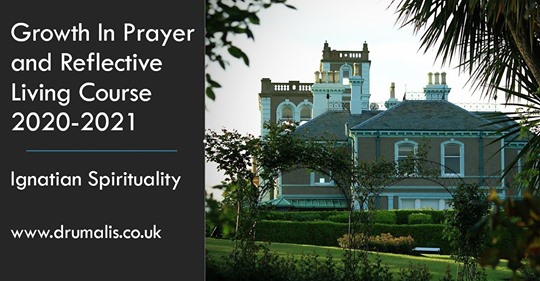
The second is ‘Growth in Prayer and Reflective Living: Ignatian Spirituality’  which we will be offering over 30 Monday evenings.  This course is in collaboration with the Ignatian Spirituality Centre, Glasgow.  Initially the course will be by Zoom but, if circumstances permit, it will be delivered in-house while continuing to be accessible remotely.

Click Here for video promoting ”Growth in Prayer and Reflective Living: Ignatian Spirituality’ 

If you are interested in either of these programmes enquiries can be made by phone from 9 am – 5 pm (Mon-Fri) – 028 28272196 / 28276455. Alternatively, please email [email protected]

“I WAS SICK AND YOU VISITED ME” – HOSPITAL CHAPLAINCY TO RESUME ROUTINE VISITS


“I WAS SICK AND YOU VISITED ME” – HOSPITAL CHAPLAINCY TO RESUME ROUTINE VISITS

On behalf of the Chaplaincy Teams across the Southern Trust, we are delighted to say that routine visitation of wards by chaplains will re-commence from Monday July 20th. Emergency on-call cover continued to remain in place throughout the Covid-19 pandemic and returning to wards for more routine visits is an important step forward at this time.

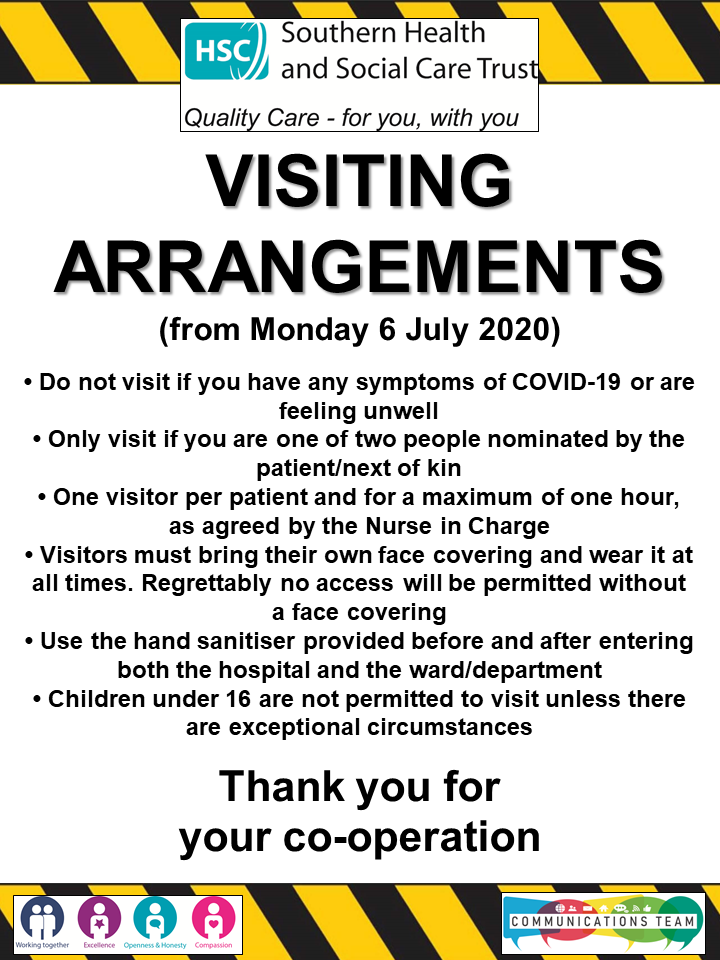
As you can imagine, it will be a gradual and tentative re-engagement as we encounter the “new normal” in hospitals. It is a very changed environment into which we step. For example, given the visiting restrictions now in place (see attached), we will be avoiding visiting hours as only one nominated person can visit a patient at a time.


While visits by the Chaplaincy Teams are permitted to resume, visits by parish clergy / ministers are not yet permitted by the Southern Trust in their hospitals. This is due to the strict limits on visitor numbers and infection prevention & control procedures. Please refrain from visiting parishioners in hospital at this time. If you know of a parishioner who is in hospital and would like a visit from the Chaplaincy Team, please ask them to consent to the visit when asked by the nursing staff. Alternatively, a member of their family can ask the hospital to call us. You can always contact the hospital and ask to speak to the chaplain on call.

On behalf of the Chaplaincy Teams across the Trust, we are deeply grateful for your support in so many ways. We know you join with us in continuing to pray in a special way for those who are sick at this time and those who care for them.

If you have any queries about hospital chaplaincy at this time, please feel free to contact any of the chaplains.


Bishops Statement regarding the Report of the Department of Health on “Termination of Pregnancy” in 2019

Statement by the Bishops’ Council for Life regarding the Report of the Department of Health on “Termination of Pregnancy” in 2019


In recent months Ireland has experienced the traumatic effects of the COVID-19 pandemic, which has touched every sector of society. While many people have suffered emotionally and economically, we think immediately of those who have died, 1,735 people as of 30 June. Each one was a unique human being, created in the image of God, and each one’s death is being grieved by a family, a friend, a community.

Every human life is worthy of respect and care from the moment of conception to natural death. The enormous contrast between the collective grief of the nation at the recent deaths of so many people, and the bland five page report from the Department of Health, published on the same day, 30 June, which details the 6,666 – six thousand six hundred and sixty six – “Terminations of Pregnancy”, which took place in Ireland in 2019, is staggering.

The report states that 24 of the abortions were carried out on medical grounds. Those carried out on the grounds of a “condition that was likely to lead to the death of the foetus” numbered 100. The Irish Catholic Bishops pointed out in advance of the referendum in 2018 that there is absolutely no moral justification for deciding that a baby should die because he or she has a serious health condition.

The vast majority of babies who were aborted in Ireland last year, 6,542 of them, are euphemistically described as having been “terminated” in “early pregnancy”. While we never got to know them personally, each one was a unique and precious human being. It was not their fault that their conception was inconvenient or untimely, or the result of sexual assault or that their parents lacked the support that would have helped them to embrace life.

The publication of the Government report is, however, a timely reminder for Irish society of the concrete consequences of the decision made in May 2018, when the majority of Irish voters (66.4%) chose to remove constitutional protection from the unborn, and the majority of politicians voted to enact this law against life. The report, for those who will look beyond the statistics, represents a fresh call to conversion for individuals, for the political establishment and for society.

It is an important expression of our pro-life commitment that Catholics would commit to offering practical and emotional support to women who experience difficulty because of pregnancy. We encourage all our parishioners to be sensitive to this need in their own network of relationships and to support the various pro-life organisations which offer that kind of outreach.

While there may be no public grief over the deaths of these 6,666 unborn babies, we know from our own experience that there will be much unexpressed personal grief. We take this opportunity to invite all those affected by abortion – women and men – to avail of spiritual, sacramental and pastoral support, and we assure them that they will be welcomed without judgement and helped to find healing and peace.

Framework Document for a return to the public celebration of Mass and the Sacraments

Statement of the Irish Catholic Bishops` Conference on the publication of the Framework Document for a return to the public celebration of Mass and the Sacraments (9th June 2020)
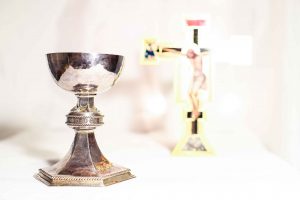
As we look forward in joy and hope to the re-opening of our churches for the celebration of Mass and the Sacraments, we offer this Framework Document [see below] to the dioceses and parishes of Ireland.  The purpose of this document is to assist priests and people in their own preparations and to help ensure that the re-opening of our churches for public worship happens in a safe and measured way.  We realize that, given the rich variety of our church buildings and communities, the Framework will need to be adapted to suit differing situations on the ground.  However, as our document states:

“in all circumstances the safety and health of people, ministers, and priests must be paramount.  No church should be opened for public prayer or worship until satisfactory arrangements, as indicated in this Framework, have been put in place.” 

This Framework has been developed in the light of extensive consultation across the dioceses of Ireland and we are very grateful to all who contributed thoughts, comments and suggestions.  The document also takes cognisance of the most up-to-date public health advice and associated regulations and obligations.

At our meetings this week we have been keeping in our prayers all who have been affected by COVID-19 in our country and throughout the world.  We are especially conscious of the pain and loss felt by so many grieving families.  We acknowledge with immense gratitude the skill and courage of our medical professionals and carers.  We appreciate deeply the prayers, sacrifice and perseverance of all our faithful.  We greatly admire the efforts of the many parishioners who have generously volunteered in charitable outreach to the elderly, vulnerable and marginalised.

At the end of the month we hope to slowly and cautiously resume public worship in our churches, knowing that it can only happen in a limited way.  We will still need patience, perseverance and self-sacrifice.  The prescriptions contained in this Framework Document will only be effective if we have the generous support of volunteers who will help to plan, implement and manage the transition back to full parish life and the celebration of the sacraments. In this regard we appeal particularly to the younger members of our parishes.  Their energy, creativity and enthusiasm are gifts that our communities need now more than ever, since some of our older generation may be unable to offer their normal help in the current circumstances.

We are also very conscious of the demands that this transition will place upon our priests, many of whom may still need to remain shielded from the virus.  Together with Pastoral Councils and the support of laity, priests have risen to the challenges presented by the recent restrictions, often in innovative and creative ways, and with great generosity of spirit together with enduring commitment to the faith communities they serve.  We hope that the return of communal worship will give new heart to our priests and parishes and that, in spite of the inevitable limitations to our celebrations, we may all be confirmed in faith and in our ministry.

For our families, our domestic churches, this has been a difficult time, especially in homes where the joyful celebrations of First Communion, Confirmation and other sacraments had been happily anticipated.  It is our hope that in each diocese arrangements can be put in place to celebrate these sacraments as soon as practicable, albeit in ways that will be influenced by whatever restrictions may still be necessary for the protection of all.

The resumption of public worship should not mean simply going back to where we were before.  We have been through testing times, but these months have opened up new possibilities for the future mission of the Church.  This crisis has much to say to us about ourselves as a community of faith, about our identity and our way forward.  We earnestly hope that what we have learned – as individuals, in the domestic churches of our family homes, and as ministers of Charity, Word and Sacrament – will enrich the life of our Church and increase the joy of our celebrations as the doors of our churches open slowly once more.

Framework Document for a return to the public celebration of Mass and the Sacraments

Introduction

This document is intended to support dioceses and parishes in their own preparations for a return to the public celebration of Mass and the sacraments and may be supplemented at diocesan level.  These guidelines should be read in conjunction with return to work protocols and insurance advice.  Diocesan bishops are encouraged to put in place appropriate mechanisms for the implementation and verification of the guidelines.

The guidelines provided in this document may need to be adapted in some cases, depending on factors such as the capacity and layout of churches, the size of the parish/church community, etc.  However, in all circumstances the safety and health of people, ministers, and priests must be paramount.  No church should be opened for public prayer or worship until satisfactory arrangements, as indicated in this Framework, have been put in place.  

It is most important that people who are vulnerable or unwell, and especially those with any symptoms that might suggest Covid-19 infection, should stay at home and, if possible, participate, as now, via webcam, social media, television, or radio.  The same applies to those who have been in recent contact with someone who has the virus, in accordance with public health advice.

Initial Steps
The following steps should be undertaken in each parish to ensure that the preparations in each church are efficiently and effectively planned.


Action  Confirm/Comment
1. Establish a Covid-19 Support Team of parishioners to organise preparations and to oversee their implementation and verification. (the verification process may be assisted at Pastoral Area and/or Diocesan level)  
2. Identify volunteers to assist with the implementation and verification.  
3. Provide appropriate induction and training where necessary to priests, ministers, readers, employees and volunteers.  
4. Secure an appropriate supply of signage, cleaning/sanitising materials and accessories and items necessary for protection.  


Checklists

Dioceses and parishes should at all times follow the most up-to-date public health advice and associated regulations and obligations. To reduce the risk of transmission of Covid-19, public health advice emphasises the importance of strict adherence to physical distancing, good hand hygiene and respiratory etiquette, and regular cleaning and sanitising of shared spaces.

  1. Physical (Social) Distancing

Public health authorities advise that people should maintain physical distance from each other (currently at least 2 metres). In our churches this will mean that the maximum number of people who can be accommodated for any communal prayer or liturgy will be much reduced. The demands of physical distancing will also need to be considered in relation to people entering the church and leaving it.

The following checklist is offered to assist dioceses and parishes in ensuring that physical distancing can be observed in our churches:


Action Confirm/Comment
5. Having considered the most up-to-date advice on physical distancing, what is the number of people that can be accommodated safely in each church?  
6. How will this be managed?


7. How will this be communicated to the people?


8. Have we clearly indicated the areas in the church where people can sit

(e.g. by closing off rows of seats, allowing one person to sit at the end of each free row while permitting those from the same household to sit together, etc.)?

 
9. Have we stewards available, as necessary and appropriate, to assist people entering or leaving the church and to direct them to available seats?  
10. Have we provided appropriate marking to help people to maintain physical distance, particularly when approaching for Holy Communion?  
11. Have we taken account of the needs of people with disabilities?  
12. Have we issued clear advice regarding people observing physical distancing while outside the church?  
13. Is there appropriate signage to communicate these messages?  


  1. Maintenance of Hygiene

While each person has individual responsibility for following advice on hand hygiene and respiratory etiquette, the church environment should itself be as safe as any enclosed public space.


The following checklist is offered to assist dioceses and parishes in maintaining the standard of hygiene required in our churches at the present time.

Action Confirm/Comment
14.  Have all Holy Water fonts been emptied?  
15.  If it is decided to continue providing toilet facilities, are these clean and appropriately stocked?  
16.  Can doors be kept open when people are arriving and departing from Mass or other celebrations to minimise contact with door handles, etc. and to improve ventilation?  
17.  Have sufficient hand sanitisers been provided at all entrances and exits?  
18.  Has the issue of the sharing of missalettes been considered?

(reusable prayer books, hymnals, hymn sheets, etc. should not be distributed at this time)

 
19.  What safe mechanism has been put in place for taking up church collections

(e.g. secure and supervised boxes near the doors of the church)?

 
20.  Have we identified those areas and objects in the church which will require frequent cleaning

(i.e. seats, ambo, microphones, shrines, door handles, etc.)?

 
21.  Has a process been put in place to ensure the regular cleaning of these, including after every gathering?  
22.  Is there a schedule for, and appropriate monitoring of general cleaning and sanitising of the church, including the sacristy?  


Liturgical Matters

A return to public worship, even gradually, will be a source of great joy and hope to our parish communities.  Public health considerations will, however, require some practical adjustments to the way we celebrate our liturgies.  These should not in any way compromise the integrity of the liturgy and every effort should be made to support active participation and prayerful and joyful celebration.

23. The following should be noted:

i.  The dispensation from the Sunday and Holy Day obligation is extended for the time being.

ii.  Careful consideration should be given to the number of priests and other liturgical ministers that can be safely accommodated in the sanctuary, allowing for physical distancing and ease of movement.

iii.  The sanctuary area should be arranged in such a way that those exercising a liturgical role can do so while respecting the required physical distance.

iv.  Concelebration should be limited, and concelebrants should receive Communion under both kinds using separate chalices or by intinction.

v.  Deacons should continue to proclaim the Gospel and give the Homily, but caution should be exercised regarding ministering at the altar for the time being.

vi.  Parishes are recommended to have designated places for Readers and Extraordinary Ministers of Holy Communion.

vii.  In the interests of physical distancing, parishes may wish, for the time being, to limit music ministry to a single cantor and a single instrumentalist.

viii.  Altar servers should assist only when all physical distancing/hygiene considerations have been taken into account, and with careful supervision.

ix.  Regarding processions, the simple Entrance and Recessional format is recommended at this time.

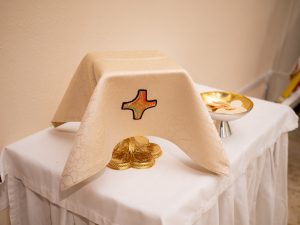
x.  Rather than an Offertory Procession, the gifts of bread and wine should be brought by the celebrant from a credence table, placed near the altar, which will also hold the water bowl and finger towel.

xi.  Care should be taken to avoid the contamination of the hosts which are to be consecrated. It is recommended liturgical practice to consecrate at each Mass a sufficient number of hosts for that celebration only.

xii. At this time, the optional exchange of the Sign of Peace can be omitted, or offered in a manner which avoids any physical contact.

xiii. The procession for people approaching for Holy Communion should be carefully planned. Stewards may assist if required.

xiv.  For the time being, it is recommended that Communion should not be given under both kinds, and should be received in the hand.

xv.  Priests and Extraordinary Ministers of Holy Communion should visibly sanitise their hands both before and after the distribution of Communion.

xvi.  Priests and ministers should wear a face-covering while distributing Communion.

xvii.  It is advisable to provide a small table at each point of distribution with a bottle of sanitiser. This would enable the priest/minister to re-sanitise their hands if necessary during the distribution of Communion.

xviii.  Care should be taken to thoroughly clean all vessels and to change purificators and finger towels after each Mass.

xix.  At the celebration of the Sacrament of Baptism, the celebrant will sign the child with the Cross without touching.

xx.  A jug of fresh water will be blessed for the Baptism. For the time being, priests may prefer to have only one child (or children from one family) baptised in each ceremony. However, if there are a number of Baptisms in sequence, the same jug of Blessed Water could be used, but water may not be re-used from the font or basin.

xxi.  The anointing with the Holy Oils will be administered by the use of cotton buds.

xxii.  For the Sacrament of Reconciliation, provision should be made in the body of the Church for a confessional area. Consideration should be given to the privacy of the sacrament as well as the requirements of physical distancing and hygiene.

Communications
Each Diocese should plan for the clear and effective communication of all necessary protocols and procedures to all parishes in the Diocese.