Home Blog Page 5

Achdiocese of Armagh Gives Thanks Ahead of Three Ordinations to the Priesthood

Archdiocese of Armagh Gives Thanks Ahead of Three Ordinations to the Priesthood

There is a real sense of joy and thanksgiving across the Archdiocese of Armagh this weekend as Deacons Gabriel Neal, Jacek Tuszkiewicz and Paul O’Reilly prepare to be ordained to the priesthood.

Archbishop Eamon Martin will ordain the three men tomorrow, Saturday 9 May, at 3.00pm in St Patrick’s Cathedral, Armagh. The ordinations mark a significant and hope-filled moment in the life of the Archdiocese, as Gabriel, Jacek and Paul prepare to offer their lives in service to Christ, the Church and the people of God.

Speaking ahead of the ordination, Archbishop Eamon said:

“We here in the Archdiocese of Armagh feel a deep sense of joy and thanks as we prepare for the ordination of these three men to the priesthood. I give thanks for their generous ‘yes’ to God’s call, and my hope is that they will have many years of fulfilment in serving God’s people here in the Archdiocese of Armagh.”

Archbishop Eamon also noted that tomorrow’s celebration brings to twelve the number of priestly ordinations for the Archdiocese of Armagh in recent years. At a time when the Church in Ireland is facing many challenges, these ordinations are a sign of encouragement, renewal and quiet hope.

The three men also reflect something of the increasingly international character of priesthood in the Archdiocese. Gabriel comes from the United States, Jacek from Poland, and Paul from Cork. Each has followed a different path, shaped by his own family, culture, formation and experience of faith, yet each has discerned a call to serve here in the Archdiocese of Armagh.

This diversity is now part of the lived reality of the Church in Ireland. The priests serving in the Archdiocese today come from a range of backgrounds, countries and pastoral experiences. Their presence speaks not only of the universality of the Catholic Church, but also of the generosity of those who leave home, family and familiar surroundings in order to minister among the people of God in a new place.

It is also a testament to the sustained investment the Archdiocese has made in priestly formation, including investment in it’s formation community and Redemptorist Mater Seminary in Dundalk, where seminarians and those discerning priesthood have been accompanied in prayer, study, pastoral experience and human formation.

Tomorrow’s ordination will be a moment of gratitude for all who have supported Gabriel, Jacek and Paul along the way: their families, friends, formators, parish communities, priests, religious and lay faithful who have encouraged them in their vocation.

As they prepare to be ordained, the Archdiocese asks the faithful to keep Gabriel, Jacek and Paul in prayer, that the Lord may bless them with faithful hearts, generous spirits and deep joy in their ministry.

May their priesthood bear lasting fruit in the lives of the communities they are called to serve.


Church Leaders condemn femicide, all violence against women and misogyny

Ending Violence Against Women and Girls: A Call to Compassion, Cultural Change and Responsibility


“Blessed are the peacemakers, for they shall be called children of God.” (Matthew 5:9)


Following their latest meeting, which took place on Friday 1 May, the Church Leaders Group (Ireland), which is made up of the Catholic and Church of Ireland Archbishops of Armagh, the Moderator of the Presbyterian Church in Ireland, and the Presidents of the Methodist Church in Ireland, and the Irish Council of Churches, have expressed their sympathy and prayerful support for all families who have been affected by violence against women and girls, calling it ‘an epidemic sweeping across Ireland.’

Following the horrific murder of Amy Doherty, Christian leaders from across Ireland’s Churches spoke with one voice in condemning femicide, misogyny and all forms of violence against women. In their statement, they described violence against women as “an epidemic sweeping across Ireland.”

The leaders expressed particular concern that Northern Ireland has become one of the most dangerous places in Europe for women, noting that 30 women have been murdered there since 2020 and that many were killed within their own homes — places which should have been safe environments of trust and protection.

Behind every statistic is a human life. A daughter. A mother. A sister. A friend. A person created in the image and likeness of God.

As Christians, we cannot remain silent in the face of such suffering.

The Church Leaders rightly point out that legislation and public policy, while essential, are not enough on their own. Long-term cultural change is needed,  a society where misogyny is challenged both online and offline, where women are respected and protected, and where boys and young men are encouraged towards models of positive masculinity rooted in dignity, compassion, responsibility and love.

The Christian understanding of human dignity leaves no room for violence, coercion, control or abuse. The Gospel calls society towards relationships marked by respect, equality, justice and self-giving love.

Church communities also have a vital role to play. Parishes, schools, ministries and faith groups must continue striving to be places where women feel safe, heard, valued and supported. Pastoral accompaniment, safeguarding awareness, practical support and partnership with charities and frontline organisations remain critically important.

At a time when anger, online hostility and dehumanising narratives are increasingly normalised, the statement is also an invitation to reflect deeply on the culture we are creating together and the example being handed on to younger generations.

We pray for all women who have lost their lives through violence, for all survivors of abuse, and for all families carrying unimaginable grief.

Read the full statement from the Church Leaders Group here:
Full Statement


Text of the Church Leader’s Statement

The Church Leaders said, “Following the recent horrific murder of Amy Doherty, which marked the 65th women to be murdered on the island of Ireland since 2020 – as people of faith, we wish to express our sympathy and prayerful support for all those families who have been bereaved in such terrible circumstances and also our deep concern at what has become an epidemic of violence against women sweeping across Ireland.

“As Church leaders we are grieved and shamed by reports that Northern Ireland is now one of the most dangerous places for a woman to live in Europe, with 30 women murdered since 2020.  We are deeply troubled by the reports that have found that the most dangerous place in Northern Ireland for a woman is her own home.  No one should feel unsafe inside their home.  Yet 21 of the 30 women murdered in Northern Ireland were attacked in what should have been for them a safe environment.

“As Christian leaders, we condemn femicide absolutely and all forms of violence perpetrated against women.  While we welcome the introduction of policy and strategies to address the horror of violence against women and girls in both jurisdictions in recent years, it is regrettable that this has not resulted in a decrease in this abhorrent murder rate.  At this particular time, we urge politicians, men and women together, to continue to work with the emergency services and the courts, to ensure that they have the resources necessary to combat this epidemic.

“While legislation and policy are important, they can only do so much.  At all levels of society there needs to be active long-term cultural change, where misogyny is not tolerated online or elsewhere, with boys and young men given the opportunity to discover the joys of positive manhood, that loves, respects, and honours women and girls, just as God loves them equally.

“Together, we want to encourage churches to remain vigilant and where possible to provide practical and pastoral support to women seeking refuge from abuse.  At the same time, we want to affirm the work that is being done by charities currently supporting these women.

“Finally, for all who have been let down by society and are grieving the loss of a loved one taken so unnecessarily, it is our prayer that you will know justice, and that the ‘…peace of God, which transcends all understanding, will guard your hearts and your minds in Christ Jesus’ (Philippians 4:7).”

Most Reverend Eamon Martin
Catholic Archbishop of Armagh and Primate of All Ireland 

Most Reverend John McDowell
Church of Ireland Archbishop of Armagh and Primate of All Ireland
 
Right Reverend Dr Richard Murray
Moderator of the General Assembly of the Presbyterian Church in Ireland
 
Very Reverend Dr Charles McMullen
President of the Irish Council of Churches
 
Reverend Alan Wardlow
President of the Methodist Church in Ireland

Ordination to the Priesthood in the Archdiocese of Armagh

Ordination to the Priesthood in the Archdiocese of Armagh

The Archdiocese of Armagh rejoices as Deacon Gabriel Neal, Deacon Jacek Tuszkiewicz and Deacon Paul O’Reilly prepare to be ordained to the priesthood.

Their ordination will take place on Saturday 9 May 2026 at 3.00pm in St Patrick’s Cathedral, Armagh, with Archbishop Eamon Martin presiding.

This is a significant and joyful moment not only for Gabriel, Jacek and Paul, but for the whole Archdiocese. Their response to God’s call is a gift to the Church and to the communities they will serve in the years ahead. All three have undertaken their formation with the Redemptoris Mater Seminary in Dundalk.

In preparation for the ordination, a Prayer Vigil will take place on Thursday 7 May at 7.30pm in Church of the Sacred Heart, Cloghouge. All are welcome to attend this time of prayer as we support the three deacons in the final days of their preparation.

The faithful of the Archdiocese are warmly encouraged to attend both the vigil and the ordination, and to keep Gabriel, Jacek and Paul in their prayers as they take this important step in their lives of service to God and His people.

May the Lord guide and bless all three men as they are ordained to the priesthood. 

Diocesan Pilgrimage to Knock Takes Place on Sunday 31 May

Diocesan Pilgrimage to Knock Takes Place on Sunday 31 May

There are now just five weeks to go until our annual Diocesan Pilgrimage to Knock Shrine, which will take place on Sunday 31 May, the final Sunday of May.

Each year, pilgrims from across the diocese make the journey to Knock for a variety of reasons. For some, it is an opportunity to give thanks and mark important milestones such as birthdays, anniversaries or special family occasions. For others, it is a quieter journey shaped by grief, remembrance or a need for prayer during difficult times. Many simply come seeking peace, healing and renewed hope.

Knock Shrine has long been a place where people bring both the joys and burdens of life before God. Whether you are returning again this year or considering making the pilgrimage for the first time, all are welcome.

This year is particularly significant as it marks the 50th anniversary of the opening of the Basilica of Mary Queen of Ireland, which was officially opened in 1976. This milestone offers an opportunity to reflect on the countless pilgrims who have visited Knock over the past five decades and the many prayers offered there.

We would love to see every parish in the diocese represented on the day. Parish groups and individuals are encouraged to begin making arrangements now, including organising coach transport where possible. If you are interested in attending, please contact your parish for further information.

Priests and deacons are also warmly encouraged to attend and support pilgrims from their parish communities.

As we prepare for this year’s pilgrimage, we entrust all those travelling to the care of Our Lady of Knock.

Our Lady of Knock, pray for us.
St Joseph, pray for us.
St John, pray for us.


Knock Pilgrimage Director:  Canon Benny Fee
Cloghog Road, Clonoe BT71 5EH, Telephone:  028 877 49184


Archbishop Eamon Martin – In Memoriam Pope Francis

Archbishop Eamon celebrates Mass in Saint Patrick’s Cathedral, Armagh, on the first Anniversary of the Death of Pope Francis

On the first anniversary of the death of Pope Francis, Archbishop Eamon Martin reflects on a papacy marked by mercy, humility and a deep commitment to mission. Drawing on powerful moments from his visit to Ireland in 2018, his homily, which was preached in Saint Patrick’s Cathedral Armagh on Tuesday 21st April 2026, invites us to recognise both the brokenness and the hope at the heart of our faith, and to rediscover what it means to be a Church that reaches out, accompanies, and heals.


Text of Archbishop Eamon’s Homily

I can’t forget the joy on the face of Pope Francis as his ‘pope-mobile’ entered Croke Park for the Festival of Families in August 2018. The pope was late because his private meeting with survivors of abuse had run over time. It was especially poignant then, that just as the Holy Father arrived into the packed stadium, Patrick Bergin and the festival choir were singing the chorus of Leonard Cohen‘s “anthem”:

“Ring the bells that still can ring
Forget your perfect offering
There is a crack, a crack in everything
That’s how the light gets in”.

Here was a pope who seemed to understand the brokenness and sinfulness of human beings, but who kept encouraging us never to give up on Hope. There may be a “crack in everything” – no one is perfect; we are all sinners – but, thanks to the mercy of God, and to the saving death of Christ on the cross, the light of hope shrines on to heal and to dispel the darkness.

In one of his first interviews, Pope Francis was asked, “Who is Jorge Mario Bergoglio?” His answer was unexpected: “I am a sinner whom the Lord has looked upon.” It reminded me of our own Saint Patrick who similarly introduced himself, “I am a sinner“. In the case of Pope Francis, we learned that as a seminarian in Rome, he was deeply inspired by Caravaggio’s painting of the calling of Saint Matthew which hangs in the Church of St. Louis of France. Matthew, the tax collector and sinner, is shocked when Jesus gazes at him with great love and calls him: “Follow me!”

“Who, me?”, Matthew seems to say. “No! I’m not ready to change my life.” But the light of Christ’s mercy penetrates Matthew’s brokenness, getting in through the cracks. “Mercy-ing” him, Jesus calls him. Pope Francis revealed that was why he chose as his motto, “Miserando, atque eligendo” Mercy-ing him, he chose him!

Looking back on the pontificate of Pope Francis one year after his death, it strikes me how much he reached out to the peripheries – to those who are most in need of God’s mercy. Early in his pontificate he wrote:

“I prefer a Church which is bruised, hurting and dirty because it has been out on the streets, rather than a Church which is unhealthy from being confined and from clinging to its own security”

Like his namesake, Francis of Assisi, he prioritised the poor and the marginalised – not just those who are financially poor – but everyone who is exploited, excluded, forgotten, or abused. Pope Francis liked to look into the faces of vulnerable people, touching their flesh, drawing them close, as if to assure them, “God loves you… Forget your perfect offering
There is a crack, a crack in everything”.

Perhaps that is why he wasted no time in announcing an extraordinary jubilee year of mercy in 2015-16, to include those who are spiritually poor, those who feel empty inside.

Pope Francis’ moving gestures of compassion spoke to millions around the world – his sincere empathy for migrants, his going into prisons to wash and kiss the feet of prisoners, and his humble avoidance of many of the traditional privileges and accoutrements of the papacy.

Beneath it all, everything Pope Francis did was about mission – reminding us that the Church has to get out and accompany people where they are at. He said: ”A Church which does not come out of herself to evangelise becomes self-referential and then gets sick.”

Our late Holy Father had a deep sense of his own brokenness and sinfulness, and that moved him to be different, always encouraging us to be “merciful like the Father”. He often used to say “pray for me – and don’t forget”! As we mark his first anniversary, let’s promise to do just that: Pray for the happy repose of Pope Francis’s soul – and don’t forget!

 
+ Archbishop Eamon Martin
Archbishop of Armagh, Primate of All ireland


United in Prayer for Peace with Pope Leo XIV

A Diocese United in Prayer with Pope Leo, 11th April 2026, 5pm (Irish Time)

In a world marked by conflict, division, and uncertainty, Pope Leo XIV has issued a simple yet profound invitation: to pray for peace.

On Saturday 11th April, he will lead a Rosary and Vigil for Peace in St Peter’s Basilica, calling Christians across the world to unite in prayer. This moment is not simply an event in Rome. It is an invitation to the whole Church.

In response the Archdiocese has invited every parish, community, and household in our diocese to take part in a Novena for Peace in the days and weeks ahead.

This novena is rooted in Scripture and each day reflects a different dimension of peace: peace in our hearts, peace among nations, justice for the vulnerable, and reconciliation between peoples. It reminds us that peace is not abstract. It is personal, communal, and deeply spiritual.

Pope Leo, in his Easter Urbi et Orbi message, speaks powerfully of the kind of peace our world needs. It is not a peace imposed by force, but one born of love, dialogue, and transformed hearts. It is the peace of the Risen Christ, who meets fear with mercy and division with reconciliation.

At a time when many feel powerless in the face of global conflict, this call to prayer is both grounding and hopeful. It reminds us that prayer is not passive. It is an act of faith, solidarity, and participation in God’s work of healing the world.

Parishes are encouraged to incorporate the novena into liturgies and prayer gatherings. Families and individuals are invited to pray it at home. In doing so, we join a global chorus of prayer, united with the Holy Father and with Christians everywhere.

Peace begins in the heart. But it does not end there.  As we pray this novena, we are also called to become what we ask for: instruments of peace in our daily lives, our relationships, and our communities.

Click here to Access the Novena for Peace


Click Here to Access Pope Leo’s Easter Urbi et Orbi Message


Light in the Darkness: An Easter Message of Hope from Archbishop Eamon Martin

Light in the Darkness: An Easter Message of Hope

Easter begins in darkness and before the joy of the Resurrection, before the alleluias are sung, a small flame is lit in the night. From that flame, the Paschal Candle is carried into the church and a simple but powerful proclamation is made: “The Light of Christ.” And we respond together: “Thanks be to God.”

This year, that ancient ritual speaks with a particular depth.

Across our world, many are living through darkness in very real and painful ways. The shadow of war, the suffering of innocent people, and a growing sense of uncertainty can weigh heavily on hearts and minds. Even from a distance, we feel the ripple effects, in our news, in our communities and within ourselves.  Yet into that darkness, Easter speaks a different word.

In his Easter message, Archbishop Eamon Martin invites us to rediscover the enduring Christian hope that shines even in the bleakest moments. It is not a naïve or easy hope, but one rooted in the truth of the Resurrection, one that knows that light is stronger than darkness, love is stronger than hatred, and life is stronger than death. This truth lies at the heart of Easter: the promise that no darkness is final.

As we journey through this sacred season, we are invited not only to receive that light but to carry it into our homes, our communities, and a world in need of hope.


Text of Archbishop Eamon’s Easter Message

The theme of “light in the darkness” is at the centre of our Easter readings and celebrations. As the new Paschal Candle is lit from the Easter fire outside and carried into the church, these profound and hopeful words are spoken:

“May the light of Christ rising in glory
dispel the darkness of our hearts and minds”.

 
Lumen Christi! Deo Gratias! The Light of Christ! Thanks be to God! 

In recent months, dark clouds of war and violence have overshadowed the coming of spring and the promise of hope that springtime naturally brings into the world. Although from this distance we cannot hear the bombs and sirens of warfare from the Middle East or Ukraine, the distressing impact of conflict ripples around the world with escalating prices and volatile markets, and a creeping sense of despair.

Proponents of so-called “modern warfare” try to tell us that attacks can be clinical and contained, but that’s an illusion. We are deceiving ourselves to think that the ongoing use of rockets and bombs in built up areas, or the destruction of essential infrastructure, roads, bridges, water and fuel stations does anything other than spread fear and terror among innocent, civilian populations. Let us be clear: war currupts and depresses. War is ‘a defeat for humanity’.

All the more reason then for us to “hold on to hope”, this Easter. This is the Christian season of “darkness into light”, of “the Hope that does not disappoint” (Romans 5:5).

It is of course hard to find Hope in the rubble of a bombed hospital or school, or in the frightened eyes of a displaced family who have lost everything they own, or in the tears of those whose loved ones have been killed through acts of violence.

But the promise of Easter is that the Risen Christ defeated the darkness of evil on the Hill of Calvary. That Good News is needed this year more than ever, and it is our mission as Christians to make it known. Pope Benedict XVI once said Easter declares “History is not in the hands of dark forces, of chance, or of merely human choices. The Lord, (who is) the supreme arbiter of historical events, rises above the discharge of evil energies.”

Although it was very early in the morning and still dark when the women came to the tomb with spices to anoint the body of Jesus, an angel bathed in light says to them, ‘There is no need for you to be afraid. I know you are looking for Jesus, who was crucified. He is not here, for he has risen, as he said he would.” The women, who had come to the tomb in sadness and grief, run quickly away, filled with joy and hope, to share the Good News with the others.

As Easter people here in Ireland, despite the temptation to be overcome by the darkness of despair and give up on peace, let us also be witnesses for the Risen Christ in these days, speaking and spreading the Easter promise of love, forgiveness, healing, reconciliation and the hope of a new springtime.

Peace be with you. Beannachtaí agus Síocháin na Cásca oraibh go léir.

Happy Easter.

 
+ Archbishop Eamon Martin 
Archbishop of Armagh, Primate of All Ireland

From Cross to Light: Walking the Journey Towards the Resurrection With Archbishop Eamon and Bishop Michael

As we journey through the Triduum, towards Easter, we invite you to journey with Archbishop Eamon and Bishop Michael.

CREDIT: LiamMcArdle.com

Holy Week, the Triduum, and Easter invite us into the heart of our faith… a journey from love, through sacrifice, into hope and new life.  As we journey towards the resurrection the Archdiocese shares Archbishop Eamon and Bishop Michael’s homilies across these sacred days, you are invited to pause, to listen, and to reflect.

What speaks to you?
What stays with you?
Where is God at work in your life right now?


Take time to walk this journey… and allow it to shape how you live, love, and hope.

Click the Link below to access all of Archbishop Eamon and Bishop Michael’s Homilies in one place” 

https://www.armaghprays.com/services


https://www.armaghprays.com/services

Joint Holy Week & Easter 2026 message by Armagh Archbishops: ‘Peace be with you’

Holy Week and Easter message by Archbishops McDowell and Martin

“Peace be with you”.  These were the first words of Jesus to his disciples, after the resurrection, when he met them behind locked doors on the evening of that first Easter Day.  He showed them the marks of the crucifixion on his hands and side – the evidence of his suffering – and he said to them, “Peace be with you”.  In the midst of their fear, sorrow and pain, he wanted them to find peace.  Despite all that had happened in previous days, the words and sentiments he offered were words of comfort and love, and not anger or hatred.  

The words, “Peace be with you”, represent much more than a simple, customary greeting.  They express a deep desire and hope for an end to pain, for calm after the storm, for a time of reconciliation and healing. 

This Easter the world we live in is overshadowed by conflict in so many places – from across the Middle East to much closer home in the war that has ravaged Ukraine for over four years now. I n all those regions, heartfelt cries are heard for an end to the violence that has already caused the deaths of tens of thousands of people, widespread destruction of homes and businesses, as well as the separation and displacement of countless families.

Too many people live in fear of what the future holds in store.  Hope is hard to find in the rubble of a bombed hospital or school, or in the tears of those whose loved ones have been killed through acts of violence.

During Holy Week, in Scripture readings and prayer, we reflect on the sufferings of our Lord Jesus Christ, and are reminded of the cruelty of humankind and the power of evil.  The cross of Calvary continues to cast a long shadow over the world.  Yet the sadness of Good Friday will give way to the joy of Easter morning.  The Easter story begins “while it was still dark”, but it is soon bathed in the light of the resurrection.  Love defeats hatred.  It overcomes the darkness of despair.  Nothing, then, should be permitted to rob us of hope that goodness will triumph over evil.  This is Easter Hope: the “hope that does not disappoint” (Romans 5:5).

We must persevere, therefore, in our prayers and efforts to build lasting peace in the world, always looking to that day when swords will be beaten into ploughshares and spears into pruning hooks.

This Holy Week and Easter, let us renew our determination to live in a world where all life is valued, where mutual respect and understanding are treasured, and where peace is a living reality.  May the words and actions of all people mirror those of our risen Lord, now and in the days to come: “Peace be with you”.

+ Archbishop Eamon Martin, Archbishop of Armagh, Primate of All Ireland, 

+Archbishop John McDowell, Church of Ireland Archbishop of Armagh, Primate of All Ireland 

Archbishop Martin’s St Patrick’s Day Homily– Pope Leo XIV’s Message for the Congress on Youth, Family and Faith

Pope Leo Sends Message of Encouragement to the Archdiocese of Armagh Ahead of it’s Congress on Youth Family and Faith

On this Feast of Saint Patrick, Archbishop Eamon Martin delivered his homily from Saint Patrick’s Cathedral, Armagh, during Mass broadcast nationally on RTÉ at 11.00am.
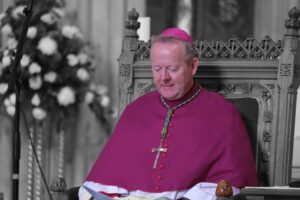
In a message of encouragement ahead of the upcoming Armagh Congress on Youth, Family and Faith, Pope Leo XIV has sent his blessing to the Archdiocese, expressing his hope that the Congress will:

“Seek concrete ways to strengthen the ties between parish and family life [to build up] … a stable and life-giving culture [and] rekindle the flame of faith once ignited by Saint Patrick.”

Pope Leo XIV


Homily of Archbishop Eamon Martin

This coming weekend, hundreds of delegates will arrive in Armagh for our Diocesan Congress on the theme of Youth, Family and Faith. Over the past five years, we have been preparing for this moment by praying and reflecting together on how best to support parishes and families in living and sharing the faith, especially with our young people.

Saint Patrick was only fifteen or sixteen years of age when he was trafficked into Ireland as a slave. He tells us that even though he had been raised in a Christian home, he was a poor sinner and had little knowledge of the true God. Yet in the isolation and loneliness of his captivity, Patrick turned to God in prayer and came to experience God’s love and protection in a deeply personal way.

Before long, Patrick found the courage to share with others how much his faith meant to him. After six years in slavery, he escaped and returned home to his family, who hoped he would never leave again. But in a dream, he heard the voice of the Irish calling him:
“Come back, holy youth, and walk among us once more.”

Patrick returned to Ireland years later as a missionary bishop. He devoted himself to baptising and confirming thousands, and to forming others to share in the mission of proclaiming the Good News.

Above us in the Cathedral, the story of Patrick’s mission is captured in art: the mosaic of Saint Patrick baptising King Aongus of Cashel, and the images of the young princesses Ethna and Fedelm receiving baptism. These remind us that for Patrick, baptism was not simply a once-off event, but the beginning of a lifelong journey of faith and friendship with God.

This is the message we bring to our Congress: that baptism calls each of us—especially our young people—into a living relationship with Christ.

Sixty per cent of those attending the Congress will be under the age of thirty-five. I believe Saint Patrick understands their struggles and questions.

Recent research suggests that young adults in Ireland are becoming more curious and searching for faith. Many are seeking hope and nourishment for their interior lives, their well-being, and their mental health. I have met young people who speak of a deep sense of emptiness in a fragile and troubled world—one that celebrates advances in technology and artificial intelligence, yet is also marked by war, aggression, and the suffering of innocent families.

Our families and young people must navigate a complex world where good and evil grow side by side, like the wheat and the darnel in today’s Gospel. We cannot withdraw into a cocoon of faith. Instead, we are called to witness.

+ Archbishop Eamon Martin

Archbishop of Armagh, Primate of Ireland