The importance of speaking in the public square – address by Archbishop Eamon Martin
· The inaugural conference of ‘The Iona Institute Northern Ireland’
· Contrary to the suggestions of some recently, the Catholic Church has no desire to create a theocracy in Ireland, north or south, but we would expect that in a true pluralist democracy or republic, religion and faith will continue to have an important part to play in the national conversation.
· The failures of the past must help us learn lessons for the present about where Church and society might be similarly marginalising the poor, stigmatising the unwanted or failing to protect the most vulnerable.
· It would hugely impoverish our faith if we were to compartmentalise it, or exclude it, completely from our conversations and actions in the public square. It would also impoverish society if the fundamental convictions of faith were not permitted to influence public debate; it would diminish the understanding of the human person and dilute the concept of the common good.
Address
Every time I am asked to speak on this topic I find myself returning for inspiration to the story from Acts of the Apostles (chapter 17) of Saint Paul in the ‘agora’ of ancient Athens – that great meeting place of government, commerce and ideas. Paul could see the city was full of idols and Acts tells us his spirit was ‘provoked’, but still, he held his ground and witnessed to Christ. His testimony was of particular interest to the philosophers who enjoyed discussing all the latest news and fashionable ideas of the time.
They brought him before the Areop′agus, where Paul remarked on all the objects of worship he had seen in the city, including an altar with the inscription, ‘To an unknown god.’ Paul proclaimed that what the Athenians worshipped as ‘unknown”, was in fact “the God who made the world and everything in it”. It is God that you are all seeking, he went on, God who is not far from each one of us; God “who gives life and breath to everything”, God “in whom we live and move and have our being”, God who created us so that we might seek after him! God calls us to repent, Paul added, and he has fixed a day on which he will judge the world by a man whom he has raised from the dead.
At the mention of resurrection of the dead, Paul’s audience in the ancient public square immediately interrupted him. Some mocked him, but others said, “We will hear you again about this”. Acts concludes the story with these words: “Some joined him and believed, among them Dionys′ius the Are-op′agite and a woman named Dam′aris and others with them”.
Two thousand years later, when we speak in the modern public square, we may expect a similar reaction. Some will mock us; some will want to hear more; others will believe and change their lives to join the flock of Jesus Christ.
But how can they change, unless someone challenges them? In another place, Paul writes (Romans 10:14): “But how are men to call upon him in whom they have not believed? And how are they to believe in him of whom they have never heard? And how are they to hear without a preacher?”
Friends, today we are the ones who are sent to speak into the public square. This is our responsibility and our privilege.
But, firstly, it is worth exploring what we mean by the public square nowadays. There is a temptation to confine the meaning of ‘the public square’ to the realm of politics, which, in my view, is a rather narrow and impoverished view of the term. I imagine the public square to be more like the ancient Athenian agora and Areopagus – a place where ideas are developed and shared and tested. The media and entertainment world, therefore, have a claim to attention in the public square, and, if you’ll allow a ‘virtual’ space, then social media has a major contribution to make. Important discussion also takes place in the boardrooms of business and industry. The arts, music and sport clearly influence the public agenda. From all of these emerge messages which shape our understanding of the truth and how we live our lives. So also, of course, does education, through academic research and discourse. So, if the voice of faith is to be heard in the public square, then people of faith must inhabit and contribute to all of these worlds and discussions, and indeed, to anywhere people meet to share opinions and ideas – the pub, the hairdressers, the dinner party and the staff coffee room.
The Second Vatican Council was clear that the Church has a voice right in the centre of the modern world, in the heart of the public square, in the hustle and bustle of people’s lives. The Council fathers pointed out the duty of the Church to ‘scrutinise the signs of the times and interpret them in the light of the Gospel’. The great Pastoral Constitution on the Church in the modern world, Gaudium et Spes (Joy and Hope), famously puts it: ‘The joys and the hopes, the griefs and the anxieties of the (people) men of this age, especially those who are poor or in any way afflicted, these are the joys and hopes, the griefs and anxieties of the followers of Christ.’
But what message do we bring, as people of faith, to the public square? Gaudium et Spes again puts it well: “the future of humanity rests on those who are capable of handing onto the coming generations reasons for living and hoping.” Our interventions in the public square therefore draw from transcendent ideas of truth, beauty and goodness, and from an understanding of the human person that is rooted in the natural law and which strives for the common good. Ultimately everything we say is founded on the Gospel of Jesus Christ, our Risen Lord, who calls people to repentance and conversion, and promises hope and everlasting life.
We should not be surprised if the reactions are as varied as those Paul experiences in Athens, or indeed in Corinth, about which he wrote (I Cor 1:22-24):
“Jews demand signs and Greeks seek wisdom, but we preach Christ crucified, a stumbling block to Jews and folly to Gentiles, but to those who are called, both Jews and Greeks, Christ the power of God and the wisdom of God”.
We do not enter the public square simply to win arguments through the clever use of reasoning and debate. When we speak, we draw upon both reason and faith and upon an integral vision of the dignity and vocation of the human person linked to the common good. We seek to present in public discourse ‘a coherent ethic of life’, based on natural law, which includes for example, our teaching about the sacredness of human life and the dignity of the person, about the centrality of the family, about solidarity and the need for a fair distribution of goods in the world. Our vision is of a society marked by a culture of justice and care for all, especially the most vulnerable.
The difficulty for us, of course, is the tendency in public debate to relegate, to the private sphere, discussion about the nature of the identity of the human person and his or her dignity. Society nowadays is inclined instead to prioritise a limited conception of freedom, often understood in a reductionist and limited fashion which doesn’t always lead to human flourishing.
As an illustration of the kinds of messages we speak into the public square, let us examine the recent statement issued by the bishops of Northern Ireland in preparation for the Assembly elections – in March and last May.
Firstly, the bishops urged all voters to engage in the democratic process. They quoted Pope Francis’ words: ‘None of us can say ‘I have nothing to do with this, they govern…’ No, I am responsible for their governance, and I have to do the best so that they govern well, and I have to do my best by participating in politics according to my ability….I cannot wash my hands” (Pope Francis on Vatican Radio, September 2013).
The northern bishops therefore encouraged all people of goodwill to consider the policies of candidates, asking: “How effectively does a particular candidate’s policies strengthen and support the full human dignity of all members of our society?”
They went on to identify key questions for voters to ask candidates on the doorsteps e.g. about:
1. the unacceptable levels of childhood poverty in Northern Ireland and the widening gap between rich and poor;
2. the right to life of unborn children and adults with severe life-limiting disabilities, as well as children conceived through sexual crime.
The bishops went on to ask:
3. Do you support abortion, the direct and intentional taking of an innocent human life in any circumstances?
4. What will you do to protect and support family and marriage and in particular the natural institution of marriage between one man and one woman as the fundamental building block of society?
5. Will you support the right of religious organisations to provide services in a manner consistent with their religious ethos and beliefs?
6. Will you support the right of parents to have Catholic schools as part of a diverse system of educational provision, based on parental choice?
7. What will you do to highlight the persecution of Christians and other persecuted groups across the world?
8. What will you do to address human trafficking in Northern Ireland and to help improve services for refugees, asylum seekers and the homeless?
9. What will you do to help achieve those UN Sustainable Development goals that are ethically consistent and ensure proper care and respect for the natural environment?
10. What will you do to create a more constructive and inclusive political culture in the next Assembly, one that gives hope to all in our society for a better future?
Our bishops’ statement sprang from the conviction that as Christians, “our encounter with the risen Jesus… has consequences for every aspect of our lives” (Northern Bishops’ Statement 1).
The bishops reiterated the duty to the Common Good that is at the heart of Catholic Social Teaching. However they were at pains to emphasise that they do not wish to “interfere in the legitimate autonomy of politics, or to support one political party or candidate over another”. This is a matter of conscience for each voter. Contrary to the suggestions of some recently, the Catholic Church has no desire to create a theocracy in Ireland, north or south, but we would expect that in a true pluralist democracy or republic, religion and faith will continue to have an important part to play in the national conversation.
The voice of faith or religion is not simply for the privacy of our homes and churches. The Gospel is meant for mission. It is not to be cloistered away from the cut and thrust of public discourse. Archbishop Rowan Williams cautioned against ‘programmatic secularism’, a kind of ‘exclusive public orthodoxy’, in which ‘any and every public manifestation of any particular religious allegiance is to be ironed out so that everyone may share a clear public loyalty to the state, unclouded by private convictions, and any sign of such private convictions are rigorously banned from public space’ (Faith in the Public Square, p 3). The suggestion here is that faith is a kind of private preference which cannot stand alongside a ‘supposedly neutral public order of rational persons’.
Since Paul first stepped into the agora at Athens, many have argued that the transcendent moral norms presented by believing Christians have no place in the public discourse. There is little tolerance nowadays for the idea of absolute moral truths or for stable moral reference points – something which is intrinsic to the content of Christian interventions in the public square.
Archbishop Rowan Williams prefers to see the Church as part of the ‘community of communities’ that is the state. It is therefore up to us to be courageous enough to argue our case, to ask awkward questions when necessary e.g. about the impact of economic policies on the most vulnerable, or to point out contradictions of populism, all the while being careful not to become too sensitive to criticism or always claiming to be offended. We need a broad back in the public square, and, particularly so, on social media where people of faith often have to endure insult or ridicule, or even personal attack simply for being present in the public square at all.
Of course, the Catholic Church in Ireland has seen great damage to its credibility on account of the child abuse scandals and other shameful episodes of our past. Many people feel they can no longer trust our message because they have been hurt and betrayed by their experience of Church. The sins and crimes of sexual abuse in the Church have not only had tragic consequences in the lives of victims and their families, but have also, as Pope Benedict XVI put it, ‘obscured the light of the gospel’.
When we speak in the public square about the right to life of the unborn, some are quick to point to the child abuse scandals and to shameful stories about Mother and Baby homes and other institutions. In my view, however, the failures of the past must help us learn lessons for the present about where Church and society might be similarly marginalising the poor, stigmatising the unwanted or failing to protect the most vulnerable.
We in the Church can tend to react defensively to criticisms – sometimes by denial, claiming unfairness, even conspiracy – rather than being thankful that the lid has been lifted on a terrible and shameful chapter of our history and at last giving a voice to those who for years had been carrying a lonely trauma. If it seemed at times that the Church was being unfairly targeted or singled out, then so be it. In hindsight this was a price that had to be paid in order to put the safety of children first.
Despite all that has happened, the Catholic Church remains of great interest to the media and society today. The Church is often counter-cultural, and a sign of contradiction in the secular world, just as it was for the Athenians when Paul spoke. It is therefore an object of fascination to many, of bewilderment or curiosity to others, and of hostility to some. Our challenge is to find ways of presenting the beautiful, edifying and spiritually inspiring lives of people of faith which reflect the beauty and goodness of God. I believe that today, when so many people are tempted to despair, we need to rediscover the ways of lifting people up, giving them, as Saint Peter put it, “a reason for the hope that lies within us”. With so much conflict, hatred and division in the world, it would do all our hearts good to celebrate more often the commitment of people of faith to peace and justice, love and understanding.
In the early Church people in the public square noticed something different about the ‘Christians’. The followers of Jesus were remarkable because of their prayerfulness, charity, joy, their willingness to suffer for their faith, their peaceful nature and communion with one another. People observed: ‘See how these Christians love one another’.
Two thousand years later, our challenge, as baptised, confirmed, and in some cases, ordained Christians, is to be just as ‘remarkable’, to be a ‘people set apart’, known and recognised as people who are not afraid to witness to Christ. Of course, to be like Christ in an increasingly secularised world often means being different, counter-cultural, and not easily swayed by the prevailing attitudes and opinions around us. This is not easy. The pressure on us to conform, to become just like everyone else, is often immense and overpowering.
The Vatican Council document, Lumen Gentium called on the lay faithful to work for the ‘sanctification of the world from within like a leaven’. In Deus Caritas Est (God is Love) (29) Pope Benedict XVI repeated that call. He says: ‘The direct duty to work for a just ordering of society… is proper to the lay faithful’. Pope John Paul II said the same in Ireland 1979: “The great forces which shape the world – politics, the mass media, science, technology, culture, education, industry and work – are precisely the areas where lay people are especially competent to exercise their mission. If these forces are guided by people who are true disciples of Christ, and who are, at the same time, fully competent in the relevant secular knowledge and skill, then indeed will the world be transformed from within by Christ’s redeeming power’.
The problem with this is that it presumes there exists a group of Catholics or Christians out there who have reflected sufficiently on their faith in action and take it seriously enough to feel confident in contributing to debate on public matters. The reality is that the vast majority of people of faith may not yet be ‘intentional disciples’. They are still seeking, still on the way, perhaps not yet able to courageously speak from the conviction of a deep personal encounter and relationship with the Risen Lord. A lot of Catholics, as members of society, find themselves easily drawn to support the liberal democratic culture and politics of the State. The politicians Catholics vote for, the media stories we like to read are not unlike those that the majority of people in the public square seem to want or support. Catholics, precisely as Catholics, need to allow their faith to influence their participation in society and the State.
That is why we need opportunities to meet like-minded Catholics and Christians who have begun to question the superficiality of much of what surrounds us. Our faith has a lot to say about the nihilism and despair of a throwaway culture that has driven young people to self-destruction. Our Church’s teachings would seriously question such a limited view of individual rights that would disputes the equality of life of a mother and her unborn baby. The work of the Iona Institute and others is therefore to be valued, as it helps to form and connect intentional disciples, and provide forums such as this for committed people of faith to develop the vocabulary of conversation and dialogue in the great public square debates.
Our arguments in these debates must aim to balance charity and truth. They must be at once gentle and patient, but firm and persuasive. Pope Francis has been emphasising the need to ‘go out of ourselves’ to the ‘edges of our existence’ where we meet the poor, the forgotten, the disillusioned, to draw near and guide the weakest of our neighbours who are experiencing a wounded or lost love.
We must beware the temptation to overuse the language of chastisement and condemnation. Most people nowadays are indifferent to condemnations. Fifty years ago Pope Saint John XXIII famously said: ‘In our own time the Bride of Christ prefers to make use of the medicine of mercy rather than of severer remedies; she thinks that, rather than issue condemnations, she should try to satisfy the needs of today, by proving the truth of her teachings’
The accompaniment of people in the public square is what Pope Saint John Paul II described as being “at the service of love’. To those in the public square we say with him: ‘Do not be afraid, the Gospel is not against you, but for you’. Last week at the SXSW Digital Technology Conference, Bishop Paul Tighe characterised the presence of the Church in the digital continent as being one of ‘compassionate disruption’. We are not there to impose, but to invite; we are not there to simply oppose, but to offer the gift and message of salvation. The Council’s declaration on religious freedom, Dignitatis Humanae puts it so profoundly: ‘The truth cannot impose itself except by virtue of its own truth, as it makes its entrance into the mind at once quietly and with power’.
Friends, it would hugely impoverish our faith if we were to compartmentalise it or exclude it completely from our conversations and actions in the public square. But I believe that it would also impoverish society if the fundamental convictions of faith were not permitted to influence public debate; it would diminish the understanding of the human person and dilute the concept of the common good. That is why I am convinced of the importance for all of us of speaking out in the public square, and of doing so with compassion and with conviction.
Thank you for listening.
ENDS
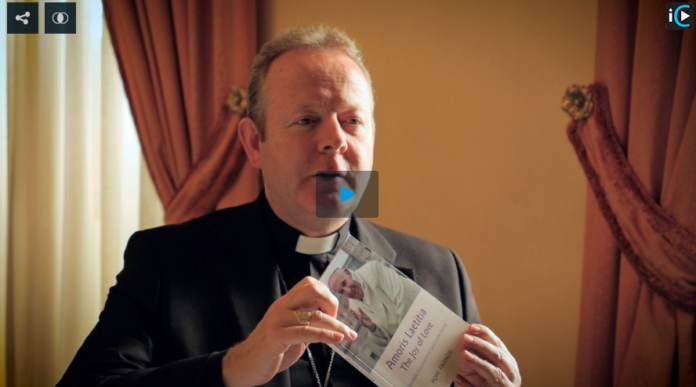
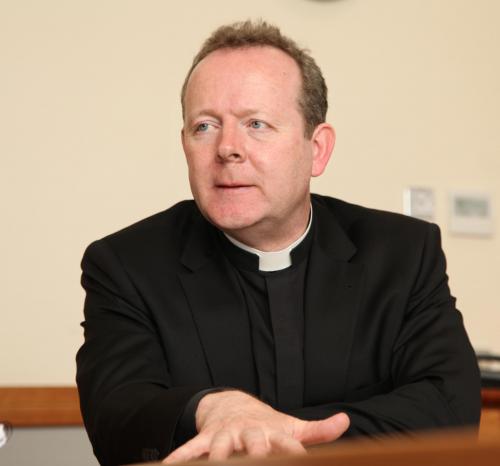
· Archbishop Eamon Martin is Archbishop of Armagh and Primate of All Ireland. Archbishop Martin was the keynote speaker this morning at the inaugural conference of ‘The Iona Institute Northern Ireland’, which took place in Saint Brigid’s Parish Hall, Derryvolgie Avenue, Belfast.
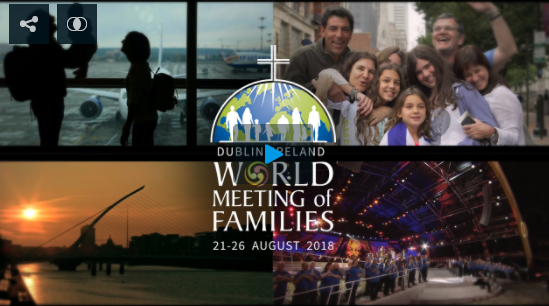
 Families and others from all over the world will gather in Dublin from 21-26 August 2018 to celebrate their lives together, to share their experiences from different parts of the world, to reflect on the different challenges they face and to grow together in faith.