Pope Francis, the Synod and the Future of the Family in Ireland
Keynote address by Archbishop Eamonn Martin at the Iona Institute & Irish Catholic conference: ‘Challenges for Ireland for from the Synod on the Family’
Red Cow Hotel, Dublin
- It is my hope that Catholic Church in Ireland will respond to the Synod on the Vocation and Mission of the Family in three similar ways: firstly, by presenting a clear, positive and challenging vision of the family; secondly, by developing effective networks of support, encouragement and advocacy for the family; thirdly, by ensuring that there is a solid foundation of prayer in and for the family in this country.
- We might ask those who seek our vote: To what extent can you, in contemporary Ireland support Family and Life, freedom of education and conscience, a proper work-life balance, which respects the role of mothers and fathers? What will your economic and social policies say to poorer families in Ireland, particularly those policies which impact directly on family: the needs of children and the elderly; tackling the proliferation of drugs, alcohol, gambling and other addictive behaviours which can destroy home and family life? How will your welfare policies and benefit programmes support families who are most in need and who are so easily targeted and exploited by loan sharks and other criminal elements? How will you better assist young people who wish to establish a family, mortgage a home, take out insurance, but who may sometimes be convinced by economic policy to remain single?
Address
The Synod and Pope Francis
Three months ago, on board the flight home to Dublin from the Synod, I found myself thanking God for being part of something special. It was my first time to be at a Synod, and, naturally, as I arrived and prepared for the Opening Mass in St Peter’s Basilica, I was nervous and uncertain. I had a sense of being part of very historic moment in the life of the Church.
The first person I met was an Archbishop from Lesotho, and soon we were joined by Bishop Eugene Hurley of Darwin and Archbishop Sore from Slovenia. By the time Pope Francis pulled up in his Ford Focus, there were more than three hundred of us: priests, bishops and cardinals from every corner of the globe, all vested and ready to concelebrate Mass with the successor of St Peter.
The phrase ‘Cum Petro et sub Petro’ (with Peter and under Peter) summed it up for me. Over the next three weeks we all shared our pastoral experiences of ministering to the families of the world. All the while, Pope Francis sat listening attentively and with deep concentration to every word.
My place in the Synod Hall was seat 2G7 between a bishop from Fiji and another from Buenos Aires. I shared with the Fiji bishop that my mother’s cousin, a Columbian missionary from Donegal, had worked for many years in Fiji. It turned out he knew him and was able to show me on his mobile phone a picture of St Patrick’s Church Fiji, built by my second cousin with the help of the people of Ireland. Next, I proudly told the bishop from Buenos Aires that my father’s cousin works there as a Christian Brother. So there we were, three bishops from places thousands of miles apart, yet linked by the missionary endeavour of the Irish Church.
The next day at our discussion group I asked Cardinal Wooer to tell me how a ‘Synod’ works. You know, Eamonn, he said, I’ve been at many Synods, but none like this one. He said Pope Francis was clearly influencing the synod process. There was a new atmosphere of openness and sharing, with more frequent small group meetings feeding into the plenary discussions in the Synod Hall. There was the Extraordinary Synod of the previous year, the sometimes controversial debate in the inter-synod period, the wide ranging consultation exercises (however impractical or clumsy they may have appeared) the presence and active contribution of many couples and lay experts; all this had helped to create a new sense of sodality or ‘journeying together’ as envisaged by the Second Vatican Council fifty years ago.
Since returning from Rome I’ve reflected on what I’ve learned. Today I want to draw out two themes that I think are particularly relevant for Ireland: firstly, an understanding of the family as the locus of mercy and evangelisation; and, secondly, the need to encourage a stronger sense of the vocation and mission of the family.
FAMILY AS THE LOCUS OF MERCY AND EVANGELISATION
Pastoral Challenges to the Family
The Synod took place on the threshold of the Year of Mercy. I couldn’t help thinking the family is the locus – or primary place – of God’s mercy. It was moving to hear the bishops as shepherds of the Church describe the hopes and anxieties that face their flocks – the families of the world. We heard passionate, first-hand accounts of forced migration, persecution and war; we were shocked by the extent of human trafficking and the exploitation and commodification of women and children. We heard about ‘wombs for hire’, child soldiers, forced prostitution and the exploitation of street children in large cities. We shuddered at the prevalence of abuse and domestic violence. We considered the challenges presented in some cultures by polygamy, arranged marriages, mixed and inter-faith marriages. We spoke about the pressures on family life from individualism and isolation and the spread of abortion, euthanasia and gender ideology. We faced the reality that in many countries the majority of marriages take place without any reference to faith or to God. The need for mercy in and to the family is indeed great.
But despite a concentration in the early days of the Synod on the pastoral challenges to family, there was also a great sense of admiration and gratitude for the many families who do their best in complex situations to persevere, to grow in love and to generously witness to commitment, forgiveness, and lifelong faithfulness.
Pastoral Discernment and Accompaniment
The overwhelming sense among the bishops was a desire to be with all families, and especially with those whose homes are visited by tragedy or violence and those who, for whatever reason, have experienced breakdown in their relationships and may feel excluded from the Church. The Synod was clear that we need to be mindful of those who have begun new relationships and unions, and find sincere and truthful ways of welcoming and including them in the life and worshipping community of the Church.
What do we do in these situations, the Synod asked? Do we sit outside and judge? Or do we accompany all our people, presenting the truth and joy of the Gospel in a loving, charitable way? The Synod proposed pastoral discernment and accompaniment in difficult situations, and a ministry of care to those whose marriage relationships have broken down, conscious that the Christian message of truth and mercy converges in Christ. ‘Mercy’, said the Final Report, ‘is not contrary to justice, but is the behaviour of God towards the sinner’.
As Pope Francis himself put it: ‘Proclaiming the truth in love is itself an act of mercy’ (Relation Synodic, 55). The Bishops concluded that we have a responsibility to help all God’s people find God’s plan for them, knowing that no one is excluded from God’s love and that all are included in the Church’s pastoral activity (Relation Synodic, 34).
Paragraph 55 of the Synod Final Report sums it up:
“We the Church start ‘from the real life situations of families today’, all in need of mercy, beginning with those who suffer most. With the Merciful Heart of Jesus, the Church must draw near and guide the weakest of her members who are experiencing a wounded or lost love, by restoring confidence and hope, as the beacon light of a port, or a torch carried in the crowd, to illuminate those who have lost their way or find themselves in the midst of a storm” (Relation Synodic, 55)
School of love and mercy
In his new book, The Name of God is Mercy, Pope Francis encourages us to consider the family as ‘a school of love’ and ‘a school of mercy’. Think about it: It is in the family that we first experience mercy and learn how to be merciful like the Father. The family is the primary locus for the corporal works of mercy like feeding the hungry, reaching out to the sick, the marginalised, prisoners, the elderly and frail; it is in the family that we learn to confront the so-called ‘globalisation of indifference’; we pick up our attitudes to the homeless and the plight of migrants and refugees; in the family home we learn grace at mealtimes to give thanks for food and not to take things for granted. In the family we confront the ‘throwaway culture’ and pick up signals about the dignity and worth of every person from conception until the natural end of life. I thought in particular, at the Synod, of families who lovingly welcome the gift of a disabled child, with all the mixed emotions, challenges and joys that brings, and of those families who turn their lives and routines upside-down to generously care for an elderly or sick relative – is this not the essence of the work of mercy?
The examples I have given are drawn mainly from the corporal works of mercy. But the family is also the primary locus of the spiritual works of mercy: e.g. teaching and handing on the faith; explaining right from wrong and gently correcting those who are going astray; consoling the sorrowful and being there in moments of disappointment, loss and bereavement; learning how to forgive and be forgiven; bearing patiently with those who wrong us; and, praying for the living and the dead.
Evangelisation
As the locus of mercy the family is at the same time a locus of new evangelisation for the Church and the world. This was one of the greatest learning’s for me at the Synod; that the family is not simply the object of ministry and evangelisation, but it is a powerful agent of evangelisation. It was very moving for me to hear testimony from so many at the Synod about the missionary character of the family.
The Synod final document emphasised that the family is the ‘school of humanity’ and the ‘domestic Church’. It is in the family that values are transmitted, the wisdom of generations is passed on, the choices between right and wrong are evaluated, connections with the past are made, links with other families are made and upheld, and where we discover who we are, where we have come from, our inter-generational relationships, our links with a place, with the land and a worshipping community, our rootedness in culture and language – I couldn’t help reflecting on the importance to the Irish of kinship groups: ‘are clan’, ‘are minter Fein’.
THE VOCATION AND MISSION OF THE FAMILY
Every morning on my way to the Synod Hall, I reminded myself that the theme of the Synod was ‘The Vocation and Mission of the Family in the Church and in the Contemporary World’. But what does it mean to talk about the ‘vocation’ of the family? In a lunchtime conversation with seminarians in Rome I pondered this question and considered if the decline in Europe and the West of vocations to the priesthood and to the consecrated life might be accompanied by a similar loss in understanding of ‘vocation’ to the family? And how might we respond?
In my opinion the best responses to the decline in vocations to the priesthood and religious life include at least three main elements: firstly, presenting a very clear, positive and challenging vision of the priesthood/religious life; secondly, the development of effective networks of support and encouragement for those who express an interest in these vocations; thirdly, a solid foundation of prayer for vocations and for those who choose to respond to the call.
It is my hope that Catholic Church in Ireland will respond to the Synod on the Vocation and Mission of the Family in three similar ways: firstly, by presenting a clear, positive and challenging vision of the family; secondly, by developing effective networks of support, encouragement and advocacy for the family; thirdly, by ensuring that there is a solid foundation of prayer in and for the family in this country.
(a) Clear, Positive and Challenging Vision of Family
The “Gospel of the Family”
The Synod process has helped us to distil for our times the beautiful and prophetic vision of God’s plan for marriage and the family. This so-called ‘Gospel of the Family’ has its origins in ‘the creation of humanity in the image of God who is love and who calls man and woman to love according to his own likeness’ (Relation Synodic, 35). The Synod Final Report traces the Gospel of the Family from Sacred Scripture to Church tradition and the teachings of the magisterium. It draws attention to formulations of this teaching at the Second Vatican Council in Gaudier et Spas; in Blessed Paul VI’s Humane Vitae, Pope St John Paul II’s Familiarise Consortia, Pope Benedict XVI’s Caritas in Vitiate, and in the catechesis of Pope Francis. I particularly liked the way Pope Francis reminded us how God chose to save us by sending his Son into the world in a human family which was open to receive him in love.
Facing Cultural Challenges
We believe that the Church’s proclamation of the family – founded on a faithful loving relationship between a man and a woman which is open to the gift of children who are the fruit of that love – is Good News for society and the world. There is no getting away, however, from the fact that this proclamation appears increasingly counter-cultural in many parts of the world, including Ireland. This has been accelerated by the departure in public discourse from the philosophical and anthropological underpinning of marriage and the family in natural law, and the erosion of social supports for traditional marriage in the form of constitutional guarantee and positive legislation.
Over Christmas I found myself reflecting on how difficult it must be for young people preparing for marriage to hear the still, small voice of faith amidst all the contradictory messages presented to them by the secular world. The Church’s proclamation of the Good News about marriage and the family must compete with a tidal wave of individualism and instant gratification. Young people are bombarded by an overly emotional and romantic concept of love and marriage that, ‘can be constructed and modified at will’ (Evangelic Gaudier, The Joy of the Gospel, 66).
There is pressure on young people to resist becoming ‘tied down’ by commitments, relationships or attachments – to delay or avoid lifelong commitments, including marriage and having children for as long as possible. Employers expect them to be flexible, movable, able to travel and work long, unsocial hours. Young people can easily pick up a distrust of commitment and institutions, fearing that marriage and family may damage their social and economic independence and freedom. Meanwhile social media demands so much of their attention and time and the inappropriate use of the internet for gaming, gambling or watching pornography can put serious pressure on relationships. On the one hand they are surrounded by a contraceptive, anti-birth mentality with its increasing indifference to abortion, whilst on the other they are offered a technocratic, commodification of child-bearing which, if necessary, can be accessed independently of any sexual relationship.
Good News for Today
Into this ‘soul-less world’ we have the joy and challenge of presenting the Church’s clear and positive vision of marriage: the Good News that human life is sacred, that each human being comes from God, who created us, male and female; that we are willed by God who loves each and every one of us; that self-giving love and commitment in the marriage of a man and a woman open to life is not only possible, but is a beautiful and fulfilling gift with the power of God’s grace; that chastity is achievable, healthy and good for our young people; that the giving of oneself to another in marriage for life is special, rewarding and a wonderful symbol of Christ’s forgiving, faithful love for his Church.
For Catholics, the expression: ‘What God joins together’ rings out as an exclamation of hope in the midst of a sometimes shallow and fickle world. We proclaim the Gospel of the Family because we believe in it, and we also believe that, with the help of God, it is attainable.
Pope Francis put it powerfully ten days ago in Rome when he said: “The Church, with a renewed sense of responsibility, continues to propose marriage in its essentials – offspring, good of the couple, unity, indissolubility, sacra mentality – not as ideal only for a few – notwithstanding modern models centred on the ephemeral and the transient – but as a reality that, in the grace of Christ, can be experienced by all the baptized faithful (to Roman Rota Tribunal, 22 January 2016)”.
(b) Support, Encouragement and Advocacy for the Family
Families supporting Families
The presentation and proclamation of our challenging vision of marriage and family must be accompanied by support for those young people who are preparing to marry. The Synod facilitated the sharing of initiatives, ideas and resources that are in place around the world to support the vocation to marriage and the family. We heard of movements, associations, basic Christian communities and many other networks which guide and nourish the marriage and family ‘vocation’. At the heart of these initiatives is the conviction that it is primarily families who minister to other families, married couples who minister to other married couples.
Married people have this role with other couples and families in the Church by virtue of the sacrament that they have received. This is their charisma, their vocation and mission. The Synod reminded us that remote preparation for marriage begins way back with parents as first teachers and with the transmission of the faith and Christian values in the family home. It continues in Catholic schools through strong Relationships and Sexuality Education programmes in accordance with the Catholic ethos which explain and promote the virtue of chastity and the Catholic vision for marriage and the family. We have much to do in Ireland in developing learning and teaching resources to support our parents and schools in this regard and to prepare helpful catechetical resources for parents themselves, for parishes and youth.
The proximate preparation for marriage with young people and young adults in school and parish is continued and built upon via the immediate preparation for marriage which takes place in pre-marriage courses and which will be celebrated in the marriage ceremony itself. It is timely for us in Ireland to evaluate with our committed ACCORD facilitators and others the ways in which our marriage preparation might be more directly linked with parish, with the worshipping community and with supportive couples and families within the parish. There is such a great need for the development at diocesan and parish level of leadership formation and support for family catechesis and spirituality. Catholic family support groups in dioceses and parishes might not only assist with marriage preparation, but also with supporting couples in the years immediately following marriage. There is much that can be done to prevent Catholic families feeling isolated, to encourage openness to life and responsible parenthood.
Catholic family support groups might also provide positive pastoral outreach to families who struggle with aspects of the Church’s teaching, including those with gay members. Catholic family support groups will grow if we begin by encouraging cells or clusters of Catholic families within parishes and dioceses – ‘families of families’. To coin a ‘grown-up’ version of the Youth 2000 motto, these groups could become, ‘families leading families to the heart of the Church’. After all, what is ‘parish’, if not a communion of ‘domestic churches’ or families nurtured by Scripture, nourished by the sacraments and united into a community of faithful?
Advocacy and State Support for Family
New movements, cells and associations of families can also become powerful advocates for the Catholic understanding and vision of marriage and the family in society. At Limerick, Pope St John Paul II was clear that lay people are called to transform society from within. He said: ‘The great forces which shape the world – politics, the mass media, science, technology, culture, education, industry and work – these are precisely the areas where lay people are especially competent to exercise their mission’. The Gospel of the Family will come across much more powerfully in Ireland if it is voiced and proclaimed by committed lay people who are prepared to be advocates for the family and for the Catholic understanding of marriage.
The State should go out of its way to support the family, and, among the many types of family that are out there, to support the uniqueness of the faithful and exclusive union between a married man and a woman and their children. In doing so, the State is not only caring for its citizens, but it is also strengthening and nurturing the foundations of society itself. Pope Francis has said: ‘The family deserves special attention by those responsible for the common good, because it is the basic unit of society, which brings strong links of union that underpin human coexistence and, with the generation and education of children, ensure the renewal and the future of society.’ As the Synod final report put it: ‘A society that neglects the family has lost its access to the future’.
In this regard it might be helpful for us to revisit and evaluate in Ireland the powerful 1983 ‘Charter of the Rights of the Family’ which remains prophetic and challenging for public policy makers today. We might ask those who seek our vote: To what extent can you, in contemporary Ireland support Family and Life, freedom of education and conscience, a proper work-life balance, which respects the role of mothers and fathers? What will your economic and social policies say to poorer families in Ireland, particularly those policies which impact directly on family: the needs of children and the elderly; tackling the proliferation of drugs, alcohol, gambling and other addictive behaviours which can destroy home and family life? How will your welfare policies and benefit programmes support families who are most in need and who are so easily targeted and exploited by loan sharks and other criminal elements? How will you better assist young people who wish to establish a family, mortgage a home, take out insurance, but who may sometimes be convinced by economic policy to remain single? In asking these questions I acknowledge the good work carried out by many individuals and groups around Ireland, including the organisers of this Conference, who give voice to, and encourage, mature debate about family-friendly policy making in Ireland.
(c) Prayer in, and for, the Family
The importance of prayer
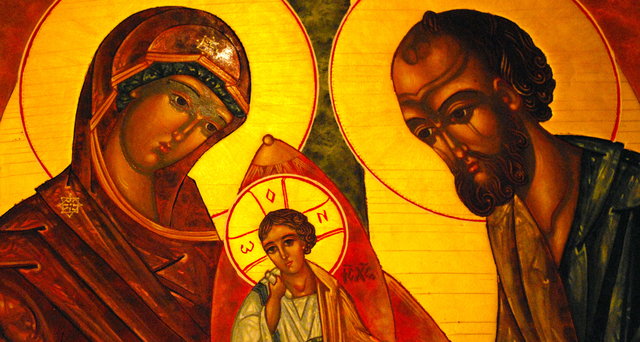
Finally, it is clear to me that the ‘vocation’ of the family can be supported by an apostolate of prayer in, and for, the family. During the Synod, Pope Francis led us in prayer every day for the family, always conscious of the reality of violence, rejection and division which, sadly, many families experience. The Holy Family of Nazareth and the Holy Trinity are our icons of family communion, love and prayer. The Eucharist, the Rosary, Grace before meals, the Angelus, the Word of God, Morning and Night Prayers remain as precious moments and opportunities for prayer and awareness of God in the home.
Prayer Guidance
Many families need prayer guidance and support, and this is another area in which Family Associations and Movements might find their mission. We need to develop new and creative ways of encouraging family spirituality and this is best facilitated by groups set up specifically for families, fathers, mothers. As a priest and bishop I have come to know and admire the wonderful work of new evangelisation that is carried out in this country by communities of families who are following the neo-catechumenal way of renewal and catechesis, the witness of the Syros-Malabar community to the importance of family catechesis of children and young people, the enthusiasm of the Catholic Grandparents Association, Retrouvaille, ACCORD, Marriage Encounter, Couples for Christ, and many others.
Intentional Catholic Families
The work of these groups should be developed and disseminated much more widely so that intentional discipleship in families might be encouraged and celebrated. Intentional discipleship in families is when we hear a young family saying: This is what we do because we are a Catholic family! We have the courage to be different. Our faith is obvious in our daily routines. We go to Mass on Sunday and holy days; we pray together; we do not waste; we say the Rosary; we protect our children as much as we can from the evil influences of alcohol, drugs, internet addictions, which would steal away their soul and their young lives; we do our best to give good example; we have religious symbols prominently on display in our homes; we do penance of some kind every Friday; we go to Confession together; we fast for Lent and we abstain on Ash Wednesday and Good Friday; we visit and look after our sick and elderly; we bear wrongs patiently and forgive one another when family quarrels begin; we do not tolerate violence or abuse of any kind in our home; we visit our family graves and we pray for our dead; we contribute to our parish, both financially and by participating in the liturgy and in parish groups; we gather with like-minded families; we help the poor and marginalised at home and abroad; we support our Catholic schools; we speak up for our faith at school, at work and in the community; we support causes which promote Respect for Life; we pray for vocations and we would encourage one of our sons or daughters who felt called to serve God in the priesthood or religious life: and, we do all this intentionally and deliberately because we are a Catholic family! We have the courage to be different! Such quiet confidence can only be sustained through an apostolate of prayer in and for the family.
CONCLUSION
In under three years’ time Ireland will host the World Meeting of Families in Dublin. This exciting event provides us with a pastoral imperative to respond to the Pope Francis, the Synod on the Family and build a sure future for family in this country. The World Meeting of the Families is our catalyst towards mapping out a Mission to the Family in Ireland as the Locus of Mercy and Evangelisation and in promoting the vocation and mission of the family itself. We do so, knowing that, as the Synod final document puts it:
‘The Proclamation of the Gospel of the Family has to make people experience it as a response to the deepest longings of the human person, a response to his or her dignity and a response to complete personal fulfilment in reciprocity, communion and fruitfulness.’ (Relatio Synodi, 56
Thank you for listening.