Wednesday, December 24, 2025
Home Blog Page 30

Bishops Statement regarding the Report of the Department of Health on “Termination of Pregnancy” in 2019

Statement by the Bishops’ Council for Life regarding the Report of the Department of Health on “Termination of Pregnancy” in 2019


In recent months Ireland has experienced the traumatic effects of the COVID-19 pandemic, which has touched every sector of society. While many people have suffered emotionally and economically, we think immediately of those who have died, 1,735 people as of 30 June. Each one was a unique human being, created in the image of God, and each one’s death is being grieved by a family, a friend, a community.

Every human life is worthy of respect and care from the moment of conception to natural death. The enormous contrast between the collective grief of the nation at the recent deaths of so many people, and the bland five page report from the Department of Health, published on the same day, 30 June, which details the 6,666 – six thousand six hundred and sixty six – “Terminations of Pregnancy”, which took place in Ireland in 2019, is staggering.

The report states that 24 of the abortions were carried out on medical grounds. Those carried out on the grounds of a “condition that was likely to lead to the death of the foetus” numbered 100. The Irish Catholic Bishops pointed out in advance of the referendum in 2018 that there is absolutely no moral justification for deciding that a baby should die because he or she has a serious health condition.

The vast majority of babies who were aborted in Ireland last year, 6,542 of them, are euphemistically described as having been “terminated” in “early pregnancy”. While we never got to know them personally, each one was a unique and precious human being. It was not their fault that their conception was inconvenient or untimely, or the result of sexual assault or that their parents lacked the support that would have helped them to embrace life.

The publication of the Government report is, however, a timely reminder for Irish society of the concrete consequences of the decision made in May 2018, when the majority of Irish voters (66.4%) chose to remove constitutional protection from the unborn, and the majority of politicians voted to enact this law against life. The report, for those who will look beyond the statistics, represents a fresh call to conversion for individuals, for the political establishment and for society.

It is an important expression of our pro-life commitment that Catholics would commit to offering practical and emotional support to women who experience difficulty because of pregnancy. We encourage all our parishioners to be sensitive to this need in their own network of relationships and to support the various pro-life organisations which offer that kind of outreach.

While there may be no public grief over the deaths of these 6,666 unborn babies, we know from our own experience that there will be much unexpressed personal grief. We take this opportunity to invite all those affected by abortion – women and men – to avail of spiritual, sacramental and pastoral support, and we assure them that they will be welcomed without judgement and helped to find healing and peace.

Framework Document for a return to the public celebration of Mass and the Sacraments

Statement of the Irish Catholic Bishops` Conference on the publication of the Framework Document for a return to the public celebration of Mass and the Sacraments (9th June 2020)

As we look forward in joy and hope to the re-opening of our churches for the celebration of Mass and the Sacraments, we offer this Framework Document [see below] to the dioceses and parishes of Ireland.  The purpose of this document is to assist priests and people in their own preparations and to help ensure that the re-opening of our churches for public worship happens in a safe and measured way.  We realize that, given the rich variety of our church buildings and communities, the Framework will need to be adapted to suit differing situations on the ground.  However, as our document states:

“in all circumstances the safety and health of people, ministers, and priests must be paramount.  No church should be opened for public prayer or worship until satisfactory arrangements, as indicated in this Framework, have been put in place.” 

This Framework has been developed in the light of extensive consultation across the dioceses of Ireland and we are very grateful to all who contributed thoughts, comments and suggestions.  The document also takes cognisance of the most up-to-date public health advice and associated regulations and obligations.

At our meetings this week we have been keeping in our prayers all who have been affected by COVID-19 in our country and throughout the world.  We are especially conscious of the pain and loss felt by so many grieving families.  We acknowledge with immense gratitude the skill and courage of our medical professionals and carers.  We appreciate deeply the prayers, sacrifice and perseverance of all our faithful.  We greatly admire the efforts of the many parishioners who have generously volunteered in charitable outreach to the elderly, vulnerable and marginalised.

At the end of the month we hope to slowly and cautiously resume public worship in our churches, knowing that it can only happen in a limited way.  We will still need patience, perseverance and self-sacrifice.  The prescriptions contained in this Framework Document will only be effective if we have the generous support of volunteers who will help to plan, implement and manage the transition back to full parish life and the celebration of the sacraments. In this regard we appeal particularly to the younger members of our parishes.  Their energy, creativity and enthusiasm are gifts that our communities need now more than ever, since some of our older generation may be unable to offer their normal help in the current circumstances.

We are also very conscious of the demands that this transition will place upon our priests, many of whom may still need to remain shielded from the virus.  Together with Pastoral Councils and the support of laity, priests have risen to the challenges presented by the recent restrictions, often in innovative and creative ways, and with great generosity of spirit together with enduring commitment to the faith communities they serve.  We hope that the return of communal worship will give new heart to our priests and parishes and that, in spite of the inevitable limitations to our celebrations, we may all be confirmed in faith and in our ministry.

For our families, our domestic churches, this has been a difficult time, especially in homes where the joyful celebrations of First Communion, Confirmation and other sacraments had been happily anticipated.  It is our hope that in each diocese arrangements can be put in place to celebrate these sacraments as soon as practicable, albeit in ways that will be influenced by whatever restrictions may still be necessary for the protection of all.

The resumption of public worship should not mean simply going back to where we were before.  We have been through testing times, but these months have opened up new possibilities for the future mission of the Church.  This crisis has much to say to us about ourselves as a community of faith, about our identity and our way forward.  We earnestly hope that what we have learned – as individuals, in the domestic churches of our family homes, and as ministers of Charity, Word and Sacrament – will enrich the life of our Church and increase the joy of our celebrations as the doors of our churches open slowly once more.

Framework Document for a return to the public celebration of Mass and the Sacraments

Introduction

This document is intended to support dioceses and parishes in their own preparations for a return to the public celebration of Mass and the sacraments and may be supplemented at diocesan level.  These guidelines should be read in conjunction with return to work protocols and insurance advice.  Diocesan bishops are encouraged to put in place appropriate mechanisms for the implementation and verification of the guidelines.

The guidelines provided in this document may need to be adapted in some cases, depending on factors such as the capacity and layout of churches, the size of the parish/church community, etc.  However, in all circumstances the safety and health of people, ministers, and priests must be paramount.  No church should be opened for public prayer or worship until satisfactory arrangements, as indicated in this Framework, have been put in place.  

It is most important that people who are vulnerable or unwell, and especially those with any symptoms that might suggest Covid-19 infection, should stay at home and, if possible, participate, as now, via webcam, social media, television, or radio.  The same applies to those who have been in recent contact with someone who has the virus, in accordance with public health advice.

Initial Steps

The following steps should be undertaken in each parish to ensure that the preparations in each church are efficiently and effectively planned.


Action  Confirm/Comment
1. Establish a Covid-19 Support Team of parishioners to organise preparations and to oversee their implementation and verification. (the verification process may be assisted at Pastoral Area and/or Diocesan level)  
2. Identify volunteers to assist with the implementation and verification.  
3. Provide appropriate induction and training where necessary to priests, ministers, readers, employees and volunteers.  
4. Secure an appropriate supply of signage, cleaning/sanitising materials and accessories and items necessary for protection.  


Checklists

Dioceses and parishes should at all times follow the most up-to-date public health advice and associated regulations and obligations. To reduce the risk of transmission of Covid-19, public health advice emphasises the importance of strict adherence to physical distancing, good hand hygiene and respiratory etiquette, and regular cleaning and sanitising of shared spaces.

  1. Physical (Social) Distancing

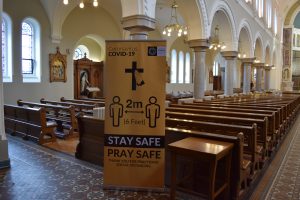
Public health authorities advise that people should maintain physical distance from each other (currently at least 2 metres). In our churches this will mean that the maximum number of people who can be accommodated for any communal prayer or liturgy will be much reduced. The demands of physical distancing will also need to be considered in relation to people entering the church and leaving it.

The following checklist is offered to assist dioceses and parishes in ensuring that physical distancing can be observed in our churches:


Action Confirm/Comment
5. Having considered the most up-to-date advice on physical distancing, what is the number of people that can be accommodated safely in each church?  
6. How will this be managed?


7. How will this be communicated to the people?


8. Have we clearly indicated the areas in the church where people can sit

(e.g. by closing off rows of seats, allowing one person to sit at the end of each free row while permitting those from the same household to sit together, etc.)?

 
9. Have we stewards available, as necessary and appropriate, to assist people entering or leaving the church and to direct them to available seats?  
10. Have we provided appropriate marking to help people to maintain physical distance, particularly when approaching for Holy Communion?  
11. Have we taken account of the needs of people with disabilities?  
12. Have we issued clear advice regarding people observing physical distancing while outside the church?  
13. Is there appropriate signage to communicate these messages?  


  1. Maintenance of Hygiene

While each person has individual responsibility for following advice on hand hygiene and respiratory etiquette, the church environment should itself be as safe as any enclosed public space.


The following checklist is offered to assist dioceses and parishes in maintaining the standard of hygiene required in our churches at the present time.

Action Confirm/Comment
14.  Have all Holy Water fonts been emptied?  
15.  If it is decided to continue providing toilet facilities, are these clean and appropriately stocked?  
16.  Can doors be kept open when people are arriving and departing from Mass or other celebrations to minimise contact with door handles, etc. and to improve ventilation?  
17.  Have sufficient hand sanitisers been provided at all entrances and exits?  
18.  Has the issue of the sharing of missalettes been considered?

(reusable prayer books, hymnals, hymn sheets, etc. should not be distributed at this time)

 
19.  What safe mechanism has been put in place for taking up church collections

(e.g. secure and supervised boxes near the doors of the church)?

 
20.  Have we identified those areas and objects in the church which will require frequent cleaning

(i.e. seats, ambo, microphones, shrines, door handles, etc.)?

 
21.  Has a process been put in place to ensure the regular cleaning of these, including after every gathering?  
22.  Is there a schedule for, and appropriate monitoring of general cleaning and sanitising of the church, including the sacristy?  


Liturgical Matters

A return to public worship, even gradually, will be a source of great joy and hope to our parish communities.  Public health considerations will, however, require some practical adjustments to the way we celebrate our liturgies.  These should not in any way compromise the integrity of the liturgy and every effort should be made to support active participation and prayerful and joyful celebration.

23. The following should be noted:

i.  The dispensation from the Sunday and Holy Day obligation is extended for the time being.

ii.  Careful consideration should be given to the number of priests and other liturgical ministers that can be safely accommodated in the sanctuary, allowing for physical distancing and ease of movement.

iii.  The sanctuary area should be arranged in such a way that those exercising a liturgical role can do so while respecting the required physical distance.

iv.  Concelebration should be limited, and concelebrants should receive Communion under both kinds using separate chalices or by intinction.

v.  Deacons should continue to proclaim the Gospel and give the Homily, but caution should be exercised regarding ministering at the altar for the time being.

vi.  Parishes are recommended to have designated places for Readers and Extraordinary Ministers of Holy Communion.

vii.  In the interests of physical distancing, parishes may wish, for the time being, to limit music ministry to a single cantor and a single instrumentalist.

viii.  Altar servers should assist only when all physical distancing/hygiene considerations have been taken into account, and with careful supervision.

ix.  Regarding processions, the simple Entrance and Recessional format is recommended at this time.

x.  Rather than an Offertory Procession, the gifts of bread and wine should be brought by the celebrant from a credence table, placed near the altar, which will also hold the water bowl and finger towel.

xi.  Care should be taken to avoid the contamination of the hosts which are to be consecrated. It is recommended liturgical practice to consecrate at each Mass a sufficient number of hosts for that celebration only.

xii. At this time, the optional exchange of the Sign of Peace can be omitted, or offered in a manner which avoids any physical contact.

xiii. The procession for people approaching for Holy Communion should be carefully planned. Stewards may assist if required.

xiv.  For the time being, it is recommended that Communion should not be given under both kinds, and should be received in the hand.

xv.  Priests and Extraordinary Ministers of Holy Communion should visibly sanitise their hands both before and after the distribution of Communion.

xvi.  Priests and ministers should wear a face-covering while distributing Communion.

xvii.  It is advisable to provide a small table at each point of distribution with a bottle of sanitiser. This would enable the priest/minister to re-sanitise their hands if necessary during the distribution of Communion.

xviii.  Care should be taken to thoroughly clean all vessels and to change purificators and finger towels after each Mass.

xix.  At the celebration of the Sacrament of Baptism, the celebrant will sign the child with the Cross without touching.

xx.  A jug of fresh water will be blessed for the Baptism. For the time being, priests may prefer to have only one child (or children from one family) baptised in each ceremony. However, if there are a number of Baptisms in sequence, the same jug of Blessed Water could be used, but water may not be re-used from the font or basin.

xxi.  The anointing with the Holy Oils will be administered by the use of cotton buds.

xxii.  For the Sacrament of Reconciliation, provision should be made in the body of the Church for a confessional area. Consideration should be given to the privacy of the sacrament as well as the requirements of physical distancing and hygiene.

Communications

Each Diocese should plan for the clear and effective communication of all necessary protocols and procedures to all parishes in the Diocese.

A Reflection for Pentecost 2020 by Archbishop Eamon Martin

It is Pentecost 2020. Restrictions continue. Many people remain isolated. Come Holy Spirit with your seven great gifts.

The gift of WISDOM helps us learn life-long lessons from the Covid19 crisis. God invites us to consider wisely all that has been happening and to weigh up the choices we make.

The Spirit brings the gift of UNDERSTANDING. Everywhere there are statistics, economic forecasts, “R numbers”, the “science”. Experts offer advice; governments interpret, sometimes differently. The Spirit invites us to make personal sacrifices on the understanding that we are protecting health and saving lives. We deny ourselves for the sake of those who are most vulnerable and for the Common Good.

The Spirit gives the gift of KNOWLEDGE. As we reflect wisely on all that is happening, we get to know what God is asking of us at this time. These days of seclusion are opportunities to grow in our love of God. By prayer and reflection on God’s Word we can gain insight and self-knowledge to evaluate our lives in relation to God and in relation to others.

The Spirit gives the gift of RIGHT JUDGEMENT, sometimes called the gift of COUNSEL. This gift helps us to make choices – everyday choices, and bigger, “life choices” about the direction we are taking for the future. When this crisis is over, what judgments will we have made – will we simply go back to the way we have always been, or will we have discerned more clearly the pathway that God is offering us?

The Holy Spirit gives the gift of FORTITUDE, COURAGE to do what is right. The pandemic has brought great suffering to many families whose loved ones have died because of the virus. In many cases it was not possible to be by their side, or to present at their funeral. God hears a great cry of grief coming from his children. God knows how much we need strength, courage, consolation and comfort at this time.

The Spirit gives the gift of REVERENCE or PIETY, helping us to turn to God in prayer as we walk thorough this valley of tears. We miss being able to gather in the normal way for the Eucharist and other sacraments. Still, we have found new ways to link with each other and to praise, thank and adore God. Prayer has flooded the digital highways – and opened up new opportunities for mission and outreach which can continue when this is all over.

The Holy Spirit gives the gift of the FEAR OF THE LORD – not in the sense of being frightened of God – but in the capacity to be able to stand back with WONDER AND AWE IN GOD’S PRESENCE. This springtime, many of us have noticed in a new way the colours and sounds of nature. We have found time to pause, to walk, to savour the beauty of creation. We have become alert to God’s presence in the lonely and the suffering. May we be more aware of God’s presence and give thanks, praise God in the heavens, in the stars, in all God’s creatures. May these days help us to be more compassionate and to protect the God-given gifts of our common home.

It is Pentecost 2020. As lockdown is eased, the People of God emerge, knowing that the seven gifts of the Holy Spirit are gifts for every day, as St Paul puts it: “a variety of gifts but always the same Spirit; all sorts of service to be done, but always to the same Lord; working in all sorts of different ways in different people”. Amen. Come Holy Spirit.

Archbishop Eamon’s Statement on ‘Resumption of Services with Precautions’


Archbishop Eamon Martin offers the following statement on An Taoiseach Leo Varadkar’s statement regarding the resumption of services

“Following today`s announcement by An Taoiseach Leo Varadkar that the public health restrictions due to COVID19 will be eased on 29 June to allow  “places of worship to resume services again, with precautions”, I welcome this news and like other priests in Ireland I am greatly looking forward to celebrating public Mass and the sacraments soon with our congregations. 

 I wish to commend dioceses and parishes for undertaking preparations to facilitate the safe return of the faithful to public worship in a measured way, and for their reaching out to parishioners in very difficult circumstances during the lock-down which included the broadcasting of Mass and other prayer opportunities by webcam.

 Next week, the bishops of Ireland will meet for the first time over video-call for our Summer General Meeting.  We will finalize our framework document for the return to Mass and the sacraments which will offer best practice to parishes as we begin to fully reopen parish life again.

 It is my fervent hope and prayer that parishes in Northern Ireland will also soon be able to gather for public worship in the same way as parishes on the rest of the island.

 During the pandemic we were unable to gather in the normal way for the Eucharist and other sacraments, but we have been alert to God’s presence in the lonely and the suffering.  Sadly the pandemic has brought great suffering to many families whose loved ones have died because of the virus.  In a lot of cases it was not possible for family members to be by their side, or to be present at their funeral.  God knows our grief and how much we need strength, courage, consolation and comfort at this time.  As the restrictions ease the Church will continue to assist those in the greatest need.

Archbishop Eamon Martin

Pentecost Messages from Archbishop Eamon and Bishop Michael

Archbishop Eamon and Bishop Michael offer special messages for the Feast of Pentecost

Archbishop Eamon offers a Pentecost message to Priests, Religious and Faithful during the Covid-19 Pandemic. In the video below he explains and lays out the hopes and plans for a return to liturgical gathering in the near future. Whilst Bishop Michael offers a message of support to to all Confirmation Candidates throughout the Archdiocese, laying out all our hopes for the preparation and celebration of the Sacrament later in the year.


Archbishop Eamon Martin’s Pentecost Message

Bishop Michael Router’s Pentecost Message


Pentecost Message from Archbishop Eamon to Priests, Religious and Faithful

Pentecost Message from Archbishop Eamon to Priests, Religious and Faithful

Click Here to access link to video message from Archbishop Eamon. 


This weekend we celebrate Pentecost – the great feast of the Holy Spirit and the “birthday” of the Christian Church. I find it sad and disappointing that we have now come the whole way through the Easter season and we are still unable to gather physically for Mass and the sacraments.

We have all been making great sacrifices to protect health and life and to support the Common Good. But we miss meeting up as a parish community. Thankfully our sacrifices are bearing fruit and the number of deaths and ICU admissions from Covid-19 is continuing to decline. 

I want to thank you for the work you are doing at local level to plan for the full “re-opening” of parish life and worship. Please work closely with your priests so that your parish stands ready to respond quickly when the public health authorities tell us it is safe to begin gathering together again for Mass inside our churches.

Thanks also for your response to my call for ideas and questions to help draft a National Framework Document to maximize consistency across the dioceses and parishes of Ireland. At the Standing Committee of the Bishops’ Conference yesterday (meeting for the first time over video call) the Bishops agreed to refine this framework further to include a helpful checklist for parish priests and Covid-19 Parish Support Teams on physical distancing and hygiene. This will help you evaluate progress made to date and guide any necessary improvements in practice within your parish.

The Framework Document will also offer guidance on a number of important liturgical issues which many of you have been enquiring about e.g. the distribution and reception of Holy Communion; advice for con-celebrants, deacons, altar servers; best practice for extraordinary ministers of the Eucharist and others who assist at Mass. At the forthcoming Episcopal Conference meeting in early June the Bishops will consider extending the current suspension of the Sunday obligation, the Sign of Peace and use of Holy Water fonts.  We will also discuss the celebration of Baptism, Marriage and the Sacrament of Reconciliation in the context of any ongoing restrictions. 

It is hoped that the National Framework Document will help guide our ongoing preparations at parish and diocesan level. It will also support our continuing engagement with government and public health authorities – north and south – in making a case for the early resumption of the public celebration of Mass and the Sacraments in a measured and safe way.

God bless you and your families this Pentecost weekend.  Please Stay safe. And pray safe!

Archbishop Eamon


Homily of Archbishop Eamon Martin for Ascension Sunday, World Communications Day

“I hope that philosophers, sociologists and media commentators might critique how key relationships have been impacted – for better or worse – by this pandemic. I encourage our theologians to consider what this crisis is saying about Church, about our identity and mission, about our relationship with the State, and about prayer and faith” 

Archbishop Eamon Martin


Homily
Ever since Jesus commissioned his disciples to ‘go out to the whole world and proclaim the Good News’, the Christian faith has been handed on – from person to person, from generation to generation. In his message for today, the 54th World Day of Social Communications, Pope Francis draws attention to the importance of memory and storytelling in the handing on of faith. He chooses a line from the Book of Exodus to sum up his thoughts: ‘That you may tell your children and grandchildren’ (Ex 10:2).

When I attended the Youth Synod in Rome in 2018, Pope Francis surprised us by hosting an evening for young people and “senior citizens” to meet up and share stories so that they might listen and learn from each other. He called the event: ‘Sharing the Wisdom of Time’ and spoke that evening about the special bond between young people and their grandparents, and of how sharing stories across the generations helps to pass on faith, wisdom, hope and love.

Pope Francis returns to this theme in his World Communications message for today:

‘In an age when falsification is increasingly sophisticated … we need wisdom to be able to welcome and create beautiful, true and good stories. We need courage to reject false and evil stories. We need patience and discernment to rediscover stories that help us not to lose the thread amid today’s many troubles. We need stories that reveal who we truly are…’

During this time of COVID19 restrictions, many grandparents are missing the physical company and affection of their grandchildren – especially their hugs! And these days are challenging also for young people – I think especially of those for whom 2020 was to be an important “graduation” year – from primary school to post-primary; from school to college; from college into the world of work; from engagement to marriage – the joyful celebration of these special transition moments has been interrupted by the restrictions.

What the world is going through this year will be spoken about for generations to come. When people look back on 2020, they will tell the story of how the world had to pause; travel was suspended; people had to isolate themselves from one another and learn new ways to study, to communicate and do business. They will speak of how new opportunities were found for people to gather virtually – not only for lessons, socialising and decision-making – but also for prayer and the praise of God.

When we come to tell the story of 2020, I hope we will speak about what we learned during the pandemic: how it made us question our priorities and values; how people were prepared to make sacrifices for the common good and for the protection of health and life; how we came to appreciate those who care for the elderly and the sick and how charity and heroism can flourish in the midst of crisis. Perhaps we will speak differently about ‘2020 vision’ – that 2020 was the year we learned to value our friends, family and Church more because we had to spend so much time apart.

Today the Church remembers the Ascension of the Lord – that moment of departure and farewell between Jesus and His closest companions. But the Ascension also marked a new beginning – and the great “commission” to “go and make disciples of all the nations”, trusting that the Lord remains with us always. Soon after the Ascension the disciples would be emboldened by the power of the Holy Spirit at Pentecost to be courageous witnesses to the story of the life, death and resurrection of Christ. They would begin a mission to pass on their testimonies of how much He changed them and inspired their lives for the better. Among those early storytellers was Luke, who chose to write down for Theophilus his reflections on the life of Jesus and on the first missions of the early Church.

These days of pandemic are inspiring many people to reflect more on their personal life story and faith journey. In that way the pandemic offers an opportunity for a new beginning. We might, for example, consider the impact of the Covid19 restrictions on our personal lives and values – has it made us more determined to live better and more purposeful lives? Have we become more sensitised to the needs of the vulnerable; more in touch with our own physical, emotional, mental and spiritual needs; more aware of the fragility of our lives, our dependence on one another and on our need for God?

I hope that the philosophers, sociologists and media commentators of Ireland might begin to reflect on and critique how key societal relationships and partnerships here have been impacted – for better or worse- by the pandemic. I encourage our theologians to consider what this crisis is saying to us about Church, about our identity and mission, about our relationship with the State, and about how prayer and faith can help sustain believers in a time of anxiety and crisis.

“That you may tell your children and your grandchildren” – these ancient words written down in the Book of Exodus more than two and half thousand years ago are strangely relevant today.

Encouraged by Pope Francis, I have invited grandparents and grandchildren to pray together and to share and record stories – over the phone, on social media or video call – of how they are coping during this coronavirus crisis. I also extend a wider invitation for all of us to consider capturing the story of how we are being affected personally by the pandemic – perhaps in prayer, prose, poetry, art or music, diary or blog. One day all these separate stories, memories and reflections will help to form the narrative which future generations will ponder to understand how the world and its people coped in these challenging times.


Virtual Pilgrimage to Knock 2020

The Annual Diocesan Pilgrimage to Knock will be celebrated on May 31st, Pentecost Sunday. This year due to COVID-19 virus, the Pilgrimage will be celebrated online, from Knock Shrine beginning at 2.30 pm, with the recitation of the Rosary, a video greeting from the Archbishop at 2.55 pm and the celebration of the Pilgrimage Mass at 3 pm.  


To help prepare for our Pilgrimage an online Novena will be broadcast daily on the Diocesan website from nine different shrines and grottoes  of Our Lady in the Archdiocese.  We are grateful to the nine Parishes of the Archdiocese who very kindly are making this Novena possible.


The full schedule with links to each Novena can be found below.  Each novena will be released at 12 midday each day both here and will also be available each day on the Archdiocese of Armagh’s Facebook Page . 

Date & Time Description Location and Link
Saturday 23rd May (12 noon) Bishop Michael’s Welcome and 1st Day of Novena  Click Here 
Sunday 24th May (12 noon) 2nd Day of Novena Cooley Parish Click Here
Monday 25th May (12 noon) 3rd Day of Novena Edendork Click Here
Tuesday 26th May (12 noon) 4th  Day of Novena Keady & Derrynoose Click Here
Wed 27th May (12 noon) 5th Day of Novena Kileeshil Click Here
Thur 28th May (12 noon) 6th Day of Novena  Dundalk Click Here
Friday 29th May (12 noon) 7th Day of Novena Coalisland Click Here
Saturday 30th May (12 noon) 8th Day of Novena Cuan Mhuire Click Here
Sunday 31st May (12 noon) 9th Day of Novena Drogheda Click Here 
Sunday 31st May 2.30 pm)


Rosary, Message from Archbishop Eamon, and Pilgrimage mass Knock Shrine Click Here  

For Rosary & Sunday Pilgrimage Mass


Should you wish to have a candle lit at Knock Shrine  Click Here

The booklet for the Novena to Our Lady of Knock Can be found by Clicking Here

May the prayers of Our Lady of Knock bless and protect you and all to whom you minister especially during these stressful COVID-19 days.

Emotional Well-being during the Covid-19 Pandemic


The Archdiocese is  conscious that the Covid-19 pandemic is presenting many great emotional challenges to all throughout the Archdiocese and beyond.  With this in mind we have worked with Fr. Dermot McCaul, SMA in producing a short video which you can access by clicking the link below. 

The video is intended to offer guidance around issues of emotional well-being and mental health during these times.  It also gives some sound and practical advice on how each of us can navigate these challenges and indeed flourish beyond this period.  


Fr. Dermot’s five daily actions and activities that can help: 

  1. Reduce and limit Media and Multimedia interaction
  2. Exercise Daily 
  3. Make time for daily prayer 
  4. Develop and maintain a daily routine
  5. Whilst honoring social distancing protocol engage with family and friends

The video can be accessed by Clicking Here

For those who are struggling and finding difficulty in coping, we offer some links below to organisations that are currently offering support and counselling services in diverse areas.  The Archdiocese encourages all those struggling to reach out to these organisations and indeed contact your local priest should you need help.  

Local Parish Contacts for Support Click Here
Pieta House (Republic of Ireland) Click Here
So Sad Ireland (Republic of Ireland) Click Here
Accord Marriage and Relationship Counselling Click Here
The Samaritans (Northern Ireland)  Click Here
Lifeline (Northern Ireland)  Click Here
Southern Area Health Care Trust Website Click Here
Cuan Mhuire (Addiction NI & ROI) Click Here
Aware NI ‘Overcoming Depression Changing Lives’ Click Here
Alone (Support for the elderly) Click Here 
Archdiocesan Bereavement Service  Day, times and mobile contact numbers: 

Mon 6.30pm – 8.30pm +353 89-4677721
Tues 6.30pm – 8.30pm +353 89-4682919
Thur 6.30pm – 8.30pm +353 89-4677734
Fri    6.30pm – 8.30pm +353 89-4677747


Homily of Archbishop Eamon Martin for the Fifth Sunday of Easter: the Way, the Truth the Life

“Our forced seclusion and restricted personal freedoms have certainly reminded us all that we are not invincible and are far from in control of everything; we are dependent on others and on God“ – Archbishop Martin

It’s amazing how certain words and phrases in the Sunday readings seem to speak directly to us, as if it was planned that those lines from the Bible were chosen especially for today. But then, the scriptures are the inspired Word of God – God speaks to us in and through them; they never lose their freshness or relevance to our lives.

Today, the words that leap out at me from the lectionary are “trust”, “hope”, “life”, “love”, “truth”.

As we continue to struggle through the months of lockdown, it can be difficult to keep our spirits up. The words of today’s psalm are certainly worth praying, over and over: “May your love be upon us, O Lord as we place all our hope in you”.

There are also comforting words in today’s Gospel reading, especially for those who are sick and suffering; those who have been admitted to hospital and feel isolated from family and friends. Jesus speaks memorable words of comfort: “Do not let your hearts be troubled; trust in God still and trust in me”. I think these words would also be very helpful for our A-level and Leaving Cert students who might be feeling anxious about what happens next. “Do not let your hearts be troubled; trust in God still and trust in me”.

I notice in today’s First Reading from Acts of the Apostles, that the early Christians wanted to ensure that the preaching of the Word of God would be accompanied by practical outreach and charity towards the poor and disadvantaged. No one was to be neglected in the daily distribution of food for the needy. That is why the apostles appointed deacons like Stephen, Philip and others to ensure that the vulnerable would be nourished not only with the Word of God but would also receive food and essential daily supplies.

In recent weeks I have been impressed by the generous outreach of so many of our parishioners who have volunteered for community distribution of groceries, medicines and friendly calls to those who live alone. Earlier in the week I had an opportunity to meet with our local Knights of Malta, to hear about their work, to bless their ambulances and to pray with them for the protection of our carers and health workers.

Our parishes and dioceses have now begun to draw up their plans and “roadmaps” for a return to collective prayer as soon as it is safe to do so. It has been very difficult for us not being able to gather together in our beautiful church buildings. We’ve had to rely on spiritual communion. For this I draw strength and inspiration from the words in today’s second reading which speak about our being like “living stones” making up a “spiritual building” and Christ being the cornerstone of that building.

It is also helpful to hear in the Gospel what Jesus told His friends when they were struggling to cope with the news of His pending departure from them. They asked: ‘How will we know the way?’ Jesus said:

“I am the Way, the Truth and the Life”.

On RTÉ Radio 1’s Morning Ireland earlier this week I heard an elderly couple being interviewed about their experience of being cocooned – cut off from their family and loved ones. It was moving to hear them speak about the daily webcam broadcasts from their local parishes, describing them as being their “lifeline”!

It strikes me that, as the Covid-19 crisis rolls on, we are all beginning to reflect a little deeper, searching for our roadmaps forward, our “lifelines”. Government announcements say that we’re headed for a ‘new normal’.

I wonder what will be my ‘new normal’? Will I have learned anything from this crisis? How will it have changed me?

I am sure that many people are growing closer to God through this crisis, realising perhaps that the way they have been living their lives has been unsatisfying at a deep level. Our forced seclusion and restricted personal freedoms have certainly reminded us all that we are not invincible and we are far from being in control of everything; we are actually quite dependent – on others and on God. Life is precious and fragile; love and family is fundamental to our safety and well-being. Not only is our physical health important, but also our mental, emotional and spiritual health. They all need to be nourished if we are to truly ‘keep body and soul together’.

As we continue our journey through lockdown and sketch out a way forward, the readings of today’s Mass certainly contain much food for thought and nourishment: words of inspiration like: ‘trust’, ‘hope’, ‘life‘, ‘love’ and ‘truth’.

And they all come together in Jesus Christ who is the Way, the Truth and the Life. Amen.