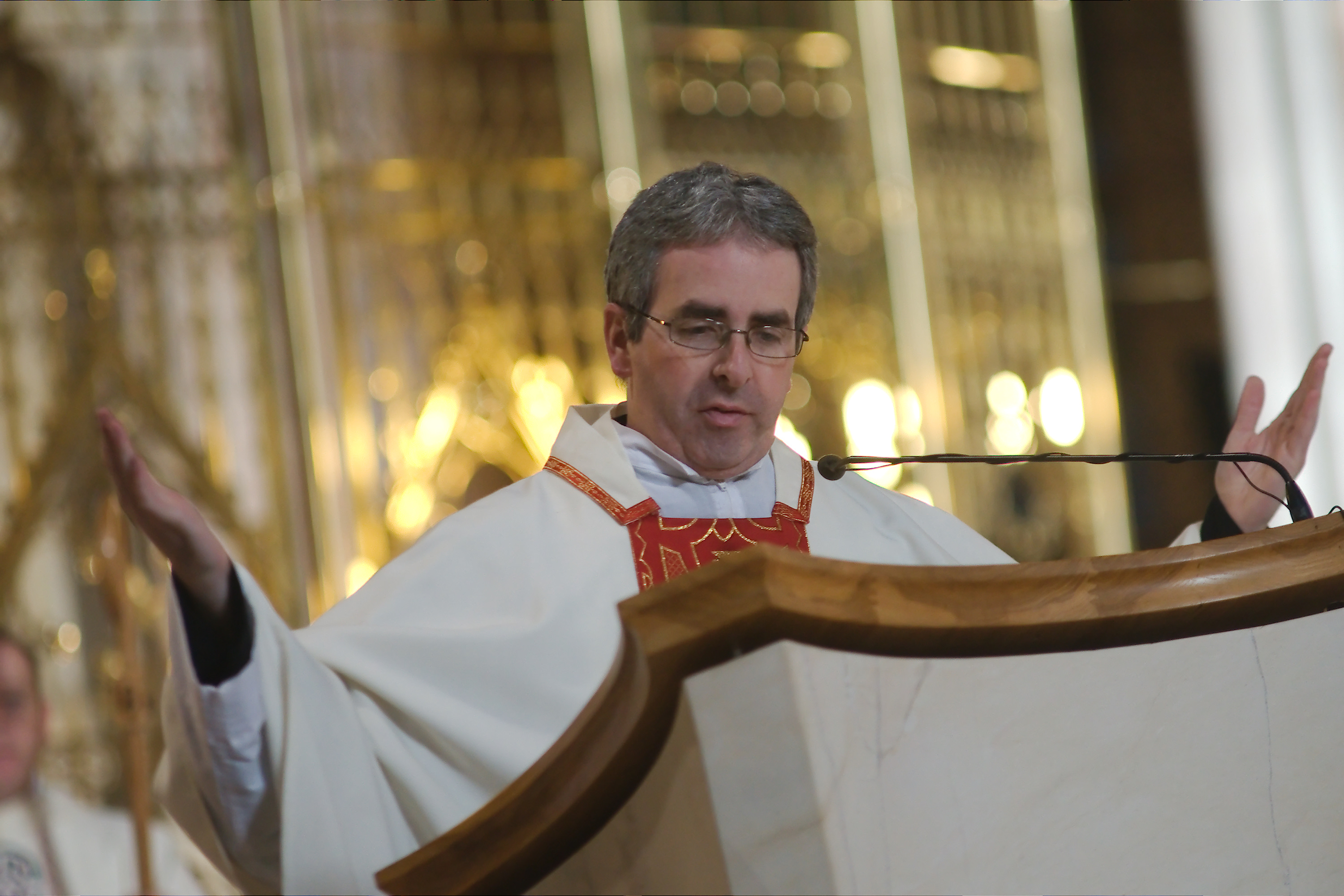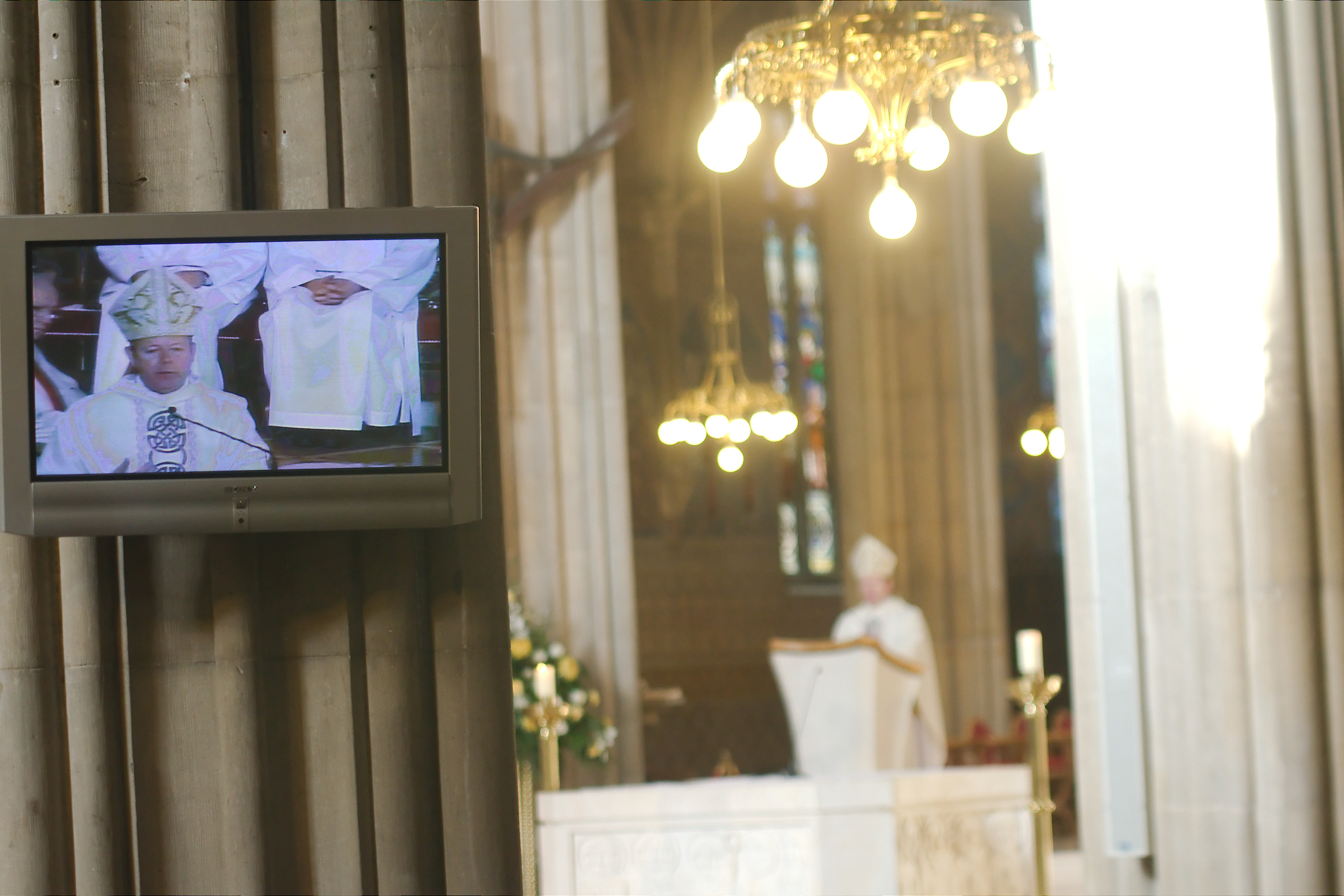

Our discussions this weekend should be rooted in a promise that we are now doing everything possible to ensure that the terrible things which happened them in the past shall not happen again – Archbishop Eamon
The first National Safeguarding Conference hosted by the National Board for Safeguarding Children in the Catholic Church in Ireland marks a significant milestone on our journey. I use the words ‘milestone’ and ‘journey’ very deliberately.
I remember as a little boy noticing ‘milestones’ along the road and being told they were markers to reassure travellers that they were on the correct path, or, useful reference points for road services and planners when they were examining the state of the highway and making decisions about future needs.
Similarly, our Conference this weekend provides an opportunity for us to look back on where we have come from and assess our progress, to survey the ups and downs along the way, and to look out for potholes that might be emerging. Our National Conference is a vantage point from which to show gratitude to those who have worked tirelessly since the mid-1990’s to bring us to where we are today, and to invite new people to bring their gifts and ideas to help us on the journey ahead.
Over this weekend we will hear from national and international experts working in Safeguarding and related fields. It will also be an opportunity to listen and learn from each other, because everyone here has insights which are worth sharing, experiences to process and evaluate. An essential ingredient of this Conference is to harness the ‘knowledge capital’ that is in this room so that we can all return home having added value to each other’s wisdom and understanding of safeguarding issues.
If our National Conference is to be worthwhile, I suggest we ground our deliberations in two underlying themes: the legacy of past failure, and the importance of safeguarding as a shared responsibility within the Church.
The legacy of past failure
We ought never to forget the legacy of betrayal, trauma and shame that abuse has left in its wake. Child sexual abuse destroys lives, ruins relationships and breaks trust which for some may never be repaired. We should not be offended if the reaction of some people to this Conference is: How dare you! Our discussions this weekend should therefore be rooted in a promise that we are now doing everything possible to ensure that the terrible things which happened them in the past shall not happen again.
Five months ago, on the day I succeeded as Archbishop of Armagh, one media commentator suggested my appointment was an opportunity to draw a line under this pitiful chapter in the life of the Church. Instinctively I found myself reacting against such a perception. How can we approach the issue of abuse or safeguarding in this way? The 28 years since my ordination as a priest have been overshadowed by a cloud of scandal over abuse and its poor handling. If God spares me for another 28 years, that shameful shadow must remain – because we have no right to draw a line under events that left such an indelible mark on the lives of so many of our people. That is why I prefer to use the words ‘milestone’ and ‘journey’ to describe where we are today.
A shared responsibility within the Body of Christ
A second underlying theme for this Conference is to remember that safeguarding is a shared responsibility. Our approach to Safeguarding springs from our calling as members of the Body of Christ, who aim to live like Jesus in this time and place sharing his compassionate love with all. It is because Jesus loved children so much that we do everything in our power to protect them. It is because Jesus reached out in compassion that we are impelled by the Gospel to seek out those who have been abused or forgotten. Five years ago this month, in his Pastoral Letter to the Catholics of Ireland, Pope Benedict XVI pointed out that the disturbing problem of child sexual abuse contributed ‘in no small measure to the weakening of faith and the loss of respect for the Church and her teachings’. He wrote: ‘Not only has it had such tragic consequences in the lives of victims and their families’, but it has also ‘obscured the light of the Gospel’. Pope Francis said something similar last summer. Speaking to survivors he said ‘the sins of clerical abuse against minors have a toxic effect on faith and hope in God’. As the People of God, called to bring the ‘Joy of the Gospel’ to Ireland and the world, our work in safeguarding must therefore not been seen as an added extra, or even as an uncomfortable burden or hindrance to our pastoral ministry; rather, it is a necessary and intrinsic part of our mission to bring God’s love to everyone we meet. By placing the needs of children and our most vulnerable parishioners in paramount pastoral position, we enhance, rather than diminish our pastoral practice.
With these two underlying themes in mind, and at this milestone on the journey, I would like to glance back and look ahead with you along the road we have travelled. I wish to mention three important issues in particular: a safeguarding culture; a One-Church approach; and, outreach to survivors.
1. A Safeguarding Culture
Firstly we can be thankful for the culture of safeguarding that is becoming embedded in the Church. I want to acknowledge all those who over the past twenty years have advised and assisted the Catholic Church in Ireland in learning to take seriously the issue of Safeguarding. At this Conference in particular I want to thank Mr John Morgan and members of the National Board. Since 2008 the National Board and its teams at the National Office under the leadership of Mr Ian Elliot and, more recently, Mrs Teresa Devlin, has helped us to build on earlier work to develop and disseminate best practice in the field. One of the big successes of their work has been the encouragement of a large number of lay volunteers, who care for young people and who love their Church, to become involved in this essential task. As designated persons, training facilitators, local and diocesan safeguarding representatives and Committee members, many women and men have found new ways of exercising their baptismal calling by bringing their gifts and expertise to the service of their local parish, diocese, religious community or congregation.
Risk to children and young people is minimised within a safeguarding culture where everyone plays their part in ensuring that all Church activities are safe places for children and young people. All around the country, from national to local level, constructive professional relationships between Church, police and statutory agencies have helped to underpin this positive culture of safeguarding, to keep practice up to date and to alert us to any new ways in which children and young people might be placed at risk. With this in mind, and looking to the present and the future, I encourage our safeguarding ‘network’ to get behind the implementation of the revised Standards and Guidance which, please God, will be finalised, adopted and rolled out over the next year. A massive consultation has taken place in order to update our Standards to take account of new learning and expertise – similar goodwill and effort will be needed to put them into practice. I welcome the fact that the new Standards will update our guidelines on care for those making allegations, as well as offer specific provision for the care of priests and religious who have been accused of abuse, including those who face long delays awaiting the conclusion of civil and canonical processes.
The landscape around safeguarding continues to shift and change. Experts point to new areas for our attention and vigilance. To this end I also strongly encourage all dioceses and religious congregations to develop awareness of safeguarding vulnerable adults, putting in place training for priests, religious, lay faithful and safeguarding personnel about the abuse of any vulnerable person, together with robust policies and procedures. Many of the lessons, structures and expertise developed in the area of safeguarding children are valuable and applicable to the situation of other vulnerable persons but there are, of course, particular emphases, scenarios and approaches which are specific to this area and which we must learn and apply in order to minimise risk and ensure safety for all.
2. A ‘One-Church’ Approach
A significant opportunity and challenge in Safeguarding within the Church has been the effort to create a “one-Church” approach. Unlike many other countries, the Catholic Church in Ireland has undertaken the task of standardising safeguarding procedures across 26 dioceses and more than 160 religious congregations and missionary societies, aiming with common Standards and practices and supported by a shared auditing and review process via the National Board. Looking back, it is clear that we have made considerable progress with this ambitious project, but equally apparent that we still have some distance to go. I am convinced that a ‘One-Church’ approach to Safeguarding is the correct way to go, whereby by the Irish Episcopal Conference, the Conference of Religious in Ireland and the Irish Missionary Union work together to protect children and vulnerable persons. To my mind, this approach emphasises the shared responsibility and communion within the Church ‘as one body’ that I have mentioned already.
But, to paraphrase Saint Paul: if one part of the body is weak in this area, the whole body suffers – we are only as good as our weakest link. That is why it is so important for us to continue to develop and disseminate via our National Board the very best practice in Safeguarding which is underpinned by clear protocols for appropriately sharing information about risk across dioceses and religious congregations. We must also increase our openness to monitoring and review, both internal and external. In the past those intent on abusing were adept at exploiting loopholes and harnessing a culture of silence and avoidance of scandal in the Church to perpetuate their criminal and sinful activity. Gaps and opportunities like these can be shut down by appropriately sharing information about risk externally with statutory authorities and internally with trained and experienced experts and advisors at diocesan and congregational level. The ongoing reviews of dioceses and religious congregations have shown us that we cannot be complacent, thinking that ‘we have things sorted’. On the contrary, there is still a need for attentiveness in ensuring that we do not become ‘safeguarding-weary’ or -complacent. It is precisely when we let our guard down in the area of safeguarding that risk factors go up.
I therefore recommend that, as well as strengthening the vertical links between the dioceses and religious congregations with the National Board, we should also in the coming years seek to strengthen the horizontal safeguarding links between dioceses and religious communities at local diocesan and parish level. We are not at the end of the journey, merely at a milestone. As soon as this round of diocesan and congregational reviews is completed, we will need to embed a cycle of ongoing monitoring, evaluation and review to ensure that our parishes and religious communities remain ‘on the alert’ for those who would abuse the vulnerable.
3. Outreach to Survivors
A third, and essential, element of our Safeguarding journey has been the provision of outreach services to those who have been abused. Earlier this month in his letter calling for support for the Pontifical Commission for the Protection of Minors, Pope Francis described outreach to those who have suffered abuse, and their families, as “an expression of the compassion of Jesus”. He encouraged us to meet with victims and their loved ones, to listen to those who have suffered so greatly and to ask their forgiveness. The Towards Healing Initiative, together with its forerunner Faoiseamh has, to date, provided more than three hundred thousand counselling sessions to survivors of abuse. Last summer, at the International Anglophone Safeguarding Conference in Rome, the work of Towards Healing made a deep impression on the delegates present from all over the world. Towards Healing has now in place a raft of listening, referral, advocacy, family and mediation services. It is a professional service, responding to the needs of survivors in a timely manner and in ways which are safe, respectful and of the highest quality. This outreach, together with Towards Peace, the new spiritual support service for survivors who wish to avail of it, is vital to our story of Safeguarding so far. As we move forward along the road, the accompaniment of victims and survivors on their painful, and often lonely, journey shall continue to be central to our work.
In recent weeks I have had the opportunity to meet survivors of abuse in Northern Ireland. Listening to their stories is at once moving and harrowing. As a Church leader, who wasn’t even born when much of this abuse took place, I find myself torn between horror and defensiveness – hearing these awful things but wanting it to be otherwise; ashamed at actions and inactions which so betrayed the compassionate love of Jesus for his little ones; amazed at the resilience and fortitude of those who come forward to share their painful memories.
Somehow in the road ahead we have to seek out new ways of dialoguing with these members of Christ’s body who have been wounded so deeply. We must beware, as Archbishop Diarmuid Martin said recently, the tendency to ‘outsource’ our care for survivors. Instead I think we might see our care for them as intrinsic to the Church’s mission, fully in line with the call of Pope Francis to go out to the peripheries, to accompany the marginalised and to be with those whom we ourselves have helped to exclude.
Conclusion: A time to Reflect on Integrity in Ministry
It often takes time before we are able to have enough perspective in order to reflect back on experience. As we gather for our first National Safeguarding Conference I’d like to conclude by suggesting that now is a good time to evaluate all we have been going through and especially on the impact on the trust which is so essential to the life and ministry of the Church.
Trust between priests, bishops, religious and the Church faithful can only be rebuilt in a climate of openness, repentance, and with the resolve to implement the very best in professional safeguarding practice.
There is sometimes a tendency to think that the injection of greater professionalism into our ministry can compromise our pastoral relationship with people. Of course no one wants us to become some sort of ‘religious professionals’ or, even worse, ‘professional religious or priests’. However I believe that the best wisdom and insight from professional life can enhance ministry and the living out of our vocation: for example, regular spiritual direction or pastoral supervision, knowledge of the law of the land and the role of canon law, knowing the value of proper record-keeping, maintaining professional boundaries – these can all help us to live our lives as priests and religious while meeting the expectations of society. Classical Catholic moral theology makes it clear that as citizens we are bound by the just law of the land. As Christians we are also bound by the law of love which requires us to employ the very best standards that we can in ministering God’s grace to His people in the most loving way possible.
I think it is timely, therefore, for us to open up across Ireland, a reflective and inclusive conversation among clergy, religious and laity about integrity in ministry. It would be worth structuring opportunities for us to reflect constructively on the experiences of recent years, and, through that reflection to enunciate central values and principles that are supportive of our efforts to live faithful and committed lives nourished by healthy, life-giving and God- centred relationships. I would like to see emerge, out of this structured conversation, a set of professional standards and guidelines for priests, religious and other Church personnel which are respectful of the human dignity of all and which describe the best possible pastoral and professional practice to which we can all aspire.
At the beginning of this First National Safeguarding Conference, and standing at this milestone on our journey, I would like to thank you all for taking time to attend this weekend. Your commitment to Safeguarding is valued by your Church and by the parents and families of Ireland. May God reward you for taking care of his little ones. Looking ahead, my hope tonight is for a renewed Church in Ireland, walking as one with humble confidence, accompanying those who have suffered grievously, evangelising and ministering with integrity in a professional yet pastoral manner, all according to the will of God and Safeguarding Standards that are recognised best practice.